

The Healing Trail
Through hospitals, history and hope

The Long Walk Home
Billy was beginning to worry. For several mornings in a row, the walking boots by the front door hadn’t moved.
Normally, as soon as Mr Rogers picked up his old flat cap, Billy would race excitedly to the door while Spud danced around in tight little circles, her tail wagging so fast that it became almost invisible.
But not today. Instead, Mr Rogers slowly made his way across the sitting room using two shiny aluminium crutches.
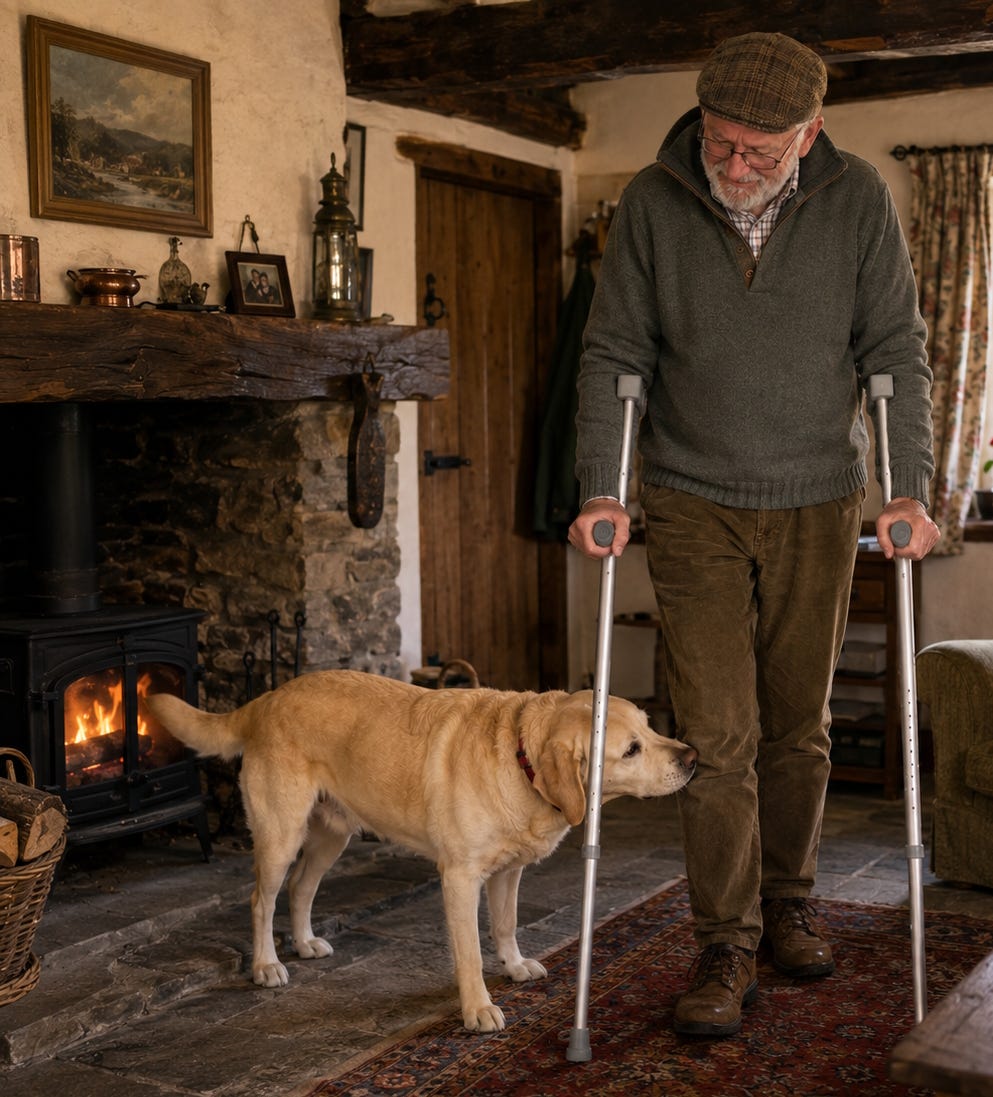
Billy gently nudged one of them with his nose. Clunk! The crutch wobbled.
“Careful, Billy,” laughed Mr Rogers. “I’m still getting used to these.”
Spud sat quietly, tilting her head as if she couldn’t quite understand why their friend suddenly needed extra legs.
“It won’t be for long,” Mr Rogers smiled. “The doctors have mended my poorly knee. Now I just need to help it to become strong again.”
Billy wagged his tail. If knees could be mended, that sounded like very good news indeed.
Mr Rogers lowered himself carefully into his favourite armchair. On the mantelpiece above the fireplace stood a curious little glass bottle. It was made of thick greenish glass, with tiny bubbles trapped inside, and one side still carried the faint raised letters of the company that had made it over a hundred years ago.
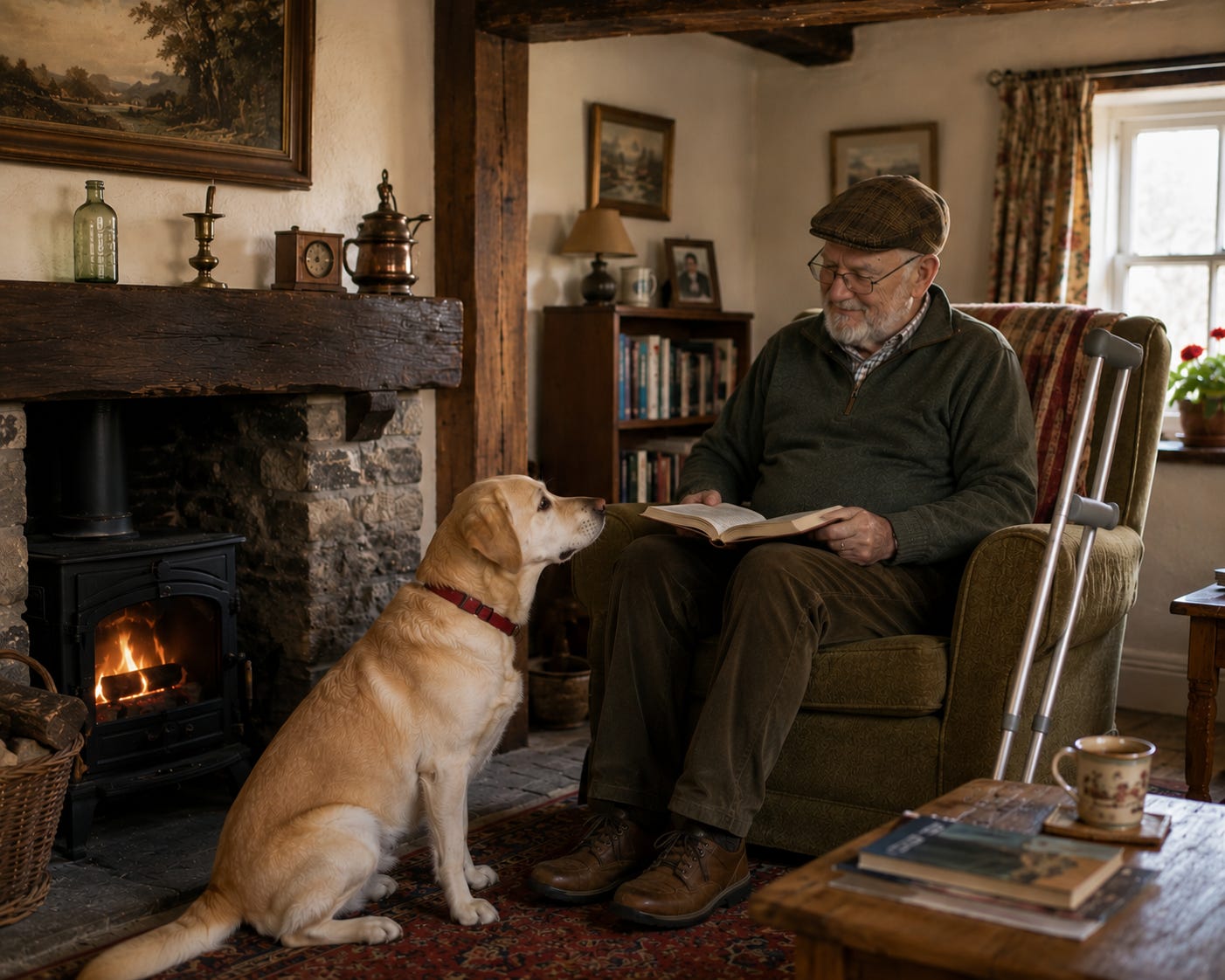
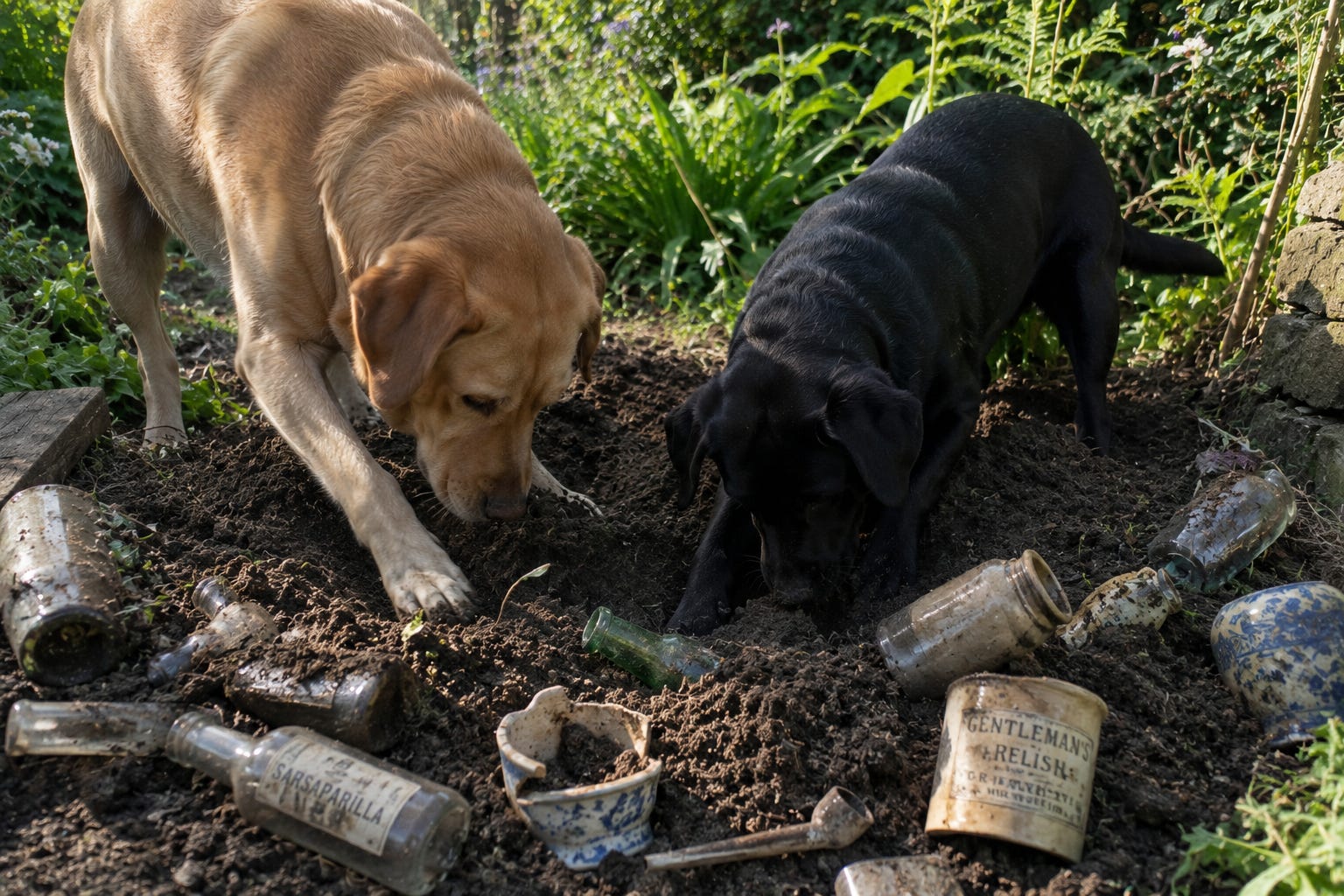
Billy remembered exactly where it had come from. One spring afternoon he had been digging enthusiastically beneath an old apple tree in the garden. He had been hoping to uncover a rabbit burrow. Instead, he had unearthed the bottle.
At first Mr Rogers had thought it was only an old piece of rubbish. But after gently washing away the mud, he realised that it was something much older. “What do you suppose it once held?” he often wondered aloud.
“Cough medicine? A healing tonic? Perhaps something to clean wounds?” Nobody really knew.
That was one of the things Billy liked best about old objects. Sometimes they answered questions. Sometimes they asked new ones.
Mr Rogers glanced up at the bottle. “You know,” he said thoughtfully, “that little bottle has made me think quite a lot recently.”
Billy looked up. Spud looked up too.
“If I had needed this operation a hundred and forty years ago, things might have been very different.”
Billy remembered another place where old bottles, splints and strange-looking medical instruments could still be seen. The old Quarry Hospital at Dinorwig. They had visited there a little while ago.
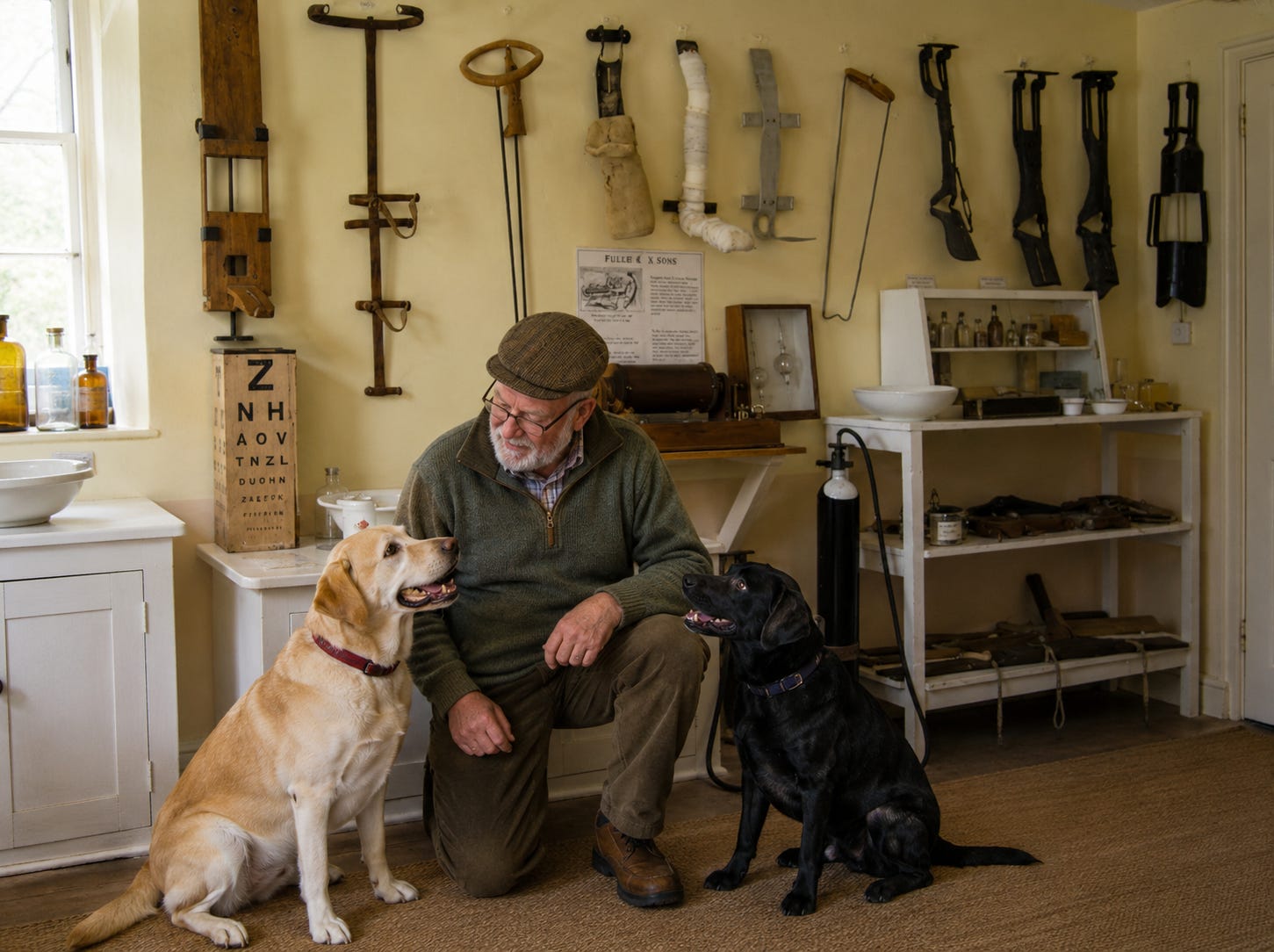
There had been wooden leg braces. Funny-looking chairs for use when treating eye injuries. A machine that sprayed a fine mist of carbolic acid over wounds to help stop infection. Heavy stretchers for carrying injured quarrymen down dangerous mountainsides.
Every object had belonged to somebody. Every scratch and dent told part of a story.
Mr Rogers smiled. “I’ve been thinking...”
Billy’s ears immediately stood upright.
“As soon as I’m allowed to walk a little farther, perhaps the three of us should become History Detectives once again.”
Billy’s tail thumped loudly against the rug. Spud barked once in agreement.
“Only this time,” said Mr Rogers, “instead of climbing mountains, we’re going to discover how people have looked after one another through the years.” He reached for a folded map on the little table beside him. It wasn’t a map of hidden treasure. Nor was it a map of old quarries. It was simply a map of the familiar lanes around their own village.
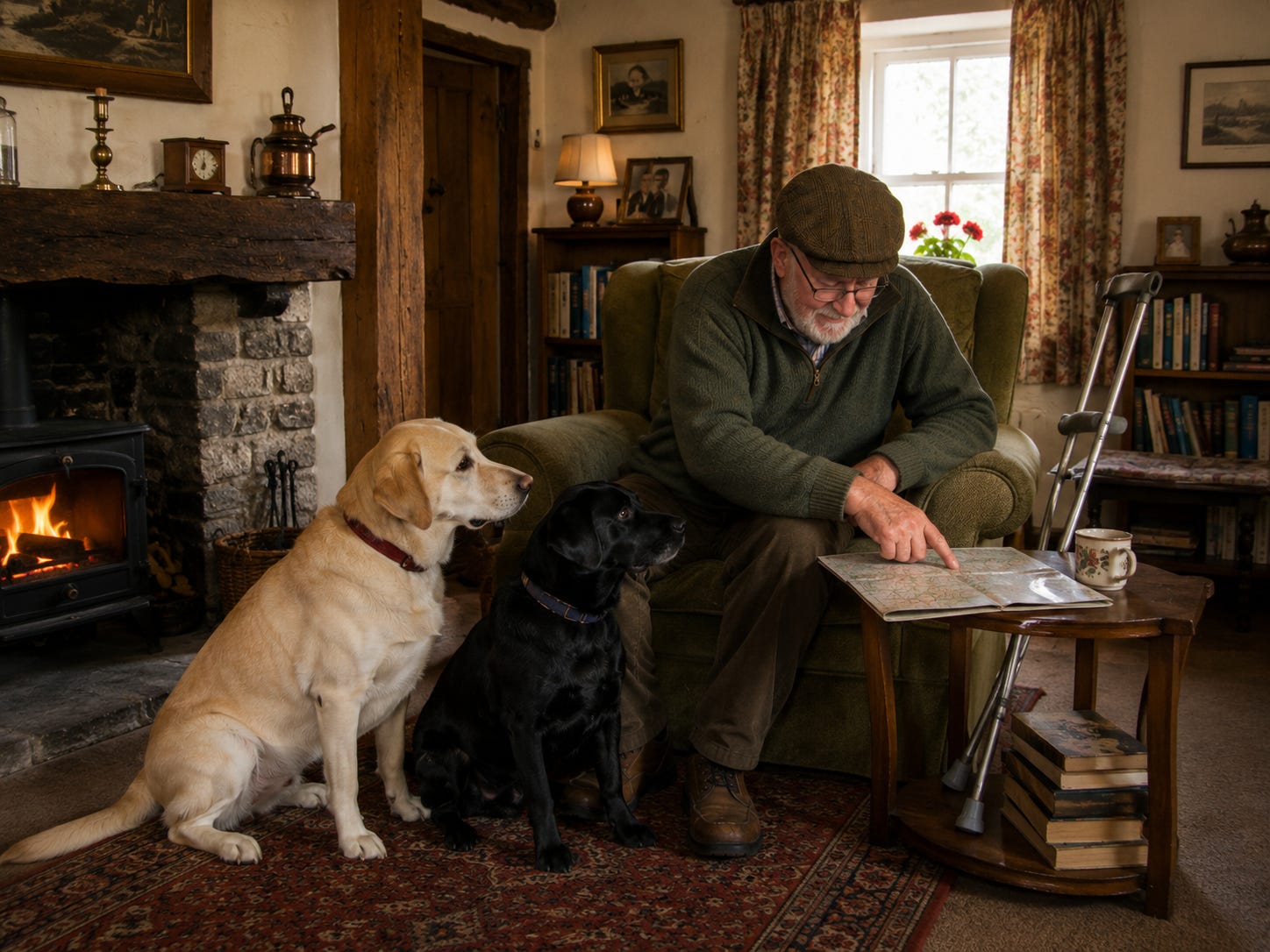
Mr Rogers traced a finger along a short route: Home… Bron-y-Garth… the churchyard... the doctor’s surgery… then home again.
Only a gentle walk. But Billy had already learned something very important.
Sometimes the shortest journeys uncovered the biggest stories.
The Quiet Walk
A few days later, the morning sunshine spilled across the garden. Billy was watching the front door. Spud was already waiting patiently beside it.
Then they heard a familiar sound. ‘Click... click...’ Mr Rogers’ walking stick. The crutches had disappeared. Billy’s tail began to wag.
“Not too excited,” laughed Mr Rogers as he carefully opened the door. “The physiotherapist says today’s walk is only a short one.” Billy wasn’t disappointed. A walk was a walk.
The three friends set off slowly along the quiet village lane. For the first few minutes, Billy found himself looking back every few steps. Usually it was Mr Rogers leading the way.
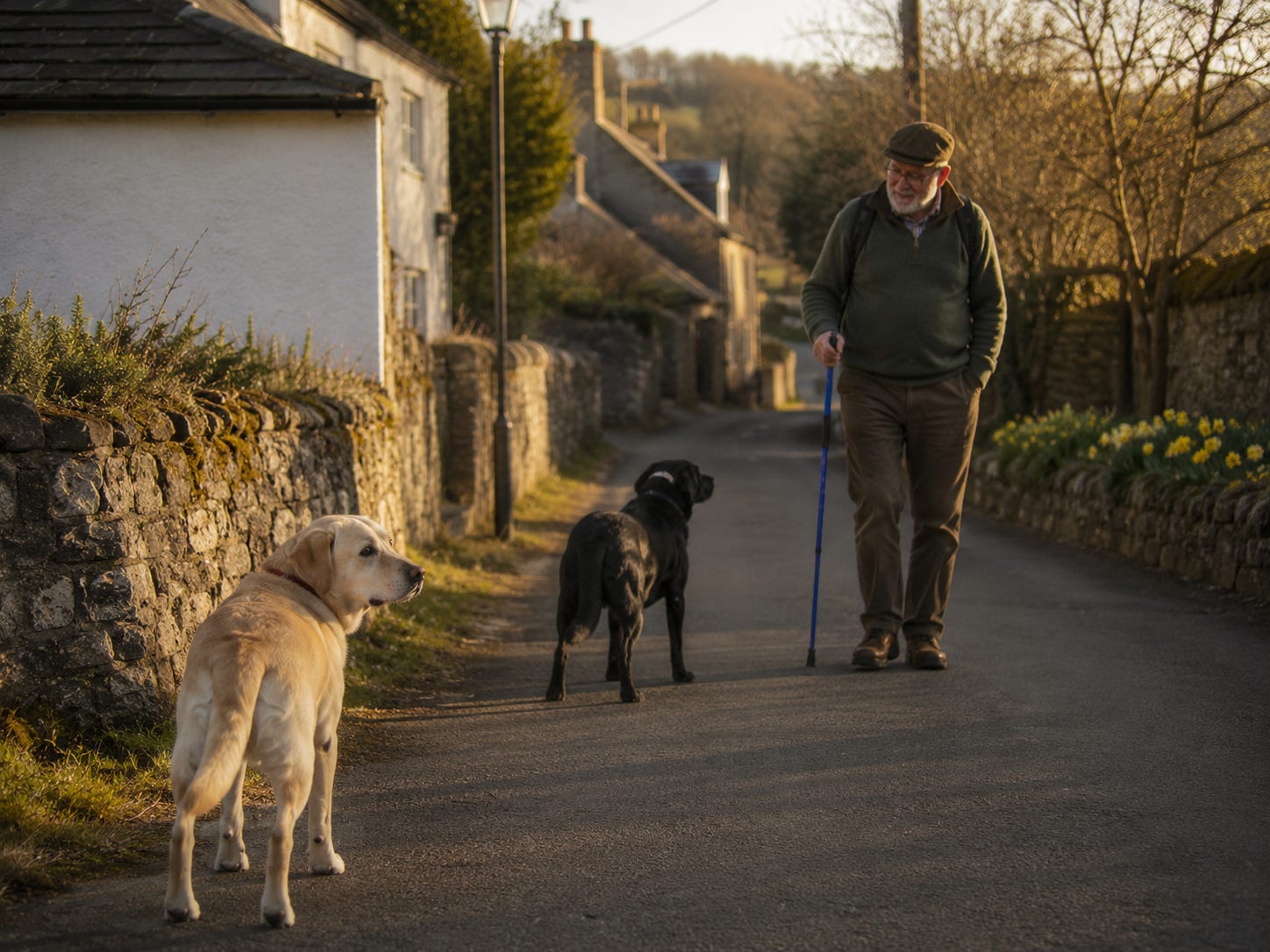
Today Billy seemed to have decided that he ought to keep an eye on his old friend instead. Spud had exactly the same idea. She trotted a little way ahead, stopped, looked back, then waited until Mr Rogers caught up before continuing.
“You two make very good nurses,” smiled Mr Rogers. Billy looked rather pleased with himself.
The lane wound gently between old stone walls where tiny ferns pushed out from cracks between the rocks. Swallows swooped overhead. A robin sang from a hawthorn hedge. Everything seemed exactly as it always had done.
Except that Mr Rogers walked much more slowly than before. Every now and then he paused, not because he was in pain, but simply to give his new knee a chance to rest. “One step at a time,” he said quietly. Billy thought that sounded like very sensible advice.
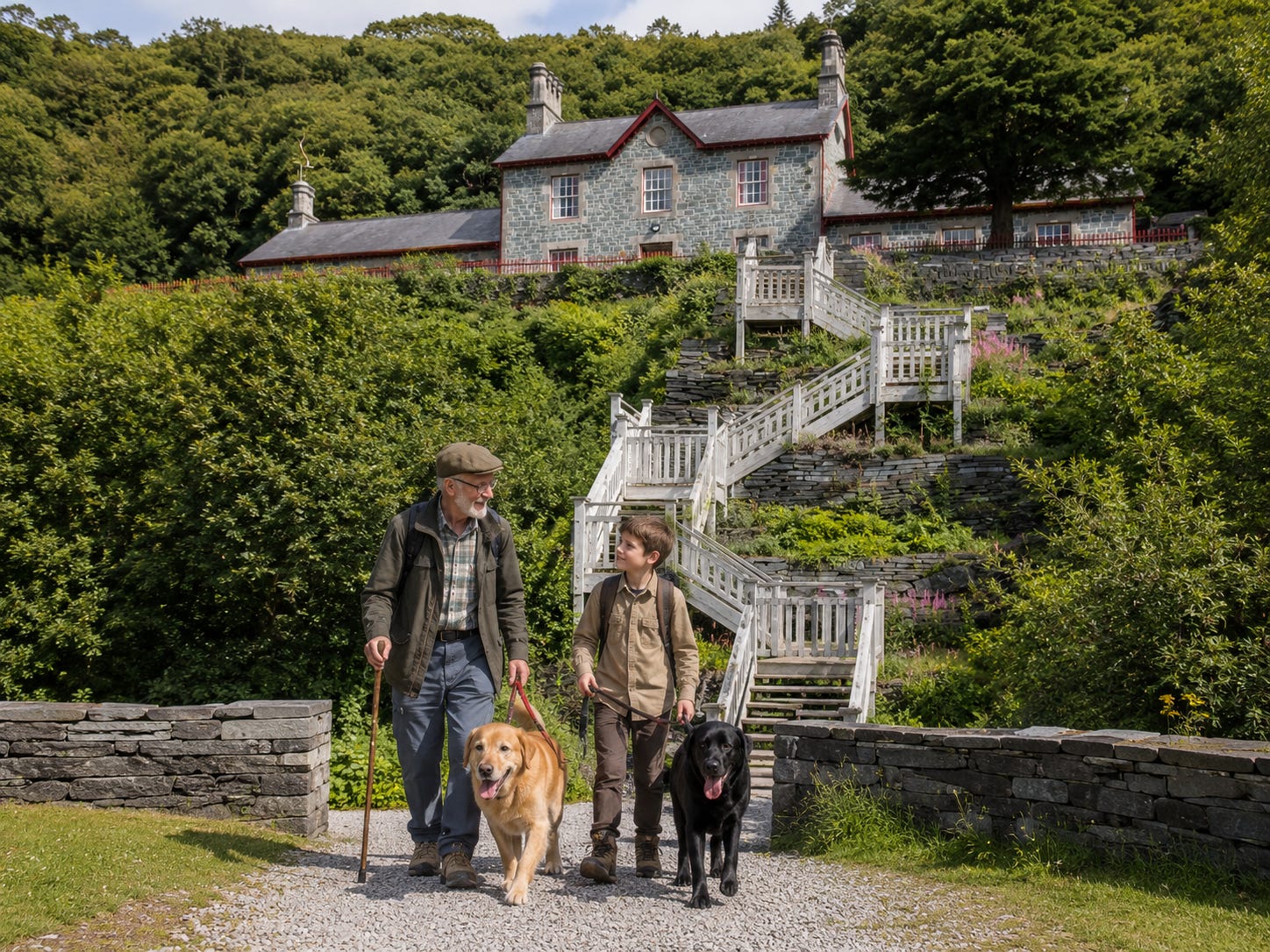
Soon they reached a bend in the road. Beyond the trees stood a large old stone building. Tall chimneys rose above the slate roof. Some of the windows were boarded up. Others reflected the blue summer sky.
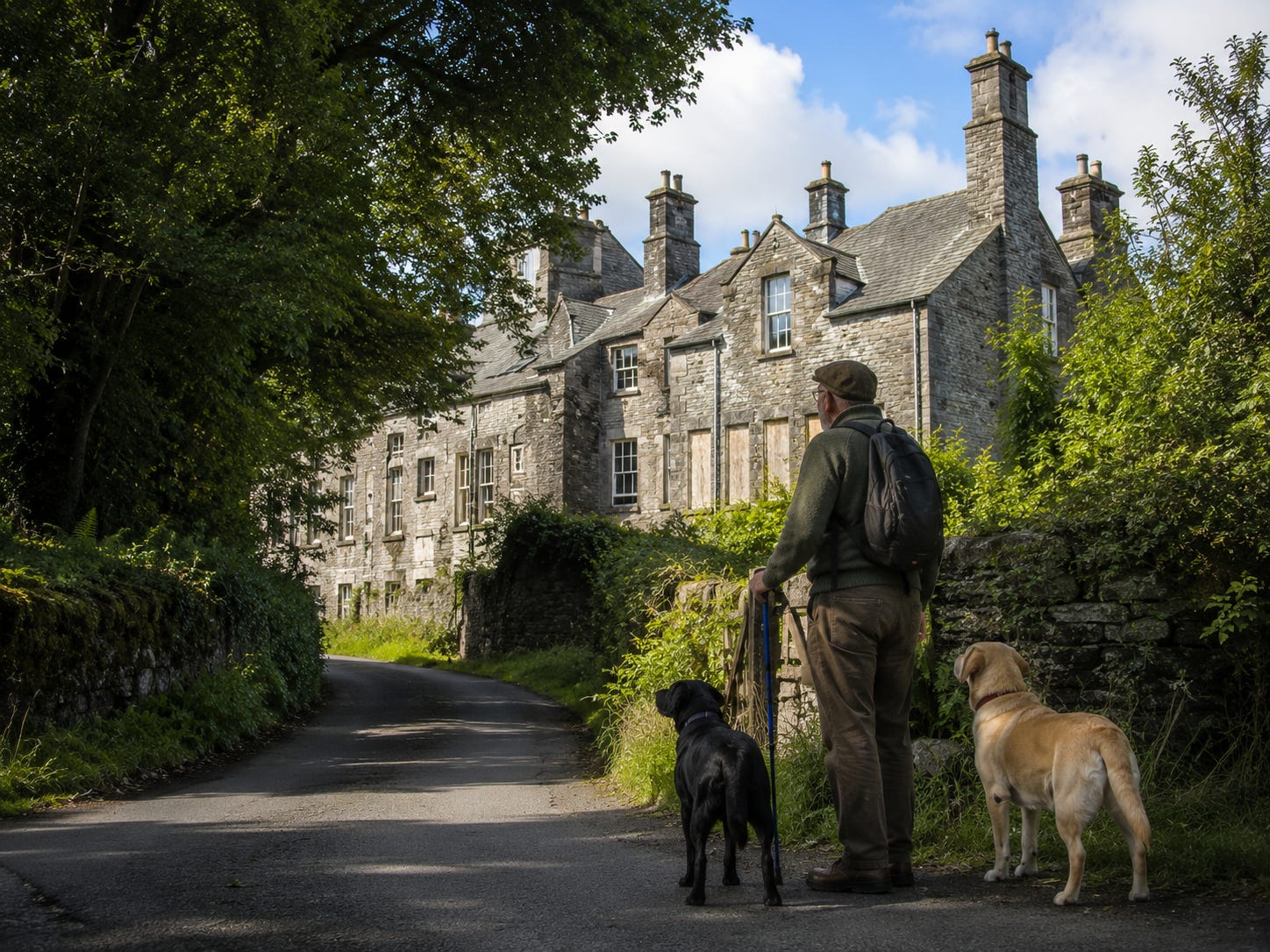
Nothing moved. Billy had passed this building dozens of times before. Usually he gave it little more than a passing sniff. Today something caught his attention.
He stopped. His nose twitched. He looked carefully at the building. Then back at Mr Rogers. Then at the building again.
Mr Rogers smiled. “I was wondering how long it would take you.”
Billy wagged his tail.
“This,” said Mr Rogers, “is Bron-y-Garth.”
Spud stared at the quiet building.
“It used to be a hospital.”
Billy looked puzzled.
“It doesn’t look much like a hospital now, does it?” said Mr Rogers. “No ambulances. No nurses. No patients. No one waiting at the door.” Only the breeze stirred the leaves of the old lime trees.
Billy walked slowly towards the entrance. The heavy stone walls felt cool even in the warm sunshine.
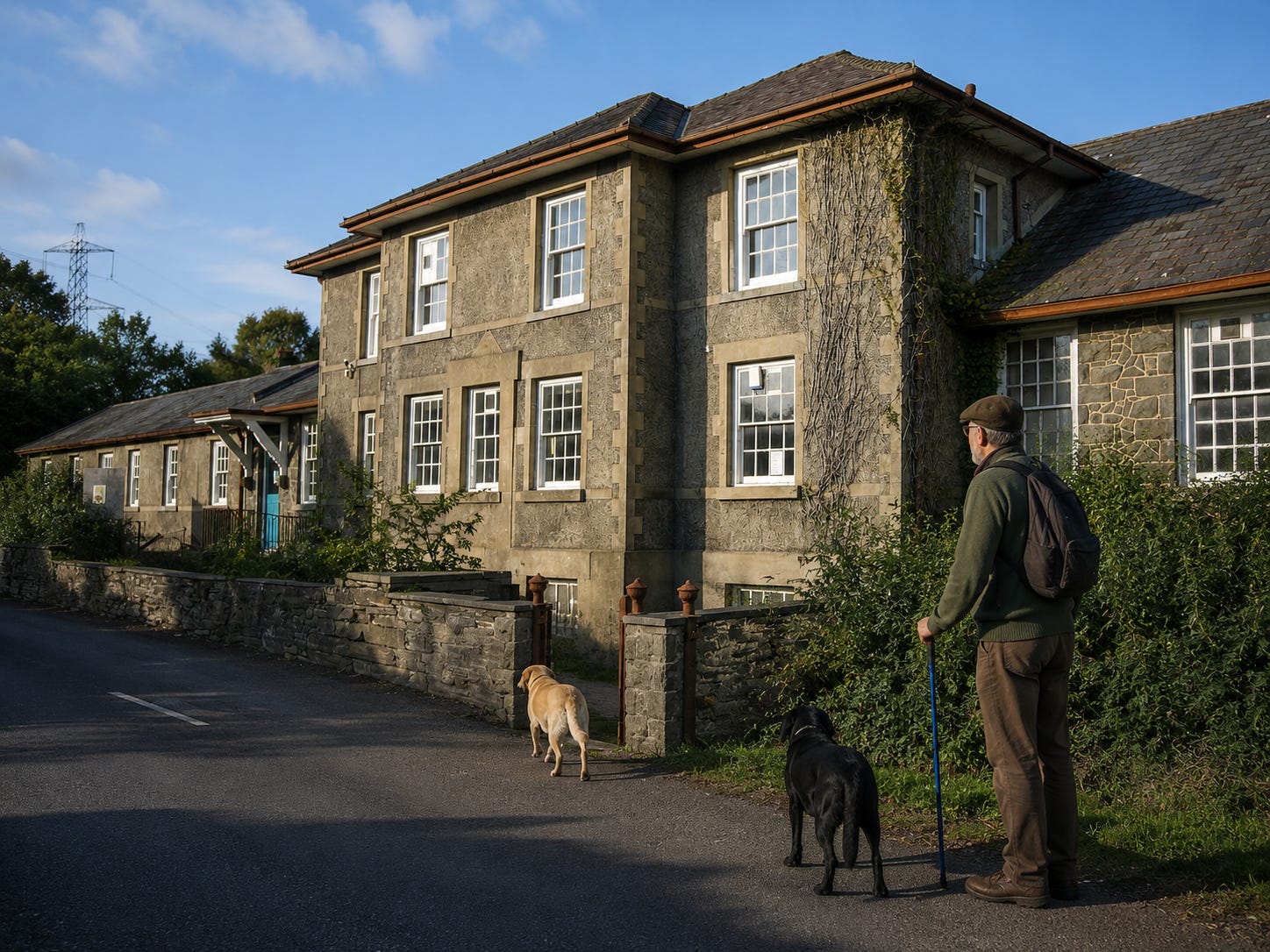
Above one doorway he noticed weathered stonework. Some parts looked older than others. One wing seemed to have been added long after the rest of the building. Billy sniffed thoughtfully.
Mr Rogers nodded. “You’re doing exactly what a History Detective should do.”
Billy looked pleased.
“You’re noticing clues.” Mr Rogers rested for a moment on a nearby bench. “When people look at old buildings, they often think they only have one story.” He looked up at the weathered stone. “But most old buildings have lived many different lives.”
Billy looked at the windows. Spud examined the garden wall. “What do you think happened here?” asked Mr Rogers.
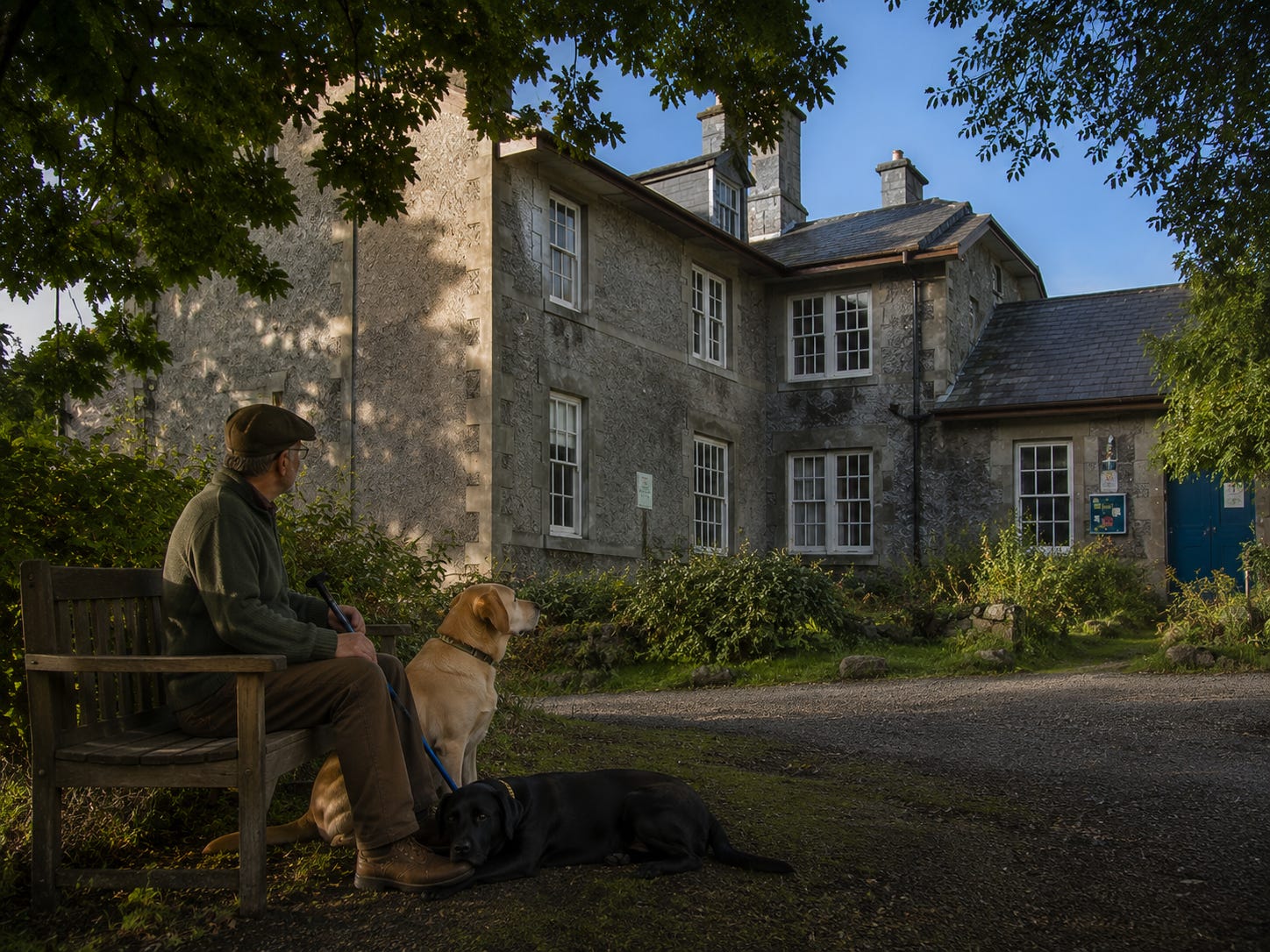
Billy imagined doctors hurrying through the corridors. Spud imagined patients looking out through the windows. Mr Rogers smiled. “Some people came here because they were ill.” He paused. “Some came after terrible accidents.”
Billy immediately remembered the old quarry hospital. The stretchers. The splints. The strange bottles. The carbolic spray.
“But,” continued Mr Rogers gently, “there were other people here too.” He spoke more quietly now. “Long ago, before there was a National Health Service, life could be very difficult for people who had nowhere else to turn.”
Billy sat beside the bench. Spud rested her head on Mr Rogers’ foot.
“Some people were elderly and had no family to care for them. Some had disabilities. Some were desperately poor. And some people were living with illnesses of the mind that doctors simply didn’t understand very well.”
Billy looked back at the silent building. “So... was this a hospital?”
Mr Rogers smiled. “Yes, it was.”
“And before that?” Billy waited.
“It also served another purpose… A workhouse.”
Spud tilted her head.
“A place where people without money or a home might be given food and shelter; but where life could also be very hard.”
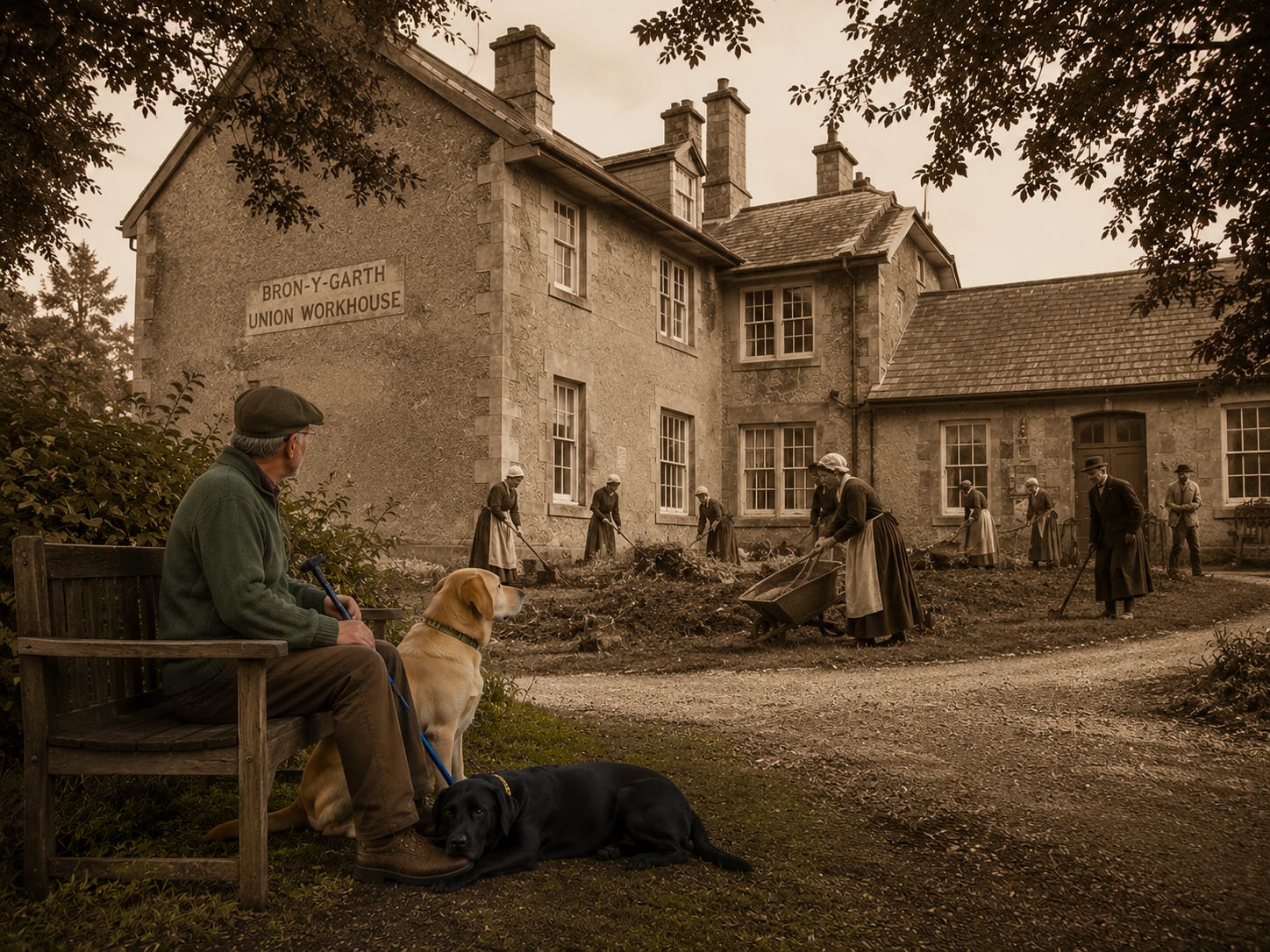
Billy looked thoughtful.
“They hadn’t done anything wrong, then?”
Mr Rogers shook his head. “No. Most were simply living in difficult times.”
For a little while nobody spoke. A blackbird landed on the old stone wall. Bees drifted among the wild flowers that now grew where people had once hurried about their daily work. At last Mr Rogers stood carefully. “Come on…”
Billy looked up.
“We’ve another place to visit.”
He smiled. “And I think it may help explain why this valley has always needed hospitals.”
The three friends continued slowly down the lane.
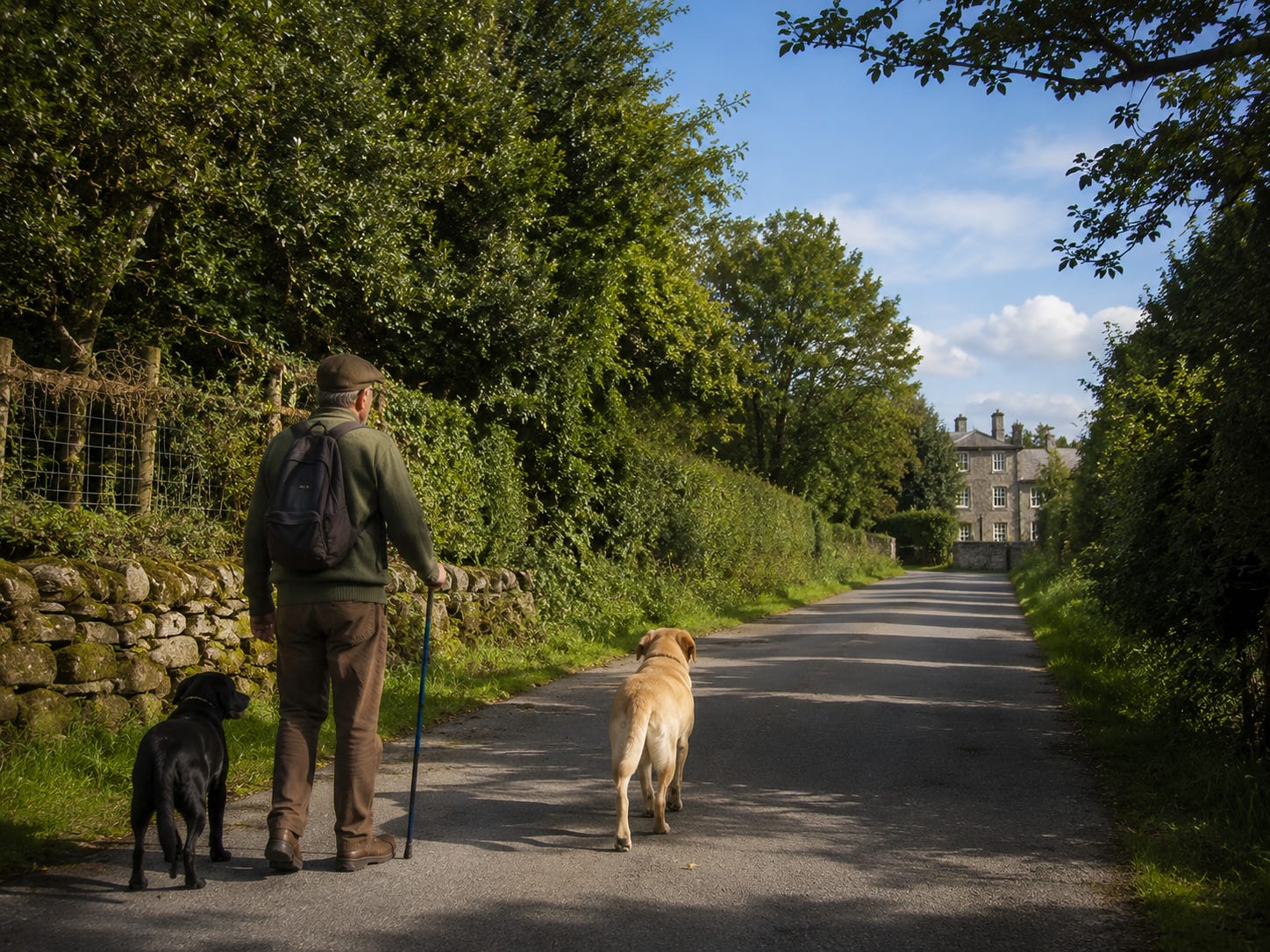
They paused briefly to look back. Bron-y-Garth stood quietly in the sunshine. Its doors were closed. Its windows were silent. But to Billy, it no longer seemed empty.
It was simply waiting for someone to remember its stories.
The Tranquility Garden
The lane became quieter as Billy, Spud and Mr Rogers left the Bron-y-Garth hospital behind them. Mr Rogers was walking a little more confidently now. His new knee still felt rather stiff, but each step seemed easier than the last.
“You know,” he smiled, “the physiotherapist says every little walk is helping my knee to learn how to work again.”
Billy looked puzzled. “Knees can learn?”
“In a way,” laughed Mr Rogers. “Not just my knee - my muscles have to become stronger again, and my brain has to remember how everything works together.”
Billy thought that sounded rather clever.
Spud simply wagged her tail. She didn’t mind how knees worked, provided they kept everyone out walking.
Soon they reached the old church in the centre of the village. Its stone bell-tower had watched over the valley for many, many years.
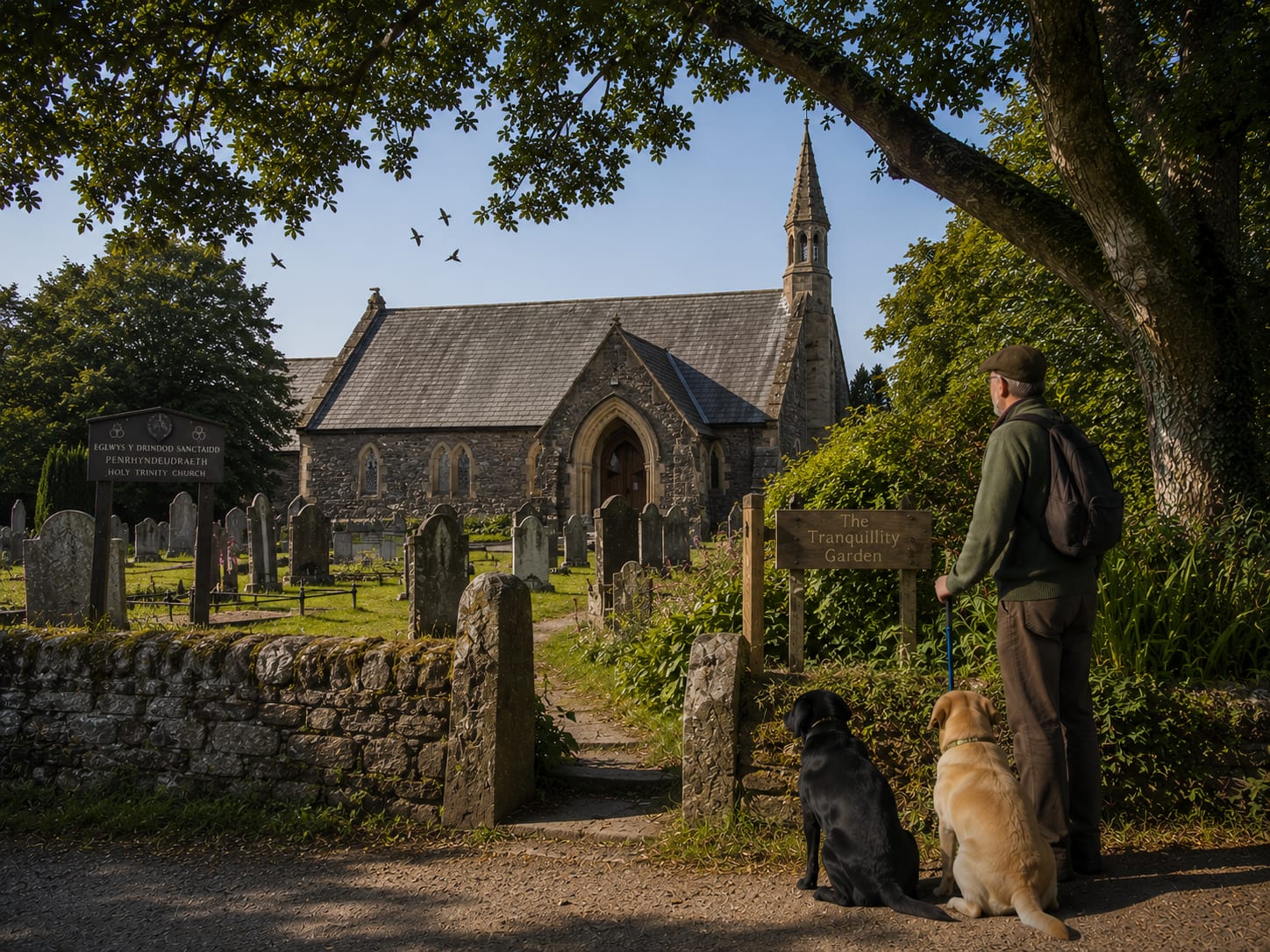
The churchyard was peaceful. Ancient yew trees cast their shadows across the old graves, while swallows skimmed gracefully through the warm summer air.
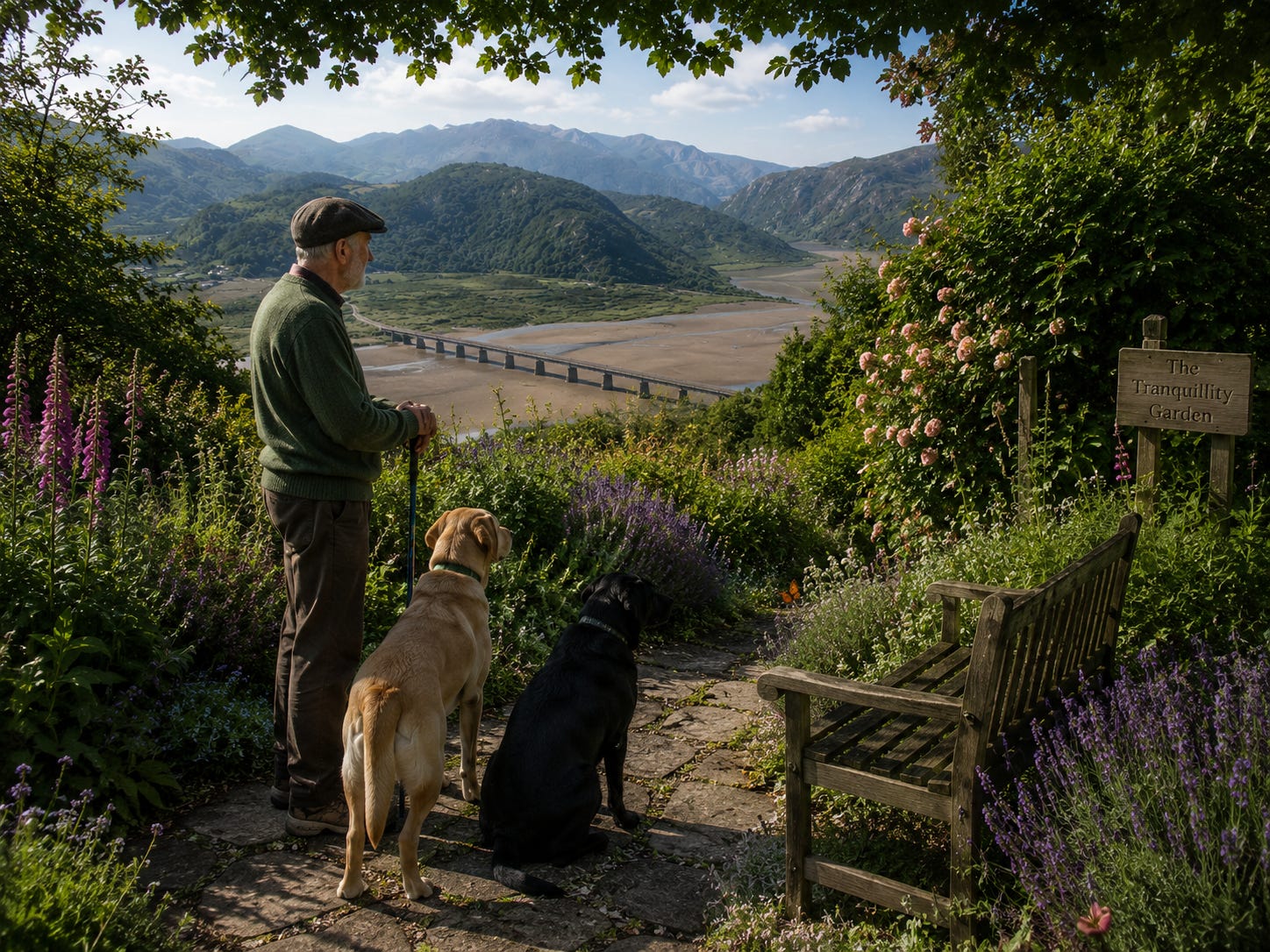
Tucked away beside the church was a little garden. A small wooden sign simply read:
“The Tranquility Garden”
“This,” said Mr Rogers, “is one of my favourite places.” Billy and Spud followed him through the little gate. There were flowers everywhere. Lavender. Foxgloves. Roses. Wild thyme growing between the paving stones. Butterflies drifted lazily from flower to flower. Honeybees hummed busily among the blossoms.
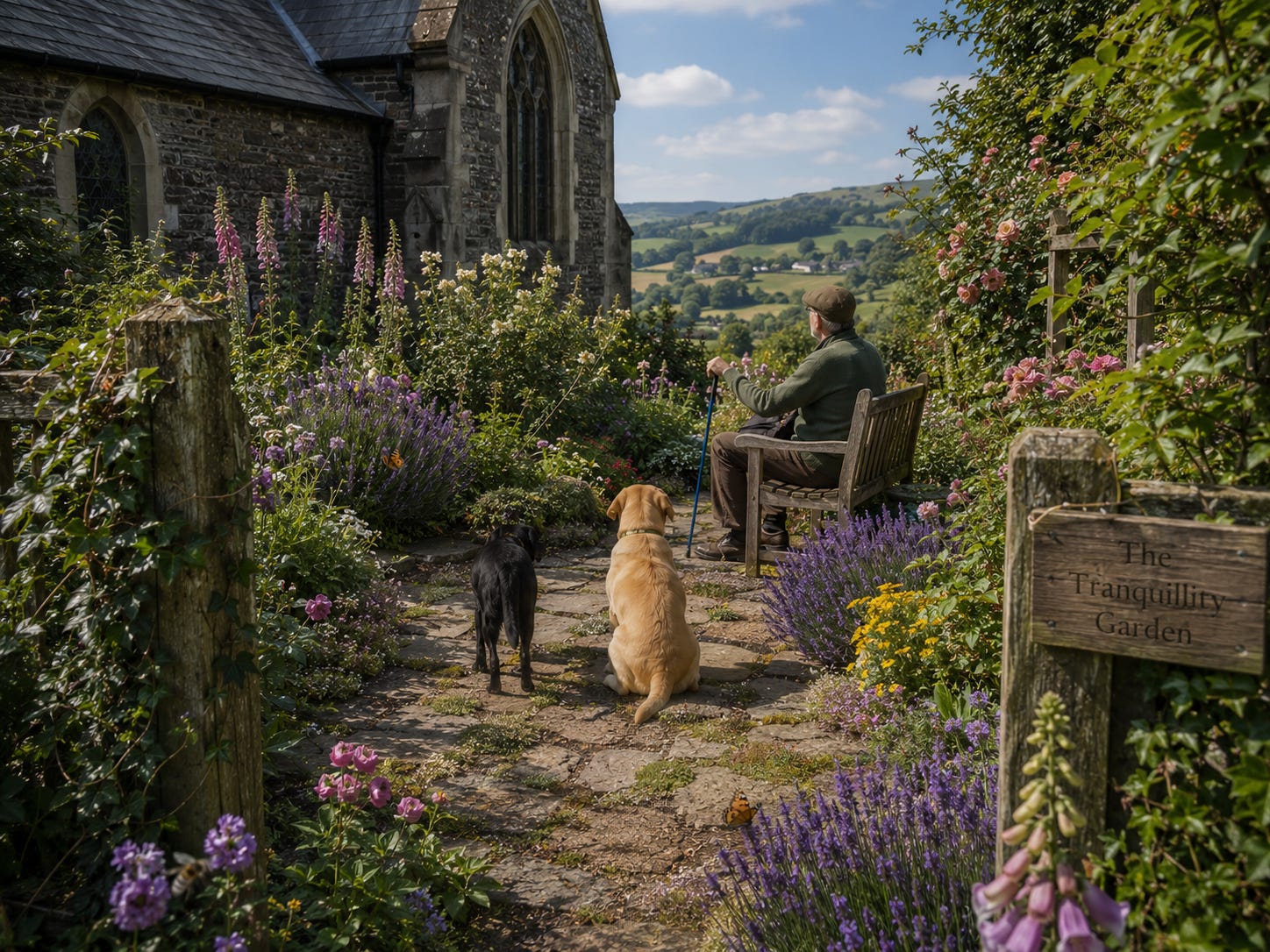
In one corner stood a wooden bench looking out across the valley. Mr Rogers lowered himself onto it with a grateful sigh. “I think we’ve earned a little rest.”
Billy stretched out beneath the bench. Spud curled herself beside his feet. For a few minutes, nobody spoke. The only sounds were those of birds singing and the gentle rustling of leaves.
Mr Rogers closed his eyes for a moment. “Can you hear it?” he asked quietly.
Billy listened carefully. A blackbird. A robin. Wood pigeons. The distant call of a buzzard circling high above the hills.
“Exactly,” smiled Mr Rogers. “A hundred years ago this view would have sounded very different.”
Billy opened one eye. Mr Rogers pointed along the valley to wards a distant hill. “Can you see those woods over there, beyond the railway?”
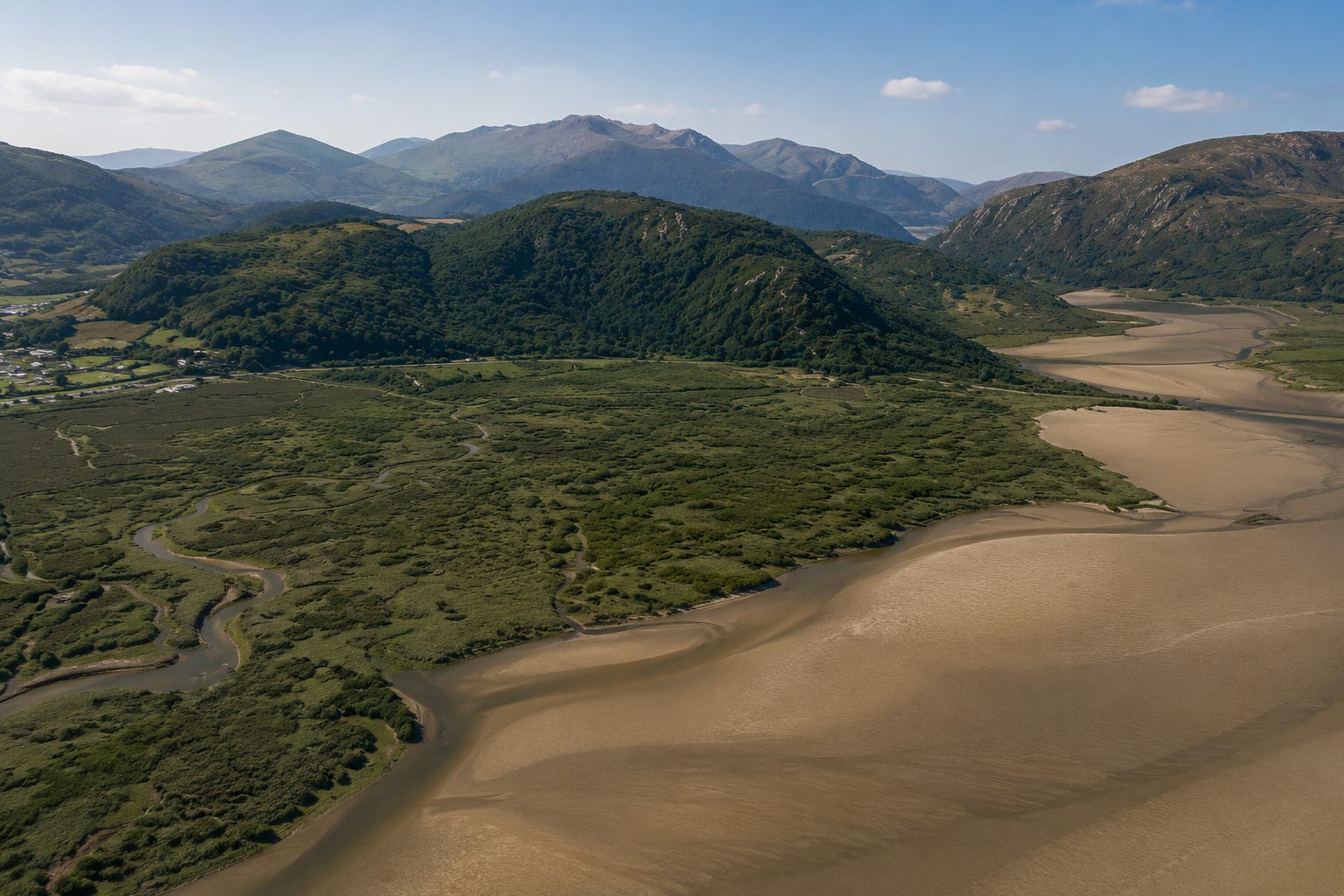
Billy followed his finger. Beyond the trees and across the railway there lay a broad stretch of woodland stretching across the hillside. “It looks like an ordinary woodland,” thought Billy.
“It does now,” said Mr Rogers, as though reading his thoughts. “But for many years that was one of the busiest places in the whole area.”
Billy looked again.
“It was called Gwaith Powdwr - the Powder Works.” Spud tilted her head. “They made explosives there.”
Billy’s ears stood upright. “Explosives?”
Mr Rogers nodded. “Very carefully. The slate quarries needed blasting powder. So did the mines. Without it, many tunnels and quarries could never have been worked.”
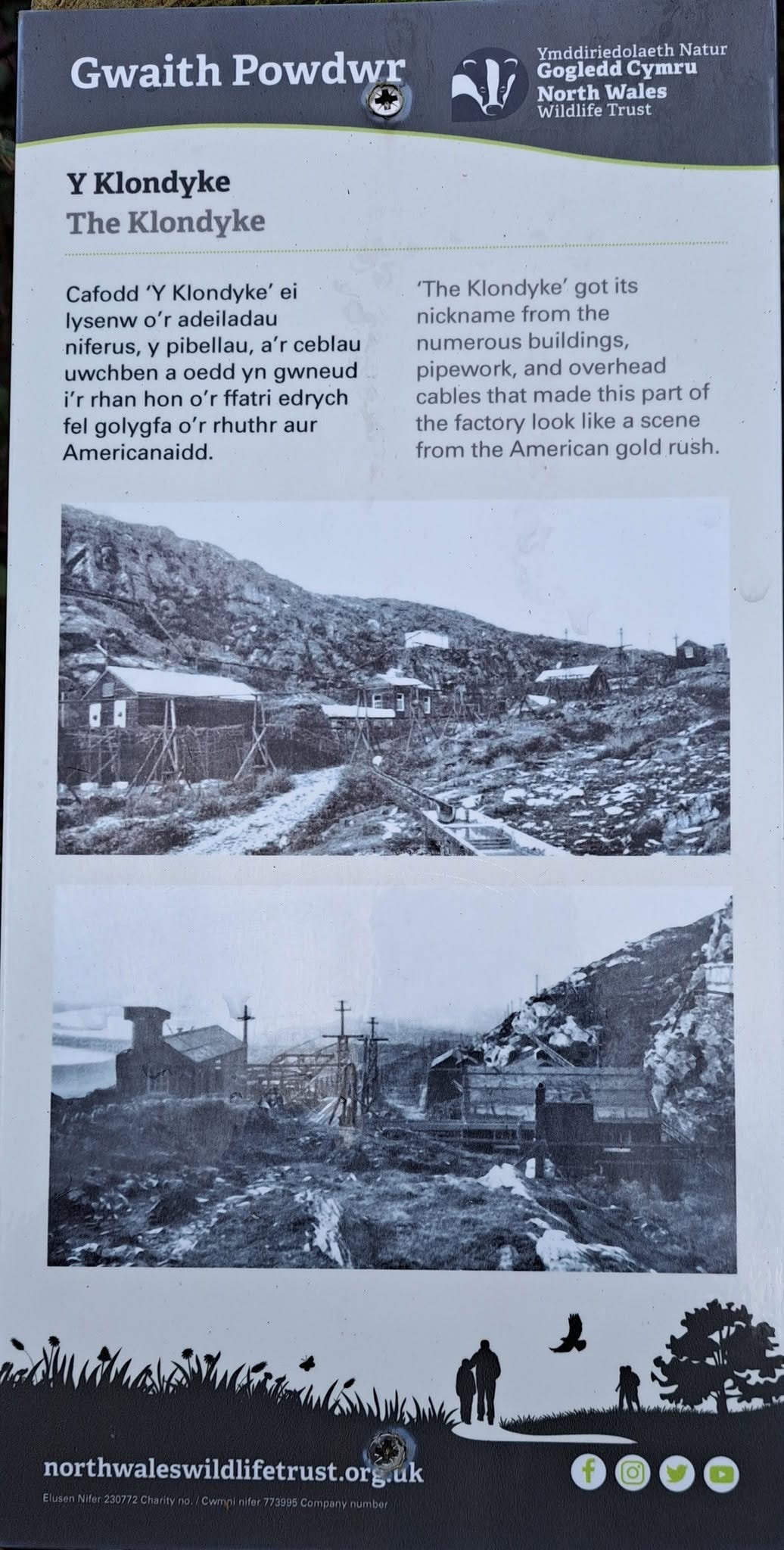
Billy imagined hundreds of people arriving every morning. Factory whistles. The hiss and clatter of machinery. Railway wagons. Boxes marked with warning labels. Men and women busy at work. “It must have been noisy,” he thought.
“It was. And sometimes...” Mr Rogers paused for a moment, “...sometimes accidents happened.”
Billy remembered the patient records at Dinorwig Quarry Hospital. Fractured legs. Burns. Crushed hands. Eye injuries. Every line in those old ledgers had belonged to a real person.
“Some of the people injured at Gwaith Powdwr may have been treated at Bron-y-Garth,” said Mr Rogers. “Others may have travelled further, for specialist treatment.”
Billy looked across the valley once more. Now all he could see were trees gently swaying in the breeze. “What happened to the factory?” he wondered.
“It closed many years ago. And nature slowly returned.” Mr Rogers pointed towards the woodland. “Those woods are now a nature reserve. Bats live there.”
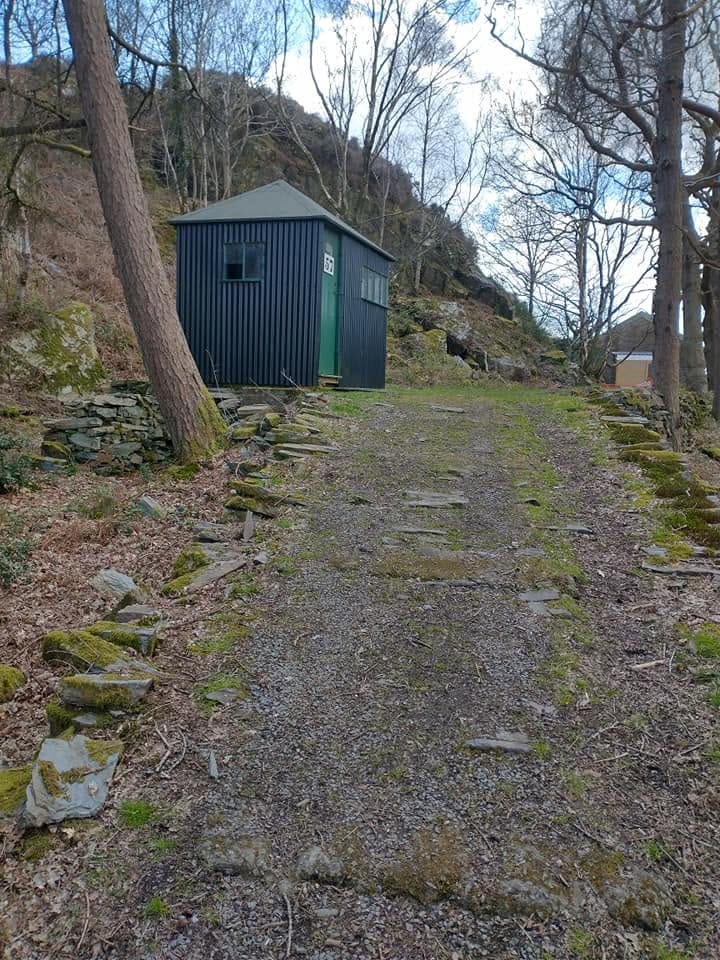
Billy looked interested.
“Several different kinds. And on warm summer evenings, nightjars fly silently over the heath.”
Spud listened carefully.
“They’re rather unusual birds,” smiled Mr Rogers. “You hear them more often than you see them.”
Billy thought about that. Once the valley had echoed with explosions. Now it echoed with birdsong. The same place. A completely different story.
Mr Rogers rested both hands on the top of his walking stick. “Nature is very good at healing.”
Billy looked at the flowers. The trees. The butterflies. The woodland beyond. Then he looked at Mr Rogers’ knee.
Mr Rogers smiled. “And people are becoming rather good at healing, too.”
Just then the church clock struck the hour. Mr Rogers glanced at his watch. “I think we’ve rested long enough.”
Billy stood up and gave himself a vigorous shake. Spud stretched each leg in turn.
“There’s one more stop before we go home.”
Billy looked expectantly at Mr Rogers. “We’re calling at the doctor’s surgery.”
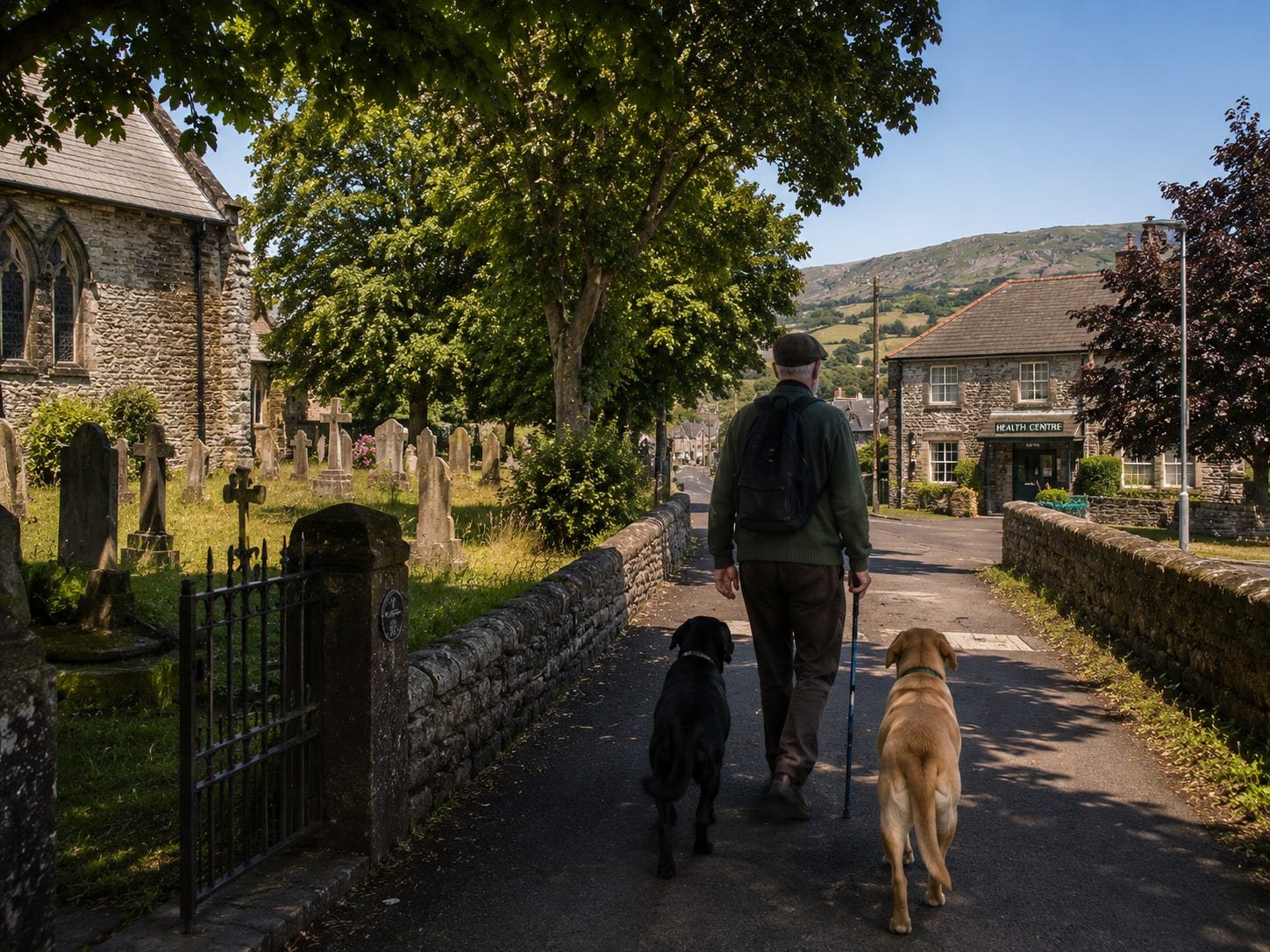
Billy wagged his tail. He quite liked visiting the surgery. The nurses always smiled at him through the window. Although he had never quite worked out why Mr Rogers voluntarily allowed a machine to squeeze his arm every time they visited.
As they walked slowly out of the Tranquility Garden, Billy glanced back one last time. The old church. The quiet graves. The peaceful flowers. The distant woodland where explosions had once echoed.
History, he realised, wasn’t always noisy. Sometimes... it whispered.
The Machine That Hugged Your Arm
The village doctor’s surgery stood only a few minutes’ walk from the church. By now, Mr Rogers’ steps had become slower again. Billy noticed that although his friend was smiling, he seemed pleased to reach the entrance doors.
Inside, everything felt calm. People sat quietly reading magazines. A receptionist smiled warmly. “Good morning, Mr Rogers.”
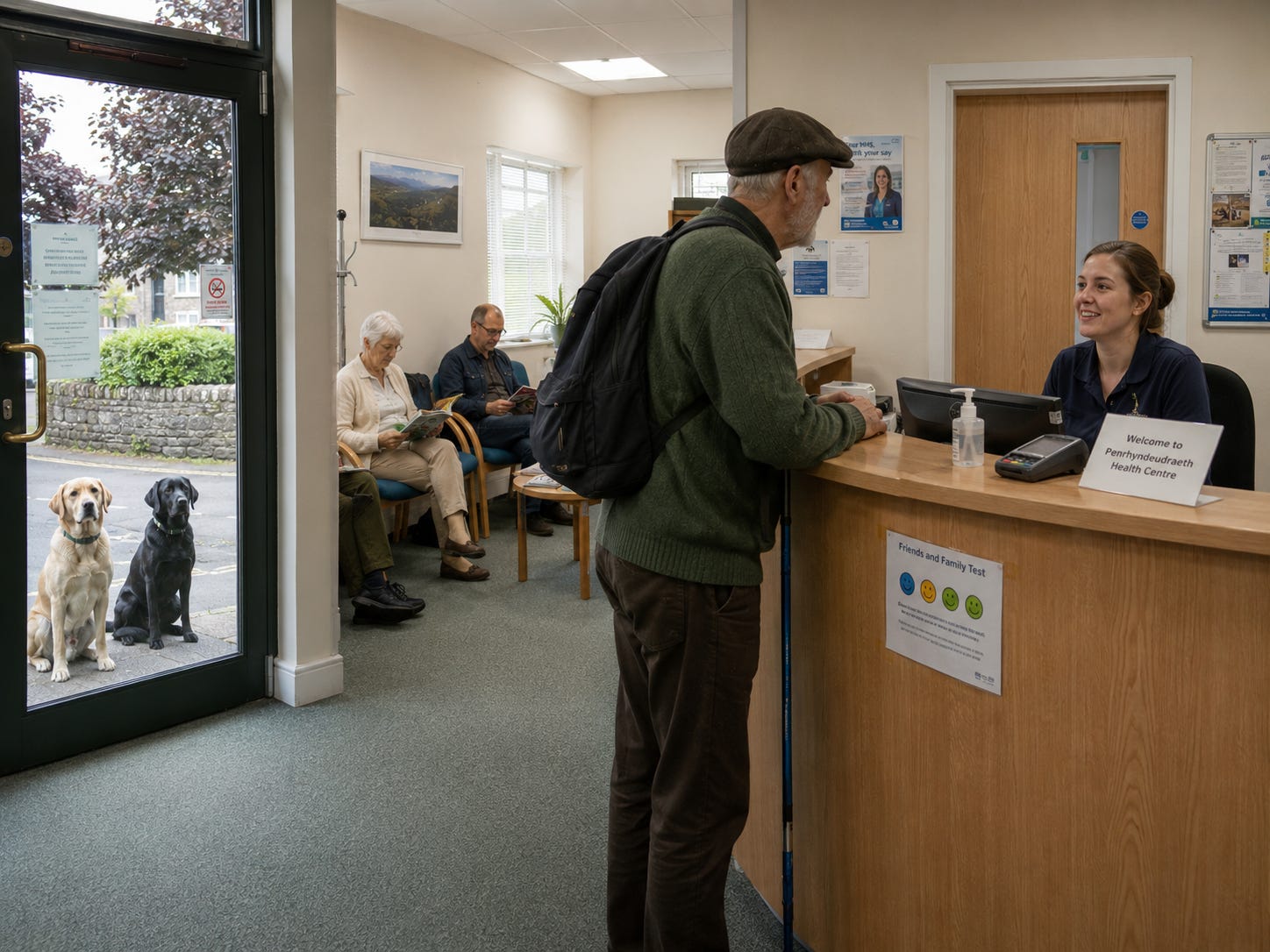
“Morning,” he replied. “Just calling in for my usual check.”
Billy knew this routine. Mr Rogers wasn’t ill. He simply liked to keep an eye on his health. “Since my new knee,” he explained quietly to Billy, “it’s sensible to keep checking that everything else is behaving itself too.”
The dogs sat patiently outside the door. Billy’s attention, however, had already been caught by a curious machine standing in one corner of the lobby. It had a little screen. Some buttons. And a hole on one side just large enough to put your wrist into, with a sleeve around it.
The two dogs sneaked in and Billy sniffed it cautiously. It didn’t smell dangerous. It smelled of... lots of different people.
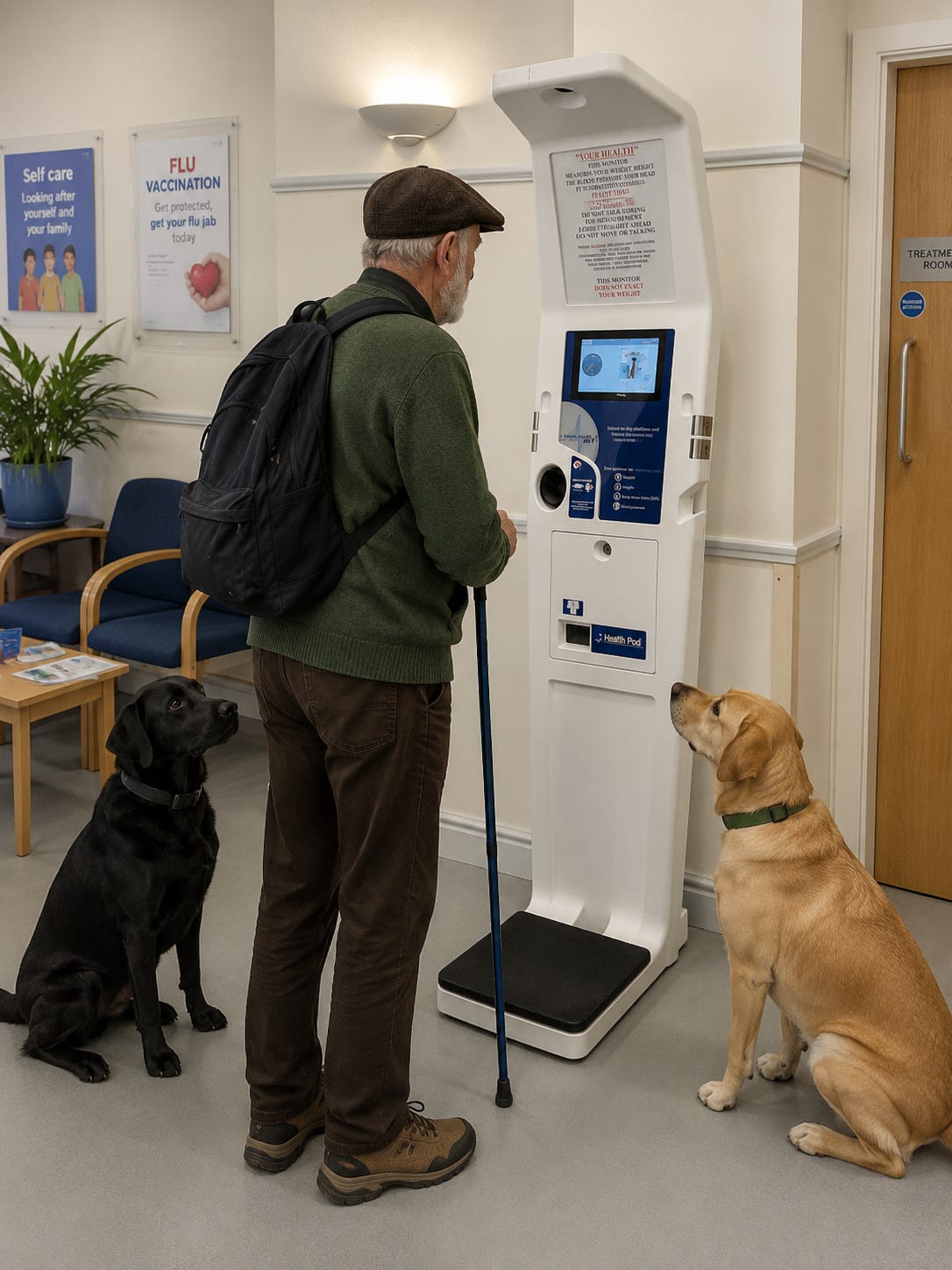
Mr Rogers chuckled. “I think you’re wondering what that does.” Billy wagged his tail.
“It measures blood pressure.” Billy looked none the wiser.
“And heart rate.” Still no sign of understanding.
Mr Rogers laughed. “It helps the doctor to see how hard my heart is working.”
Now Billy was interested. He watched carefully as Mr Rogers slipped his forearm into the hole on the front of the machine.
The machine gave a cheerful little beep. Then...
The sleeve began to tighten around Mr Rogers’ wrist.
Billy’s ears shot upright. The sleeve tightened even more. Mr Rogers’ wrist disappeared inside it.
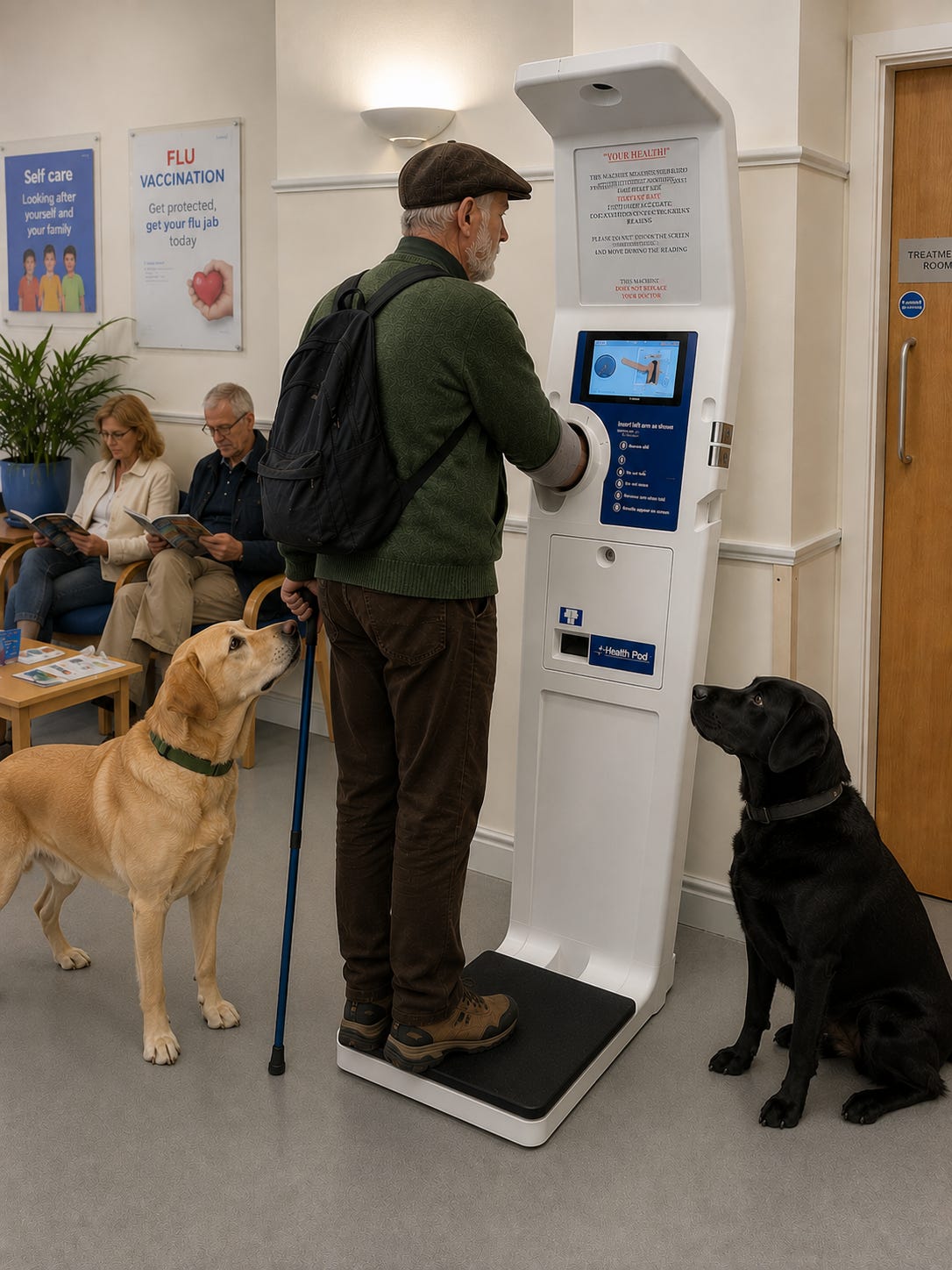
Billy jumped to his feet, concerned. Surely the machine was trying to catch him! Spud watched calmly. She had seen this happen before. “It’s all right, Billy,” she seemed to be saying with a gentle glance.
The sleeve squeezed... and squeezed... and then... quite suddenly... it let go.
Billy stared suspiciously. The machine gave another cheerful beep. Numbers appeared on the screen, and it spat out a printed ticket.
Mr Rogers looked carefully at the printed numbers on the ticket, and then smiled. “Very good.”
Billy looked at the machine. Then at Mr Rogers. Then back at the machine.
“So... it wasn’t attacking you?”
“Not at all,” laughed Mr Rogers. “It was simply measuring my blood pressure.”
Billy still wasn’t convinced that there wasn’t an easier way. As they walked back outside into the sunshine, Mr Rogers said, “Do you know, doctors couldn’t always do that.”
Billy looked up.
“Not very long ago, doctors had no little machines like this. No computers. No digital screens. No automatic cuffs.”
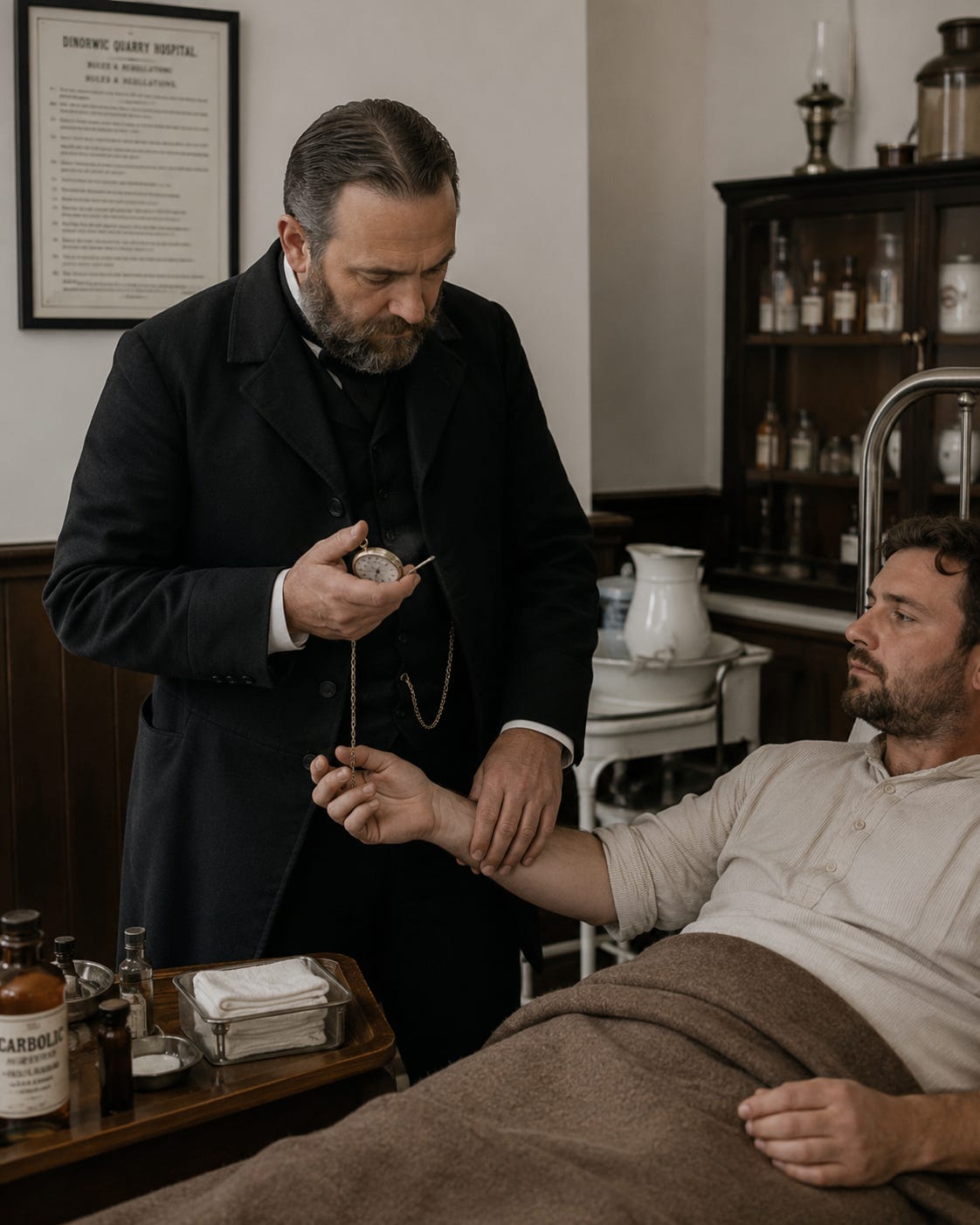
“So how did they know?” wondered Billy. Mr Rogers gently placed two fingers against the inside of his own wrist. “They felt a person’s pulse.”
Billy copied him as best a dog could by gently nudging Mr Rogers’ hand with his nose.
“They watched how someone was breathing.”
Billy took a deep breath.
“They listened.”
Billy pricked up his ears.
“They looked carefully at someone’s face.”
Billy stared thoughtfully.
“And perhaps most important of all...” Mr Rogers smiled, “they talked to their patients.”
Billy liked that. Machines were clever. But they couldn’t listen to stories.
As they slowly walked away from the surgery, Mr Rogers paused beside a flower bed. He looked thoughtfully towards the hills…
“When I was in Ysbyty Gwynedd,” he said quietly, “lots of different people helped me. The surgeons. The nurses. The physiotherapists. The radiographers. The cleaners who kept everything spotless. The people who brought meals. The volunteers who helped visitors.”
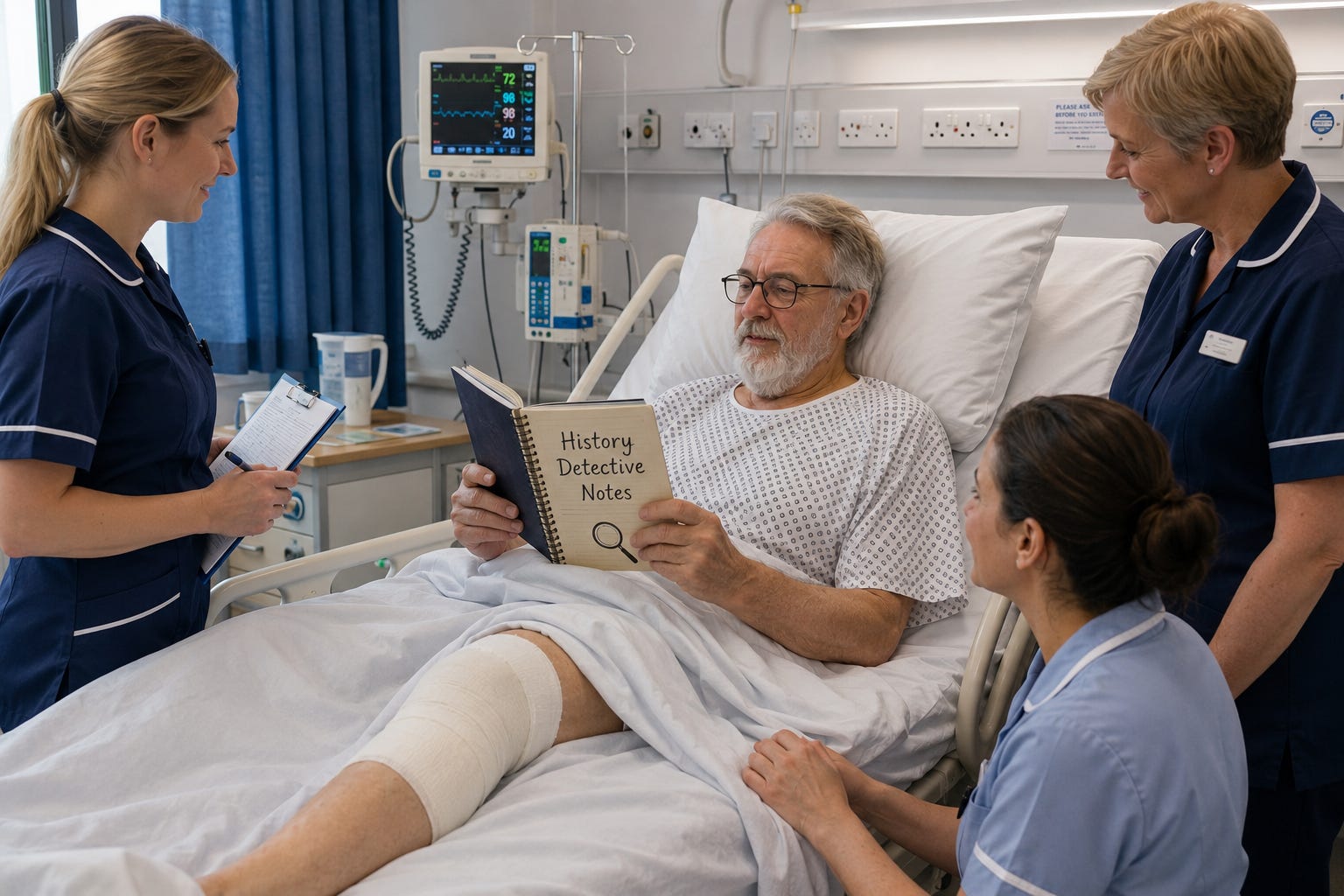
Billy wagged his tail. It seemed a great many people had been involved in mending one knee.
Mr Rogers smiled. “It reminded me of something.”
Billy waited.
“People often think hospitals are only about doctors. But they’ve always depended on teams of people.”
Billy remembered the Quarry Hospital. There had been nurses there too; and ward maids; porters; people who washed sheets; people who sharpened instruments; people who cooked meals. Perhaps they were all just as important.
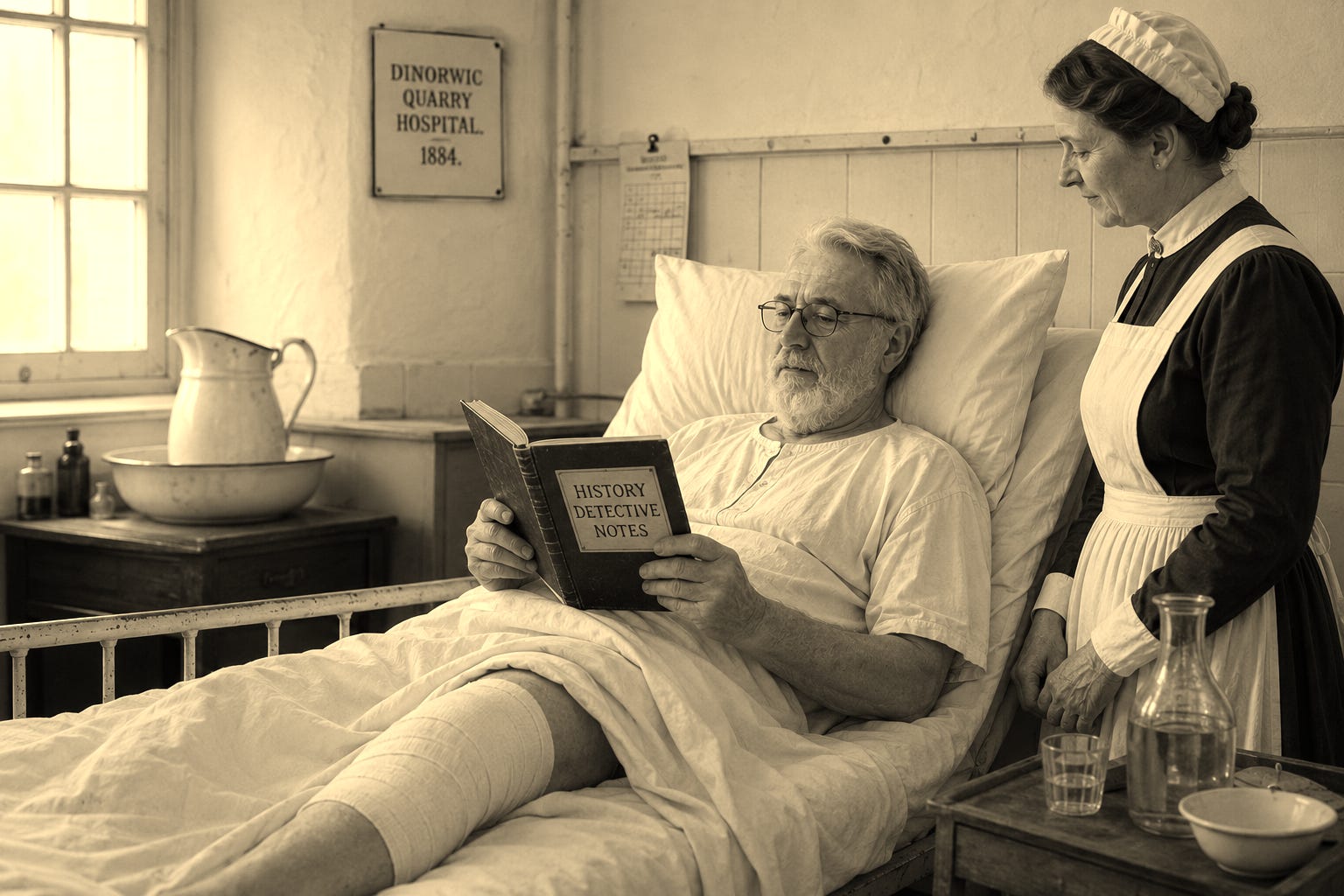
Mr Rogers looked at Billy and Spud. “And do you know who helped me most when I came home?” Billy’s ears lifted hopefully. “It was you two.”
Billy looked astonished. “We did?” Mr Rogers nodded. “You made me go for little walks. You reminded me to keep moving. You made me laugh. You never hurried me.”
Spud quietly rested her head against Mr Rogers’ leg. Billy thought for a moment. Perhaps healing wasn’t only about hospitals after all. Perhaps it also happened... one careful walk at a time.
As they turned the final corner towards home, the afternoon sunshine glinted through the sitting-room window. On the mantelpiece, the old green medicine bottle was waiting exactly where they had left it.
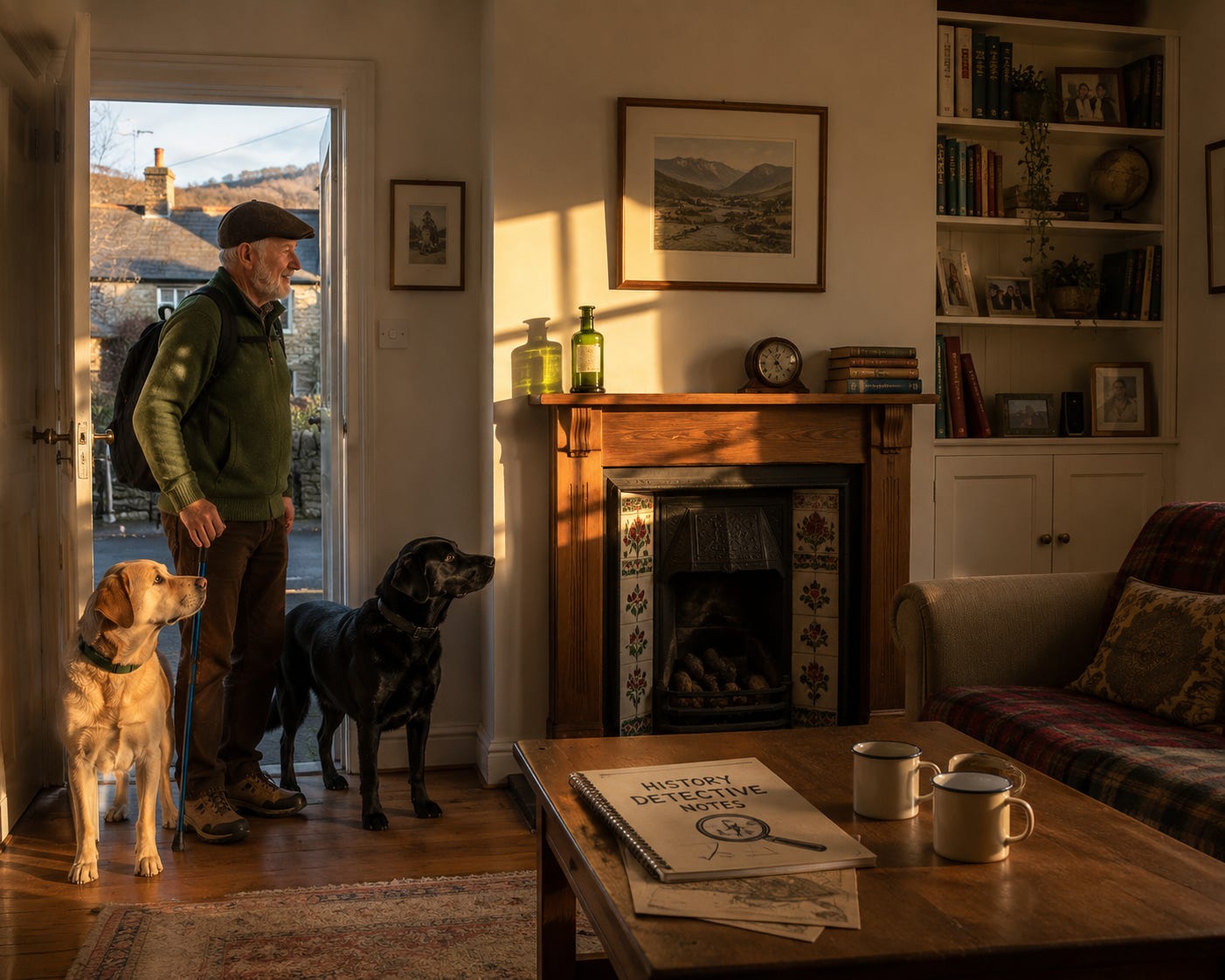
Billy suddenly remembered something. He had never asked why anyone would throw away a perfectly good medicine bottle. Perhaps... that was another mystery waiting to be solved.
The Little Green Bottle
By the time they reached home, Billy was beginning to feel pleasantly tired. Not because the walk had been long. In fact, it had only been a little further than yesterday. But today’s adventure had been full of questions.
Mr Rogers unlocked the front door and smiled. “I think we’ve earned a cup of tea.”
Billy wasn’t interested in tea. Spud wasn’t either. But they both knew that “a cup of tea” usually meant “a biscuit for everyone.”
Sure enough, a few moments later, the familiar biscuit tin appeared. Crunch... Crunch... Contentedly, Billy settled onto the rug in front of the fireplace. His eyes wandered up to the mantelpiece.
There it was again. The little green bottle. The afternoon sunshine shone through the thick old glass, making it glow like a tiny emerald.
Billy stood up. He walked closer. He sniffed. No smell.
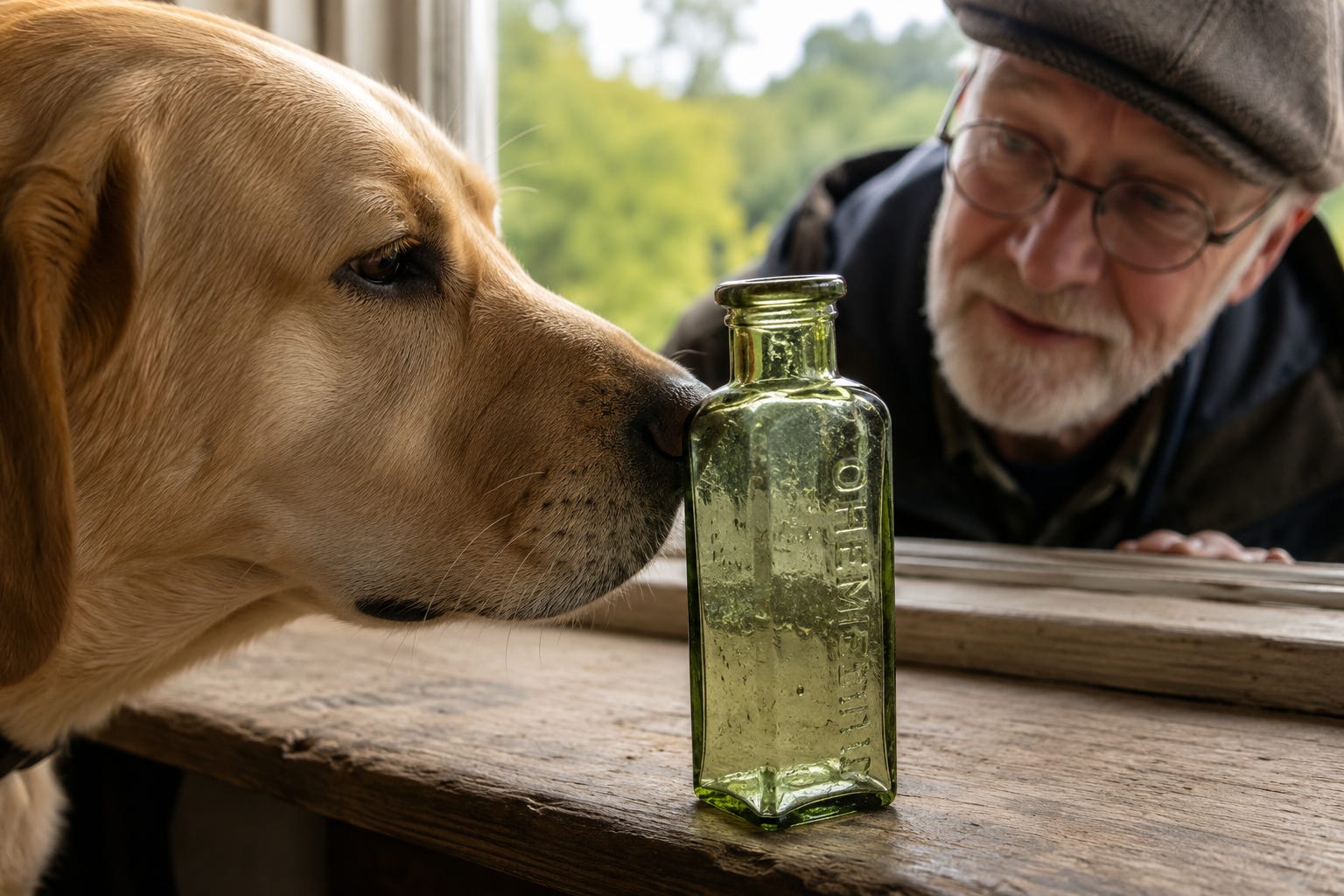
He looked inside. Empty. He gave it the gentlest nudge with his nose.
“Careful,” laughed Mr Rogers. “That’s survived underground for a very long time.”
Billy looked at him. “I’ve often wondered about it too,” said Mr Rogers. He carefully lifted the bottle down and placed it on the table between them. It was surprisingly heavy for something so small.
Tiny bubbles were trapped inside the glass. The base wasn’t perfectly flat. One side was slightly crooked.
“It wasn’t made by machines like bottles are today,” explained Mr Rogers. “Someone would have made this in a glassworks many years ago.”
Billy peered closely. Along one side, faint raised letters could still be seen. Time had worn some away. Others were almost impossible to read.
‘...CHEM...’
Mr Rogers traced the lettering gently with one finger. “I think that probably says ‘Chemist.’”
Billy wagged his tail. “So it really was medicine!”
“It probably was. But that’s only the beginning of the mystery.” Mr Rogers fetched a magnifying glass from a nearby drawer. Billy recognised it immediately. It usually meant that History Detectives were about to investigate something. Together they examined every part of the bottle.
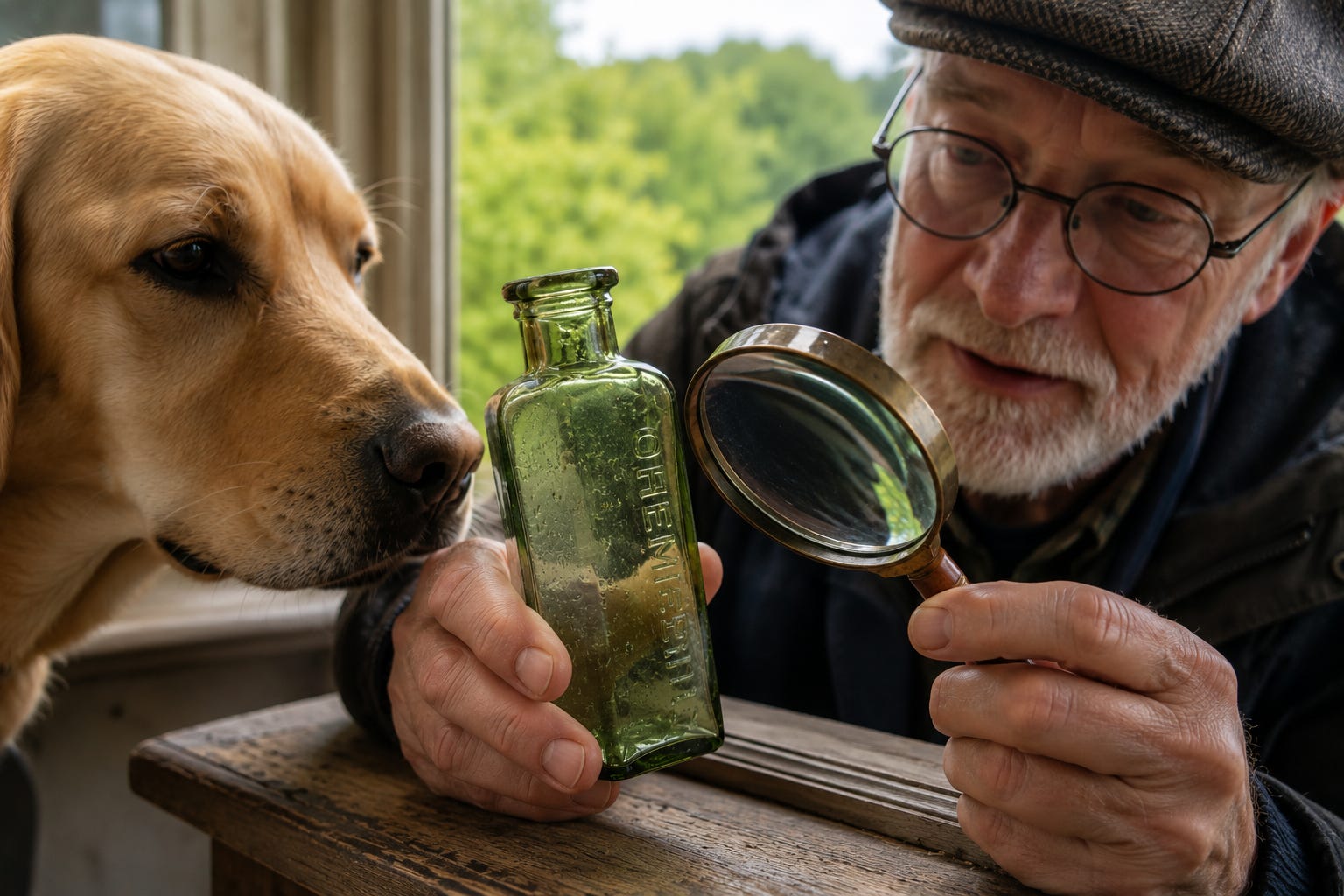
Near the bottom they discovered a tiny number. On the neck was a faint seam where two parts of the mould had once met. There was even a little chip near the lip. “I wonder who last held this,” said Mr Rogers quietly.
Billy imagined a quarryman with a bandaged hand. Spud imagined a nurse carefully measuring out medicine. Mr Rogers smiled. “We don’t know. And perhaps we never shall. But that doesn’t stop us asking sensible questions.”
Billy liked that. History Detectives didn’t guess. They looked for clues.
Mr Rogers reached across to a bookshelf and pulled down a photograph album. Inside were photographs from one of their earlier visits to the Dinorwig Quarry Hospital museum. Billy immediately recognised the familiar ward; the polished iron bedsteads; the wooden crutches; the long ward windows.
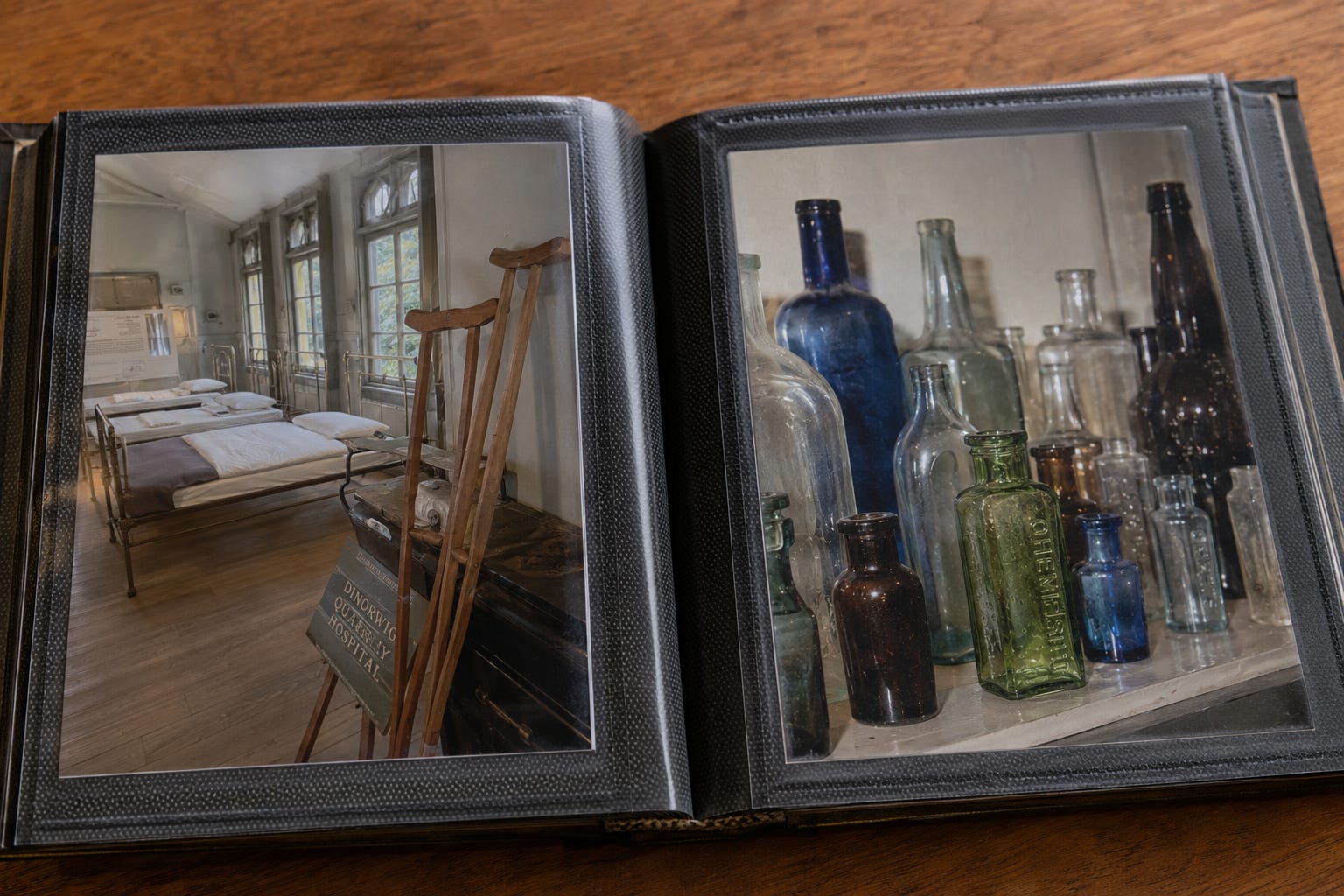
Then another photograph caught his eye. A shelf, lined with old bottles. Some tall. Some short. Some blue. Some brown. Some clear.
One... looked almost exactly like the little green bottle standing on the table.
Billy stared. Then looked at the bottle. Then back at the photograph.
Mr Rogers noticed. “I wondered when you’d spot that.” Billy’s tail began thumping excitedly against the rug.
“Yes,” smiled Mr Rogers. “There are bottles very much like ours in the old Quarry Hospital.”
Billy looked astonished. “Could ours have come from there?”
Mr Rogers thought for a moment. “It might have done. Or it might have come from a village chemist. Or from another hospital. Or even from someone’s home.”
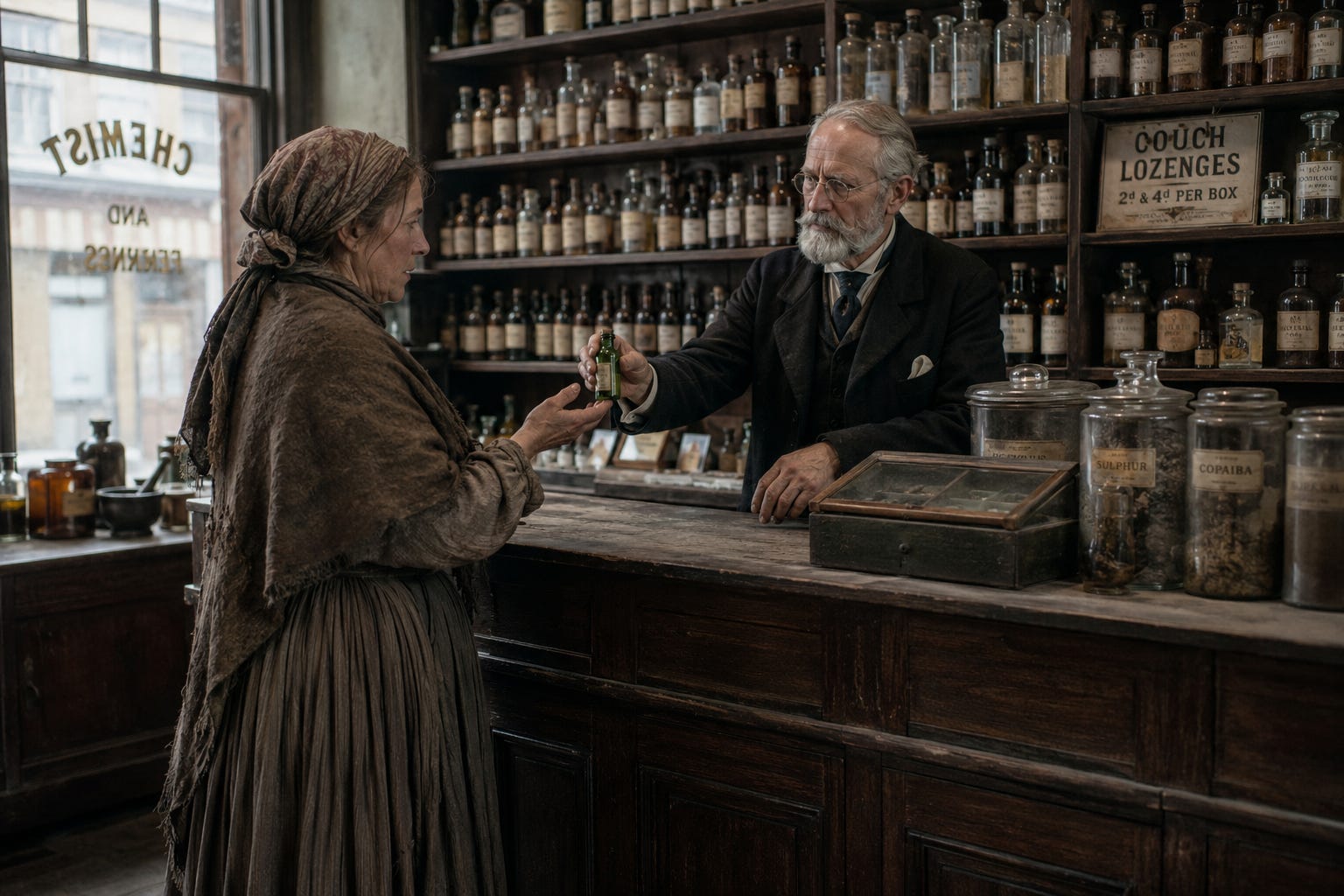
He smiled. “History doesn’t always give us definite answers. Sometimes it gives us possibilities.”
Billy considered this carefully. The bottle suddenly seemed even more interesting. Not because they knew its story. Because they didn’t.
Mr Rogers carefully returned it to the mantelpiece. “It reminds me of something.”
Billy looked up.
“Every object has two stories.”
Billy waited.
“There’s the story that we know... and there’s the story that we’re still trying to discover.”
Outside, the afternoon sunshine was beginning to soften into evening. Mr Rogers glanced through the window towards the hills beyond the village. “I’ve got an idea.”
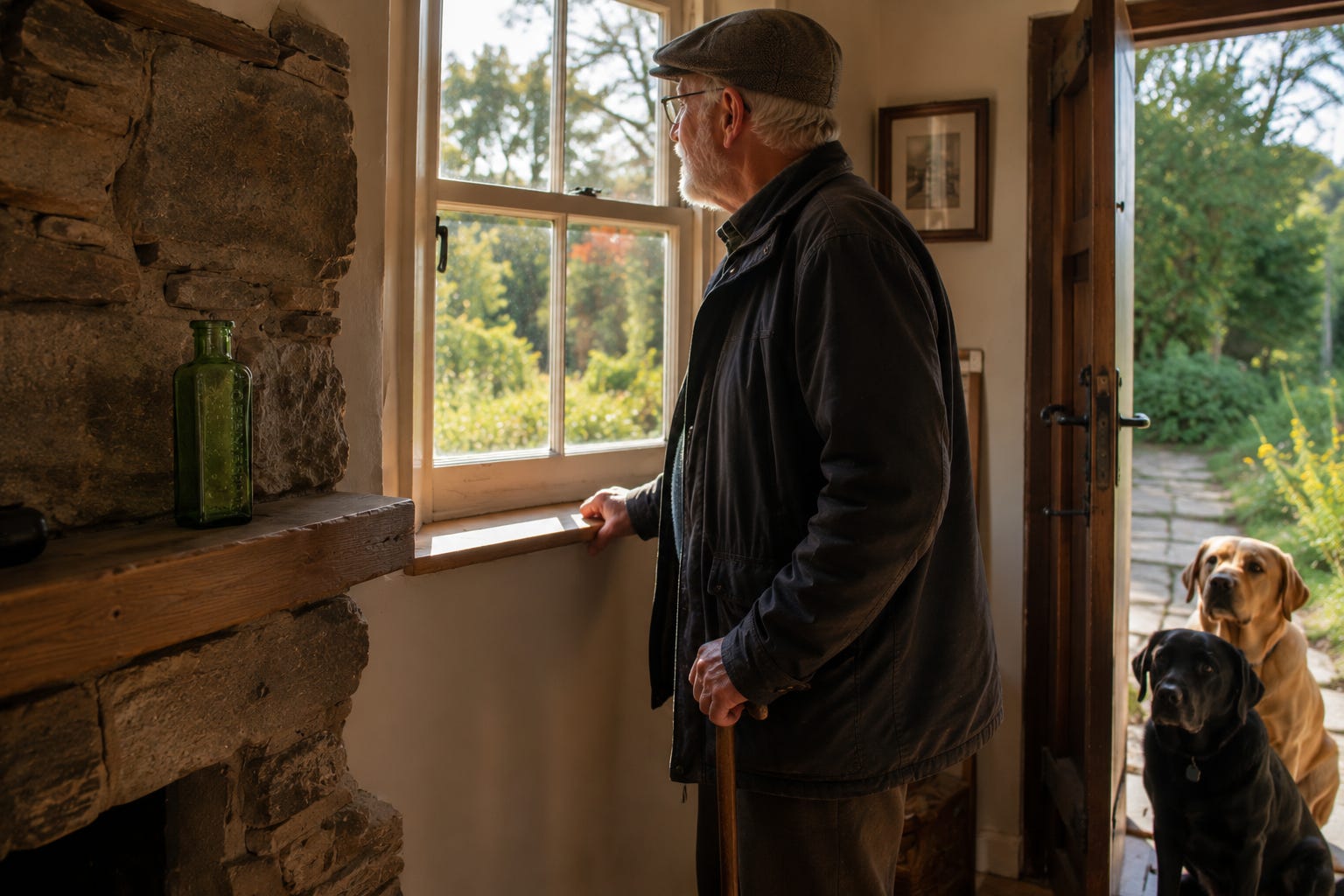
Billy’s ears immediately stood upright.
“My knee is getting a little stronger every day. So perhaps...” he smiled, “...next week we might be ready for a slightly longer adventure.”
Billy’s tail beat happily against the rug. Spud barked once. Mr Rogers looked up at the little green bottle. “I think it’s time we paid another visit to an old friend.”
Billy followed his gaze. The bottle stood silently in the fading light. Waiting. Perhaps, after all these years... it was finally about to help to tell its story.
Reading the Clues
The following morning began with gentle rain. Tiny drops pattered against the windows while Billy watched from his favourite place beside the front door. Spud lay curled up on the rug, still half asleep. Mr Rogers looked out at the grey sky. “I think today’s adventure will have to stay indoors.”
Billy sighed. Rain usually meant fewer walks. But before long, Mr Rogers appeared carrying a cardboard box from the cupboard beneath the stairs.
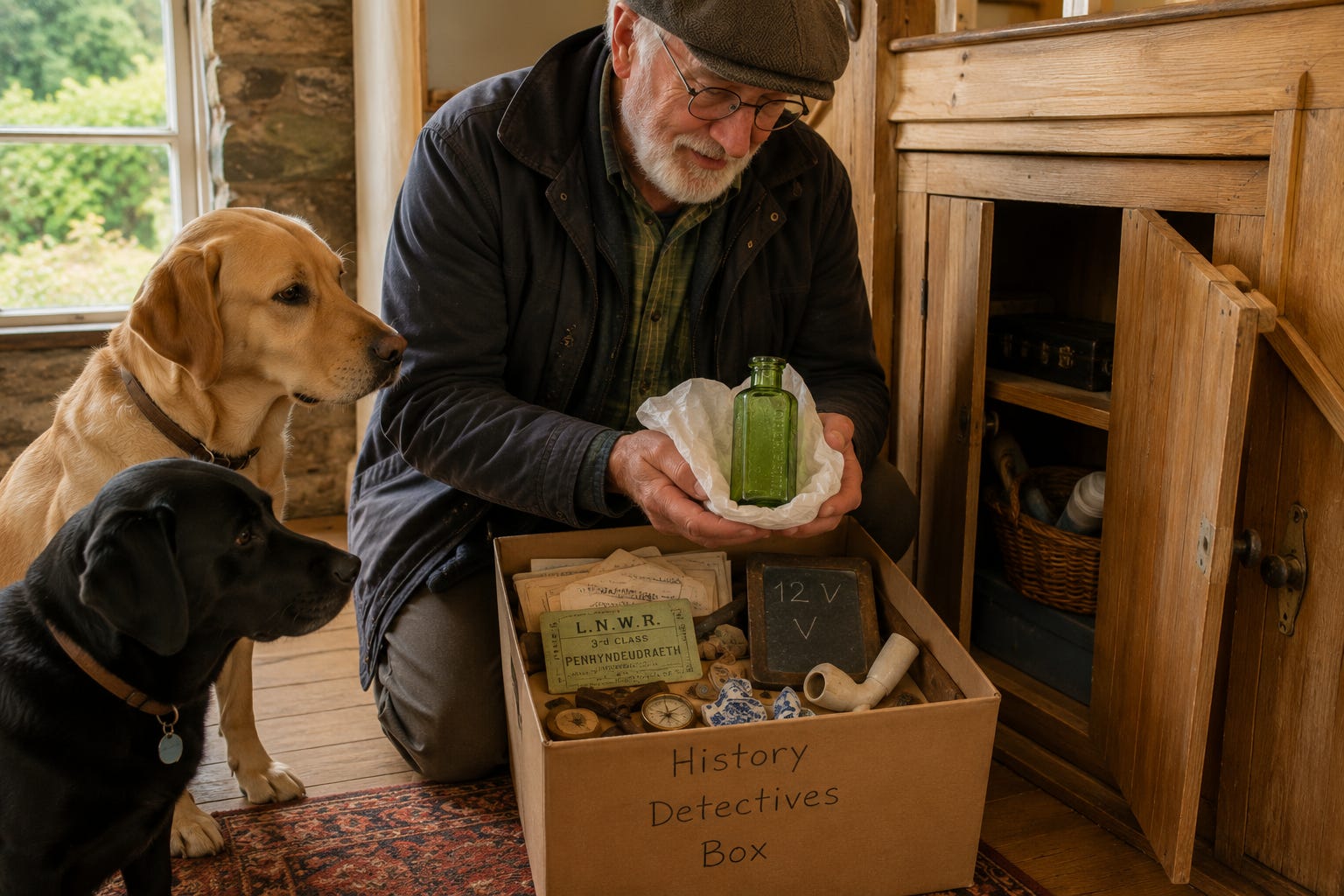
Billy recognised it immediately. It was the History Detectives Box. Inside were all sorts of curious treasures collected over many years. Old railway tickets. A slate tally. A worn compass. Victorian pennies. Fragments of blue-and-white pottery. An old clay tobacco pipe. And now, wrapped carefully in soft tissue paper, had been placed the little green medicine bottle.
Mr Rogers laid everything carefully on the dining table. “Do you remember where you found the bottle?”
Billy certainly did. He scratched enthusiastically at the rug to demonstrate.
“Exactly!” laughed Mr Rogers. “You dug it up beside the old apple tree.”
He unfolded a simple plan of the garden. “Let’s think like detectives.”
Billy jumped onto a chair so that he could see. Spud stretched herself awake and joined them.
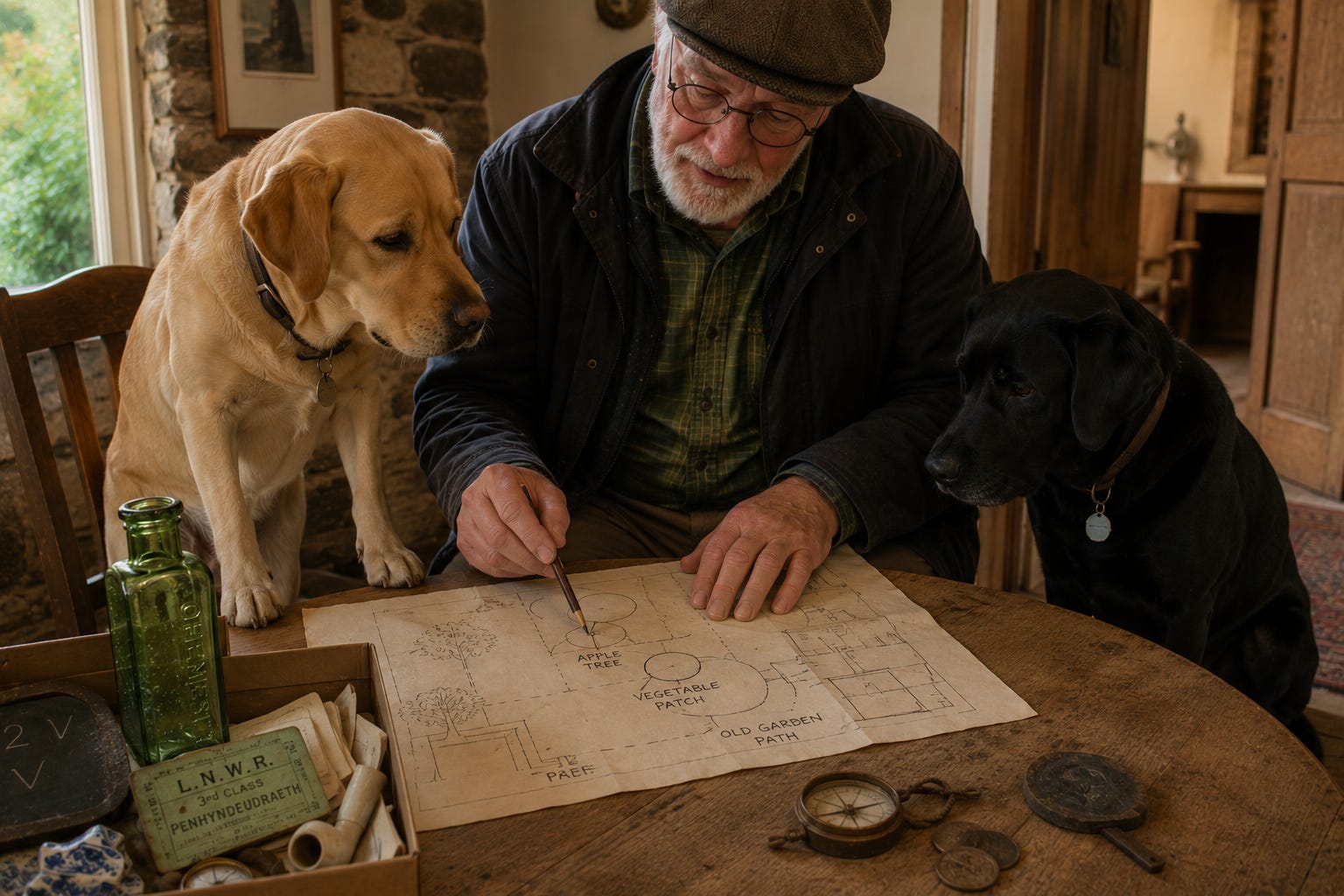
Mr Rogers drew a small circle. “Here’s the apple tree.”
Another circle. “Here’s the vegetable patch.”
Another. “And this is where the old garden path used to run before the house was altered.”
Billy watched carefully.
“The bottle wasn’t very deep underground,” continued Mr Rogers, “so perhaps it wasn’t buried on purpose.”
Billy tilted his head.
“It may simply have been thrown away.”
Spud looked surprised.
“People often did that many years ago,” explained Mr Rogers. “There wasn’t always a rubbish collection like there is today.”
Billy hadn’t thought about that. “So,” continued Mr Rogers, “perhaps someone emptied the bottle... and then threw it into the garden.”
“Or perhaps,” said Billy to himself, “someone accidentally dropped it.”
Mr Rogers smiled. “That’s another possibility.” He reached for a magnifying glass. “Now let’s look more closely.”
Billy examined the thick glass. It wasn’t perfectly smooth. Tiny air bubbles shimmered inside it. Near the base, Mr Rogers noticed something he had never seen before. “There!”
Billy peered closer. A tiny raised letter, almost hidden beneath years of wear.
It looked like the letter B. “Or perhaps an R,” said Mr Rogers, “we can’t be certain.”
Billy looked disappointed. Mr Rogers smiled. “That’s quite all right. History is often like that. We don’t always find complete answers. Sometimes we only discover another clue.”
Just then, the telephone rang. Mr Rogers answered. “Hello?”
Billy listened. After a moment, Mr Rogers smiled broadly. “Oh, hello, Megan.”
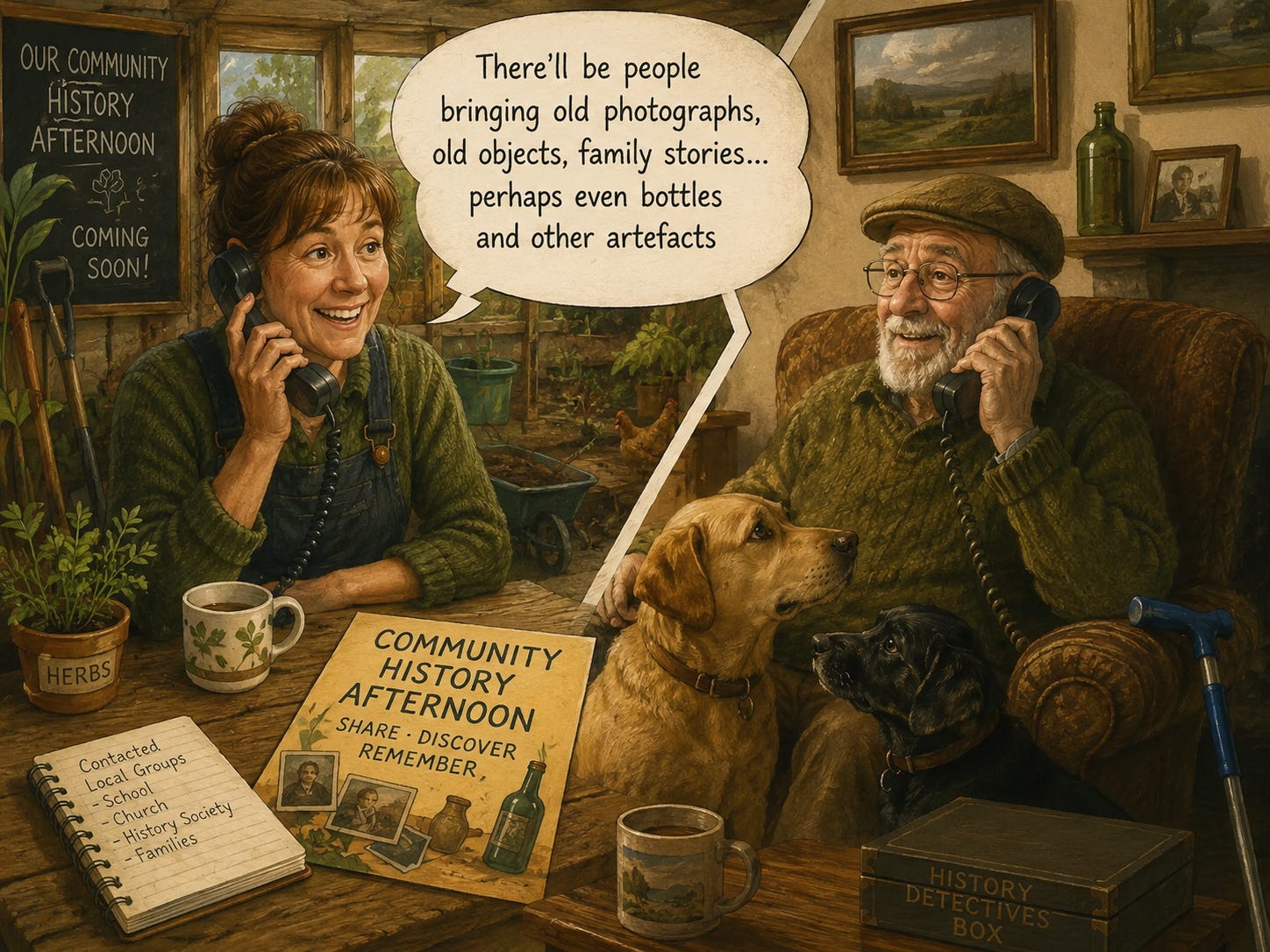
Billy’s ears immediately stood upright. He remembered Megan from the woodland garden at Seren. They chatted for several minutes. When Mr Rogers returned, he looked thoughtful. “Megan’s organising a community history afternoon next month.”
Billy wagged his tail.
“There’ll be people bringing old photographs, old objects, family stories… perhaps even bottles like this one.”
Billy’s eyes lit up. Mr Rogers laughed. “I knew you’d like that idea.” He carefully placed the bottle back onto the table. “You see, Billy... history doesn’t belong only in museums. It lives in people’s homes. In gardens. In family photograph albums. In old sheds. And sometimes...”
He smiled at Billy, “...it waits patiently underground until an inquisitive Labrador comes along.” Billy looked extremely pleased with himself.
Outside, the rain had stopped. A shaft of sunshine broke through the clouds and lit the little green bottle. For just a moment, it seemed almost to glow. Mr Rogers picked it up gently. “I’ve been thinking.”
Billy knew that sentence. It nearly always led to another adventure.
“My knee is improving. I’ve managed to walk as far as Bron-y-Garth; and to the Tranquility Garden; and even to the doctor’s surgery. I wonder...” He paused thoughtfully, “...whether I’m ready to visit somewhere a little further from home.”
Billy looked hopefully towards the car keys hanging beside the kitchen door. Mr Rogers followed his gaze and smiled. “I think it’s time we paid another visit... to the Quarry Hospital at Dinorwic.”
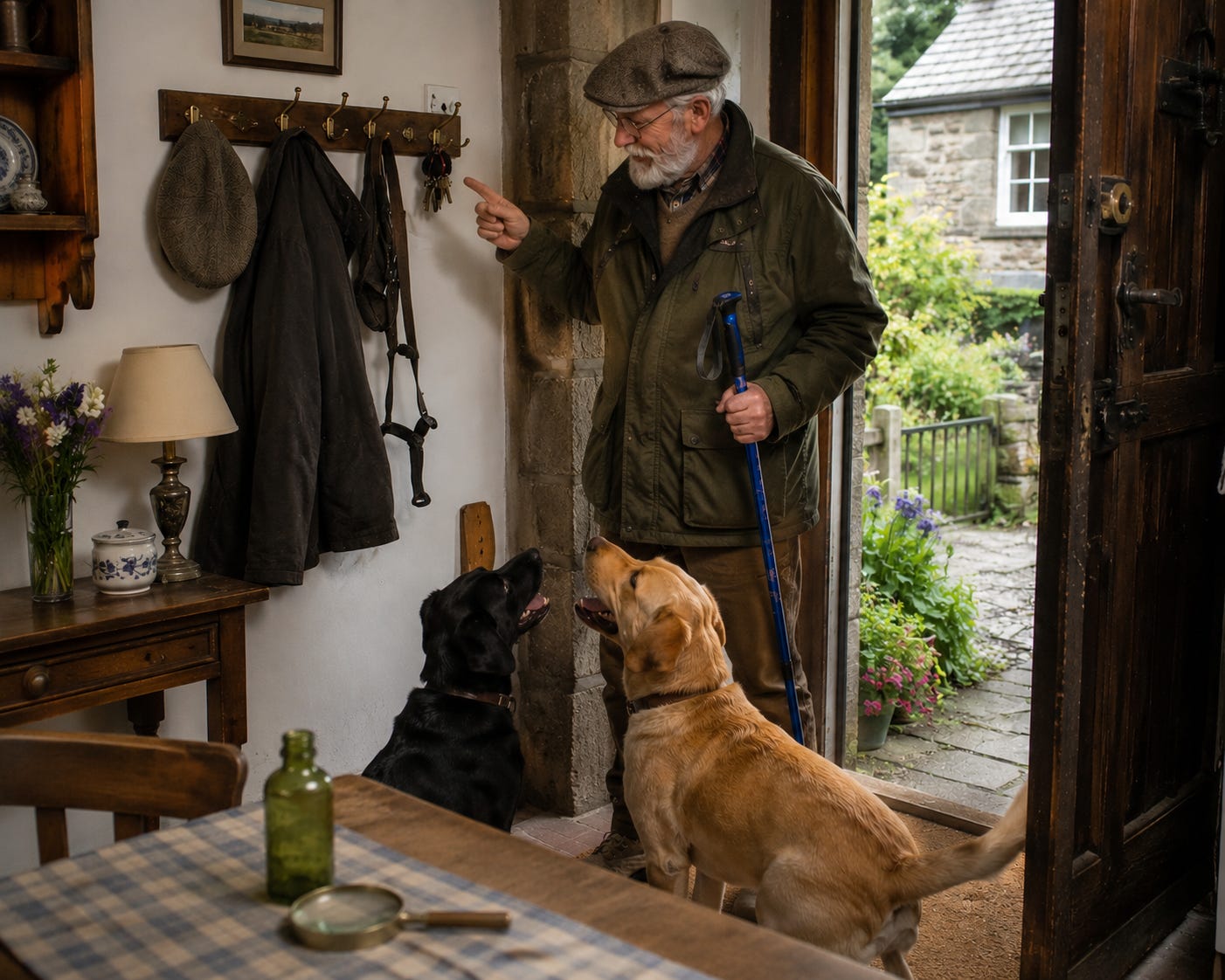
”Billy barked excitedly. Spud barked too. The little green bottle sat quietly on the table. Soon, perhaps... it would meet its old companions once again.
Returning to the Quarry Hospital
A few days later, Billy noticed something that made his tail begin to wag long before breakfast. Mr Rogers was polishing his walking boots. Not the heavy mountain boots that had climbed so many hills across Eryri. Just his comfortable walking shoes.
Even so, Billy knew exactly what that meant. An adventure. Spud knew too. She had already positioned herself beside the front door, just in case anyone forgot she was ready.
Mr Rogers smiled as he reached for the car keys. “I think today’s walk begins with a short drive.”
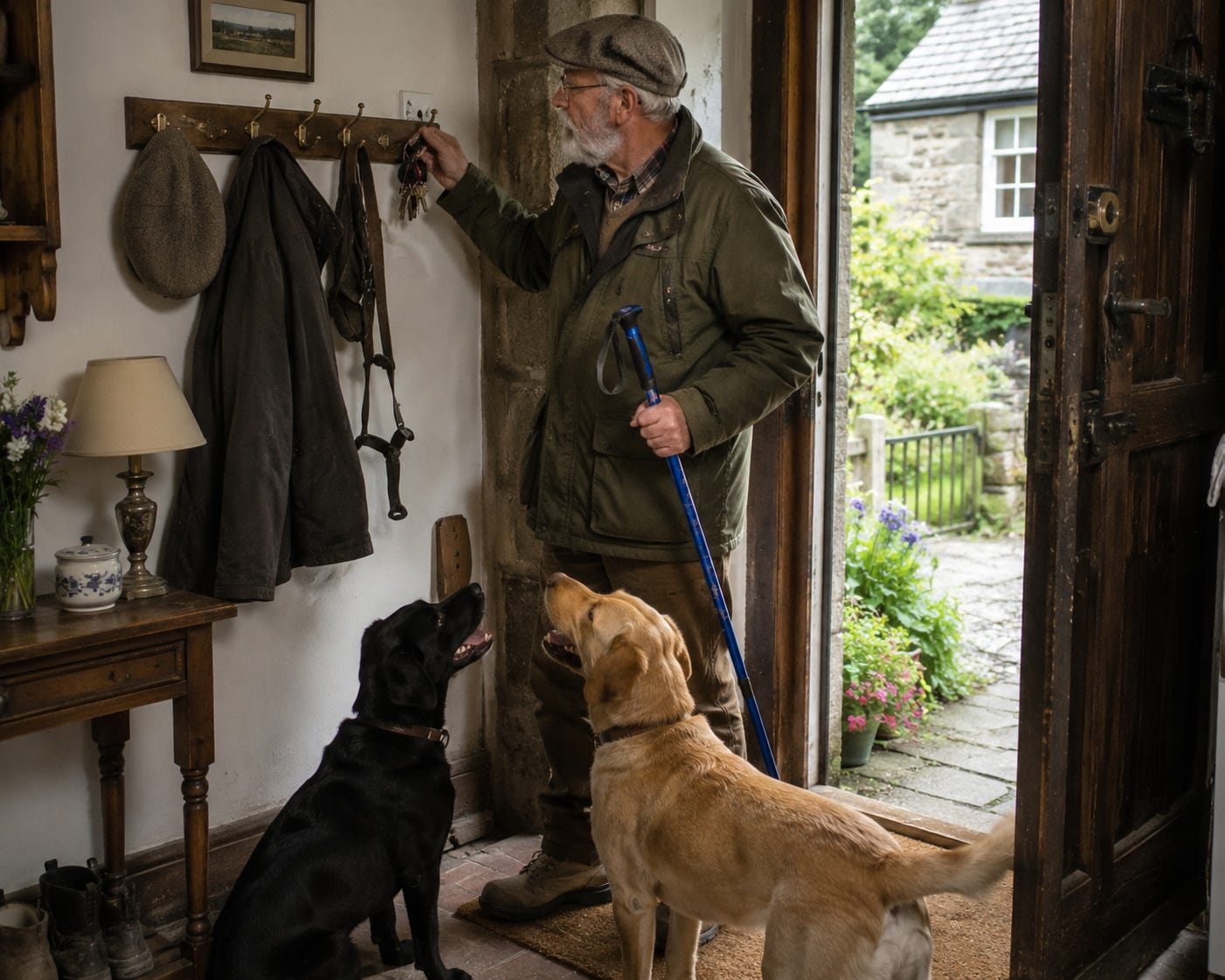
Billy jumped happily into the back of the car. Spud settled beside him. The familiar roads wound gently through the valley.
As they travelled, Billy recognised places they had visited before. The old railway. Stone cottages with their slate roofs. Dry-stone walls winding across green fields. Beyond them, the mountains rose into the morning sunshine.
Mr Rogers smiled. “It won’t be long before we’re exploring those again.”
Billy gave an encouraging bark. Every journey seemed to be taking them a little closer.
Soon the mountains around Llanberis came into view. Billy recognised the great slate tips immediately. The enormous grey slopes climbed towards the sky like giant staircases built by generations of quarrymen.
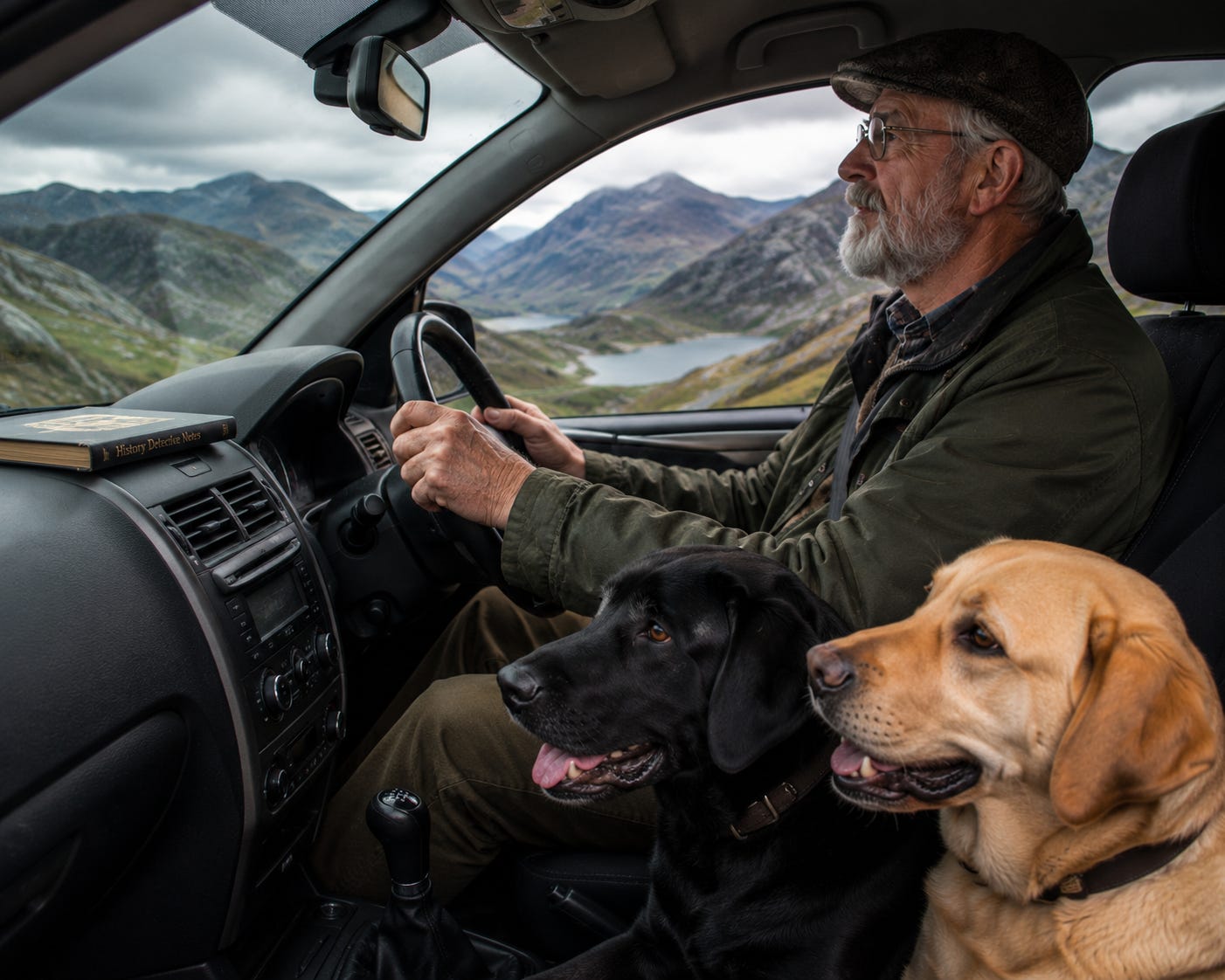
“So many stories began here,” said Mr Rogers quietly. “And many of them ended at the Quarry Hospital.”
Before long they arrived beside the familiar stone building. Billy recognised it at once. Nothing much had changed since their last visit. The handsome stone building stood proudly beneath the trees. Its windows reflected the bright blue sky. Flowers nodded gently beside the entrance.
As Mr Rogers climbed carefully from the car, Billy noticed something. He no longer paused before taking his first few steps. He walked slowly, but naturally. Billy smiled to himself. His friend was getting stronger.
Inside the museum, everything felt wonderfully familiar. The polished wooden floorboards creaked gently beneath their feet. Sunlight streamed through the tall windows into the old ward.
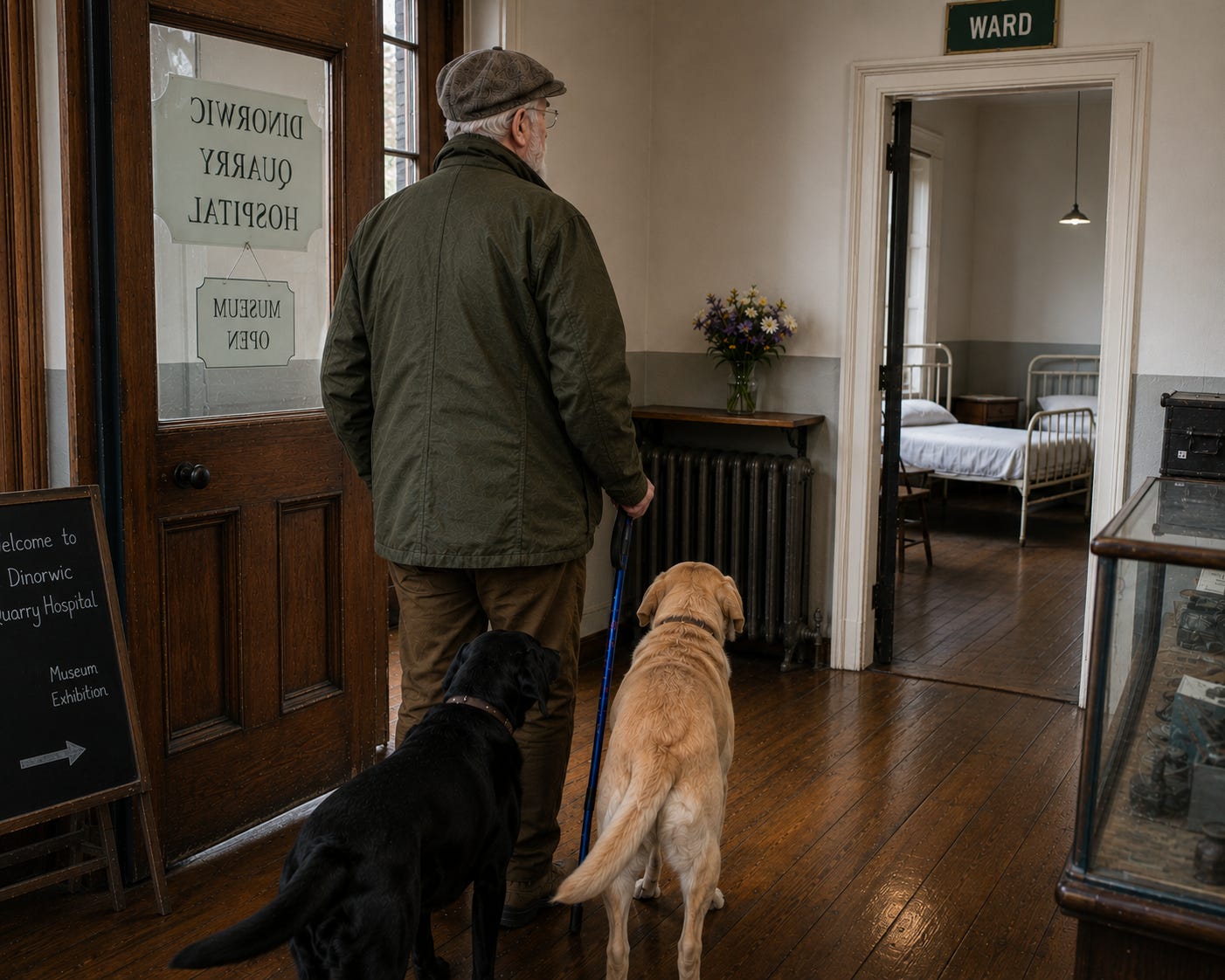
The rows of iron bedsteads stood exactly where they had always been. Neatly folded blankets lay across each bed. Glass cabinets held rows of curious instruments whose names Billy could never quite remember.
The air carried that unmistakable museum smell. Old wood. Polished brass. Clean linen. History.
Mr Rogers stood quietly for a moment. “I’ve been looking forward to coming back.”
Billy looked up. “Were you worried you might not?”
Mr Rogers nodded gently. “After an operation like mine, you begin by wondering whether you’ll ever walk comfortably again.”
Billy moved a little closer. “But every little walk helped… Bron-y-Garth. The Tranquility Garden. The doctor’s surgery. And now,” he looked around the ward with a smile, “here we are.”
Just then, a familiar voice greeted them. “Good morning!” A museum volunteer came across with a welcoming smile. “It’s lovely to see you back. And you’ve brought your two History Detectives again!”
Billy looked rather pleased that somebody remembered him. “So,” laughed the volunteer, “what mystery are we solving today?”
Mr Rogers reached carefully into his rucksack. “I wonder if you might recognise this.”
He unwrapped the little green bottle. The volunteer took it gently. Turning it over in the light, they examined every detail. “Hmm...”
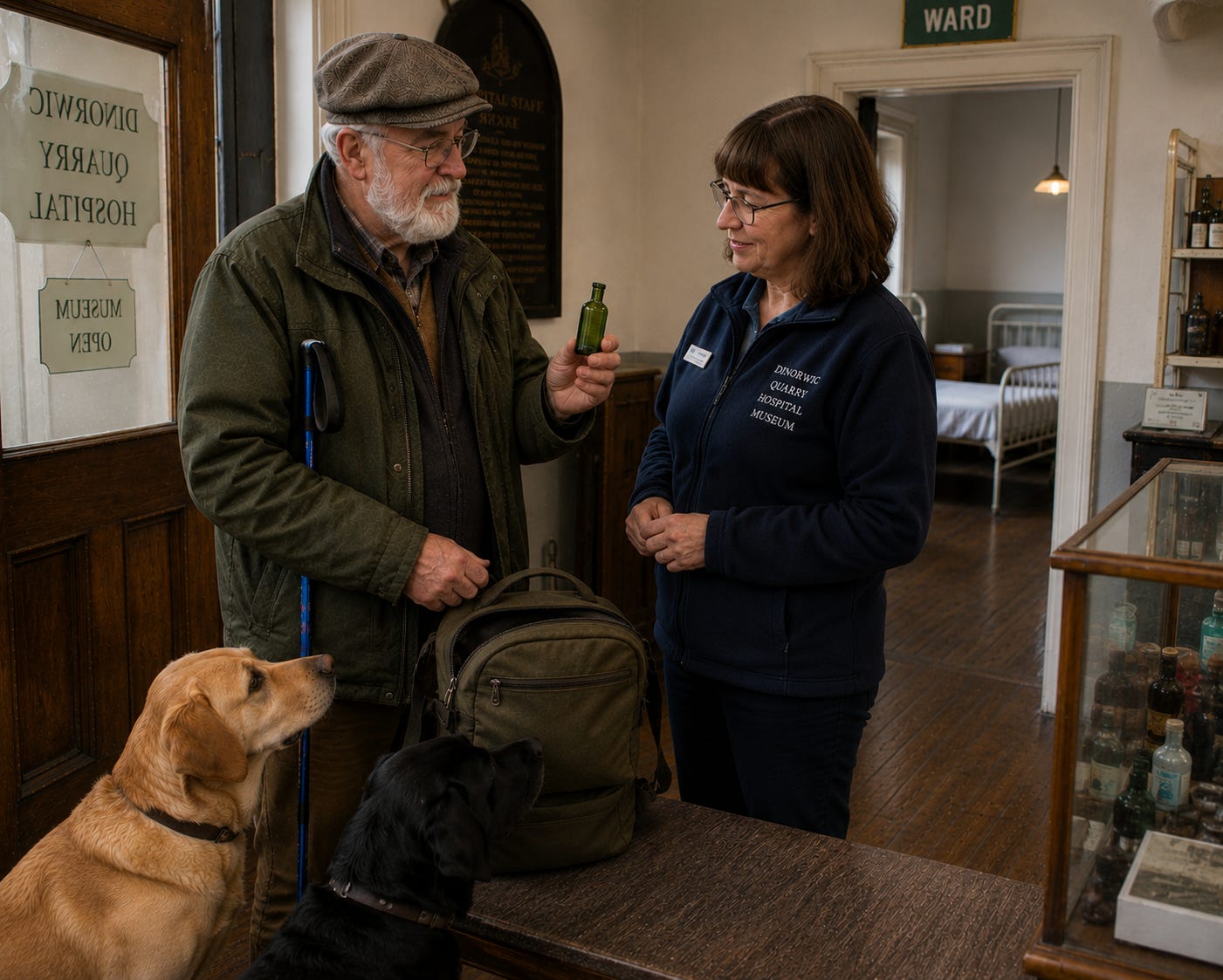
Billy waited patiently.
“It certainly looks nineteenth century.”
Billy’s ears lifted.
“The glass is hand-made. The bubbles are just what I’d expect. The mould seams are right.”
Mr Rogers smiled. “So we’re not imagining things?”
“Oh no.” The volunteer shook their head. “It’s very similar indeed to bottles used by chemists and hospitals during the Victorian period.”
Billy’s tail began to wag. “So it came from here?”
The volunteer smiled kindly. “Perhaps. But we must be careful.”
Billy listened closely.
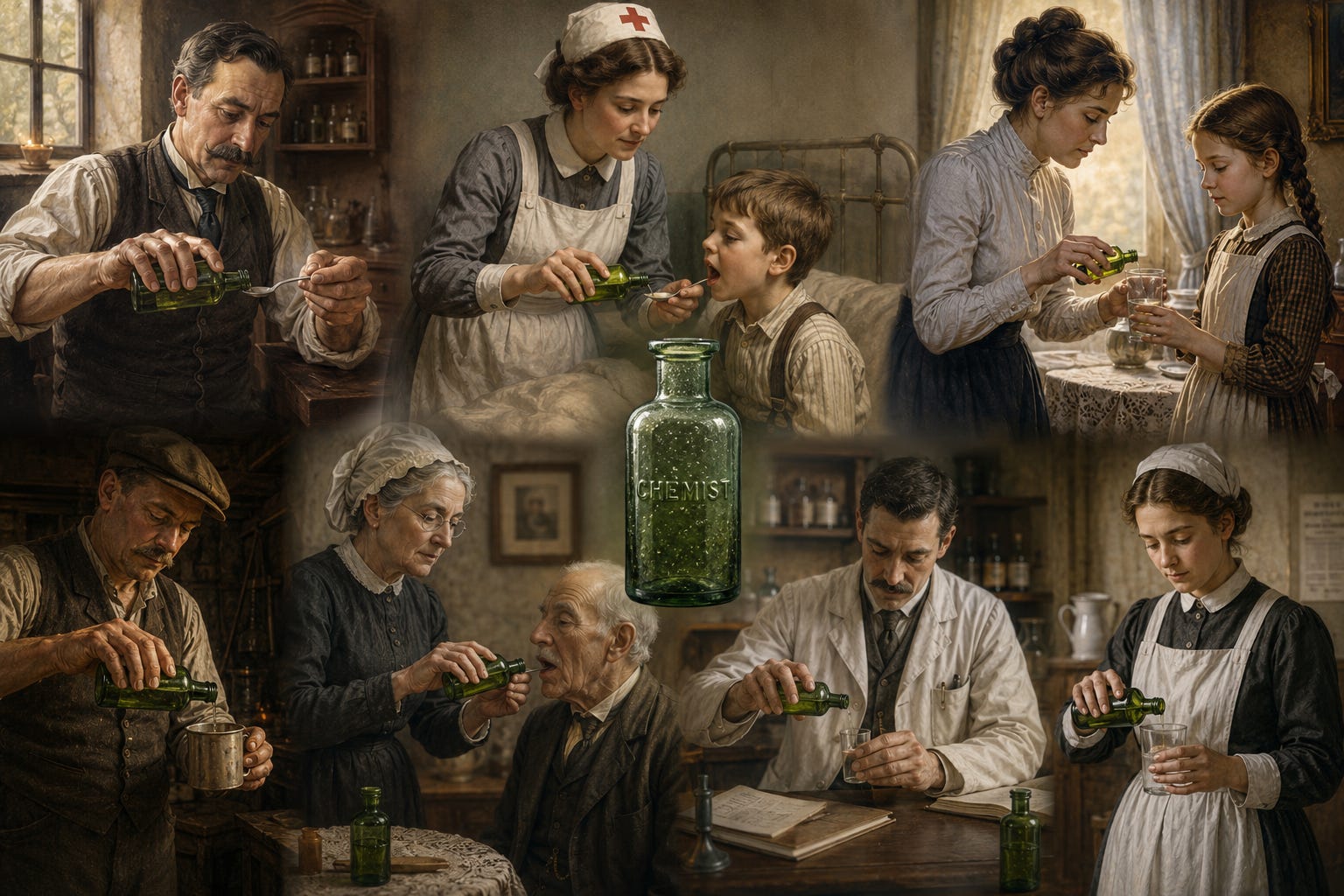
“Many hospitals used bottles like these. So did village chemists. So did families looking after people at home.”
Mr Rogers nodded. “History detectives should never jump to conclusions.”
“Exactly.” The volunteer carefully returned the bottle. “What we can say is that it belongs to the same period.”
Billy thought that was almost as exciting. The bottle suddenly seemed connected to hundreds of ordinary people. Perhaps a nurse had once carried something just like it. Perhaps a doctor had measured medicine from one. Perhaps a worried mother had walked home from the chemist carrying one carefully wrapped in paper.
The volunteer smiled. “Would you like to see something?”
Billy barked enthusiastically. The volunteer led them towards one of the display cabinets. Inside stood an entire row of old medicine bottles. Some were tiny. Some were tall. Some still had faded paper labels.
One by one, Billy compared them with the bottle from Mr Rogers’ garden. None were exactly the same. Yet none looked completely different either.
Mr Rogers smiled. “I think our little bottle has found some old friends.”
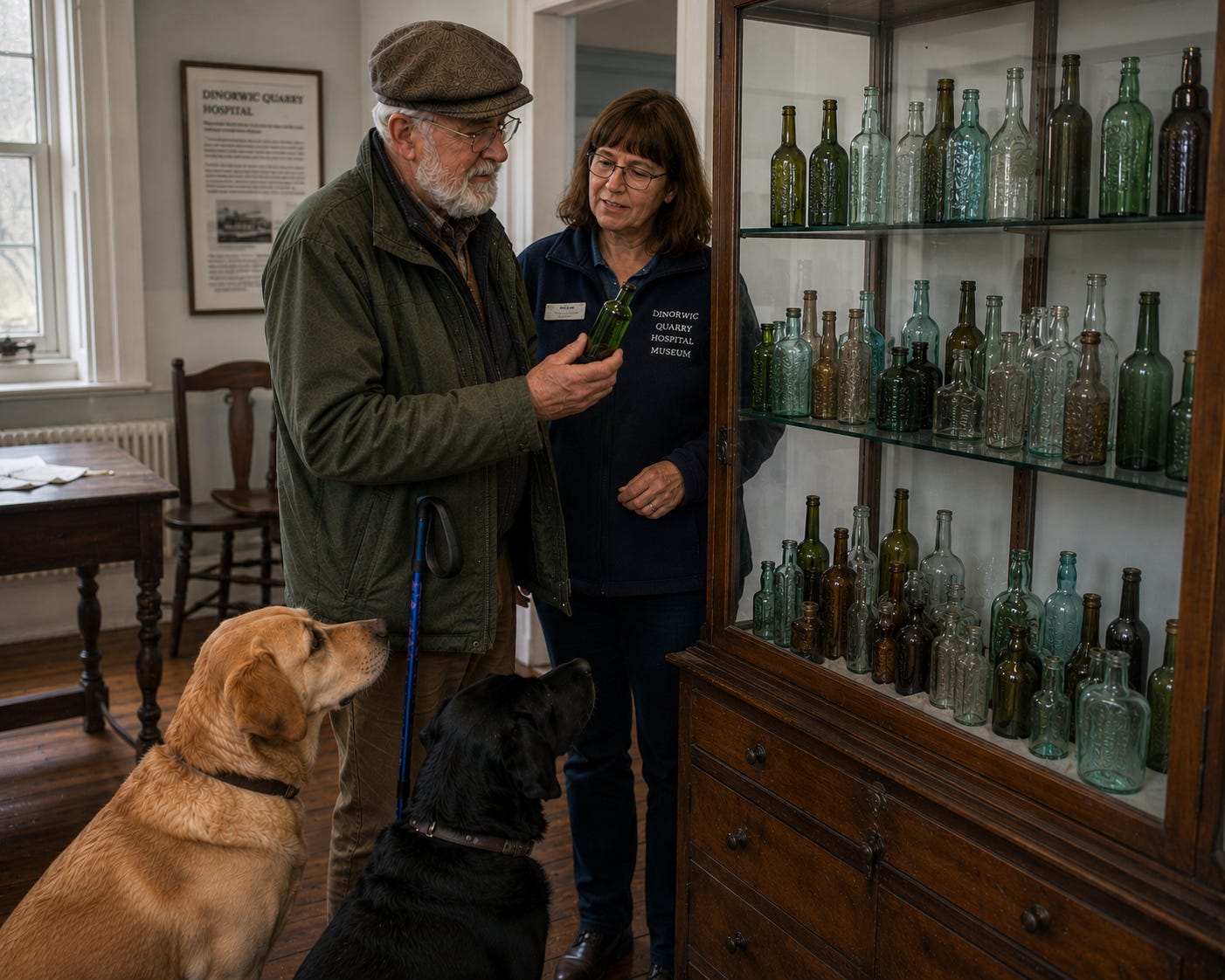
Billy sat quietly in front of the cabinet. For the first time, he realised something. The bottles weren’t really the interesting part. The interesting part was the people who had once held them. The patients. The nurses. The doctors. The families waiting anxiously for good news.
Every bottle had passed through someone’s hands. Every bottle had been part of someone’s story.
Mr Rogers rested a hand gently on Billy’s shoulder. “I think,” he said softly, “we’ve just discovered our next question.”
Billy looked up. “If these bottles could talk... what stories would they tell?”
Every Name Has a Story
Billy remained sitting quietly in front of the cabinet of medicine bottles. For once, he wasn’t thinking about glass. He was thinking about people.
Mr Rogers noticed. “I think,” he said with a smile, “you’re beginning to ask exactly the right questions.”
The museum volunteer nodded. “Come with me.” They walked slowly into another room where, beneath soft lighting, stood one of the museum’s most precious treasures. It wasn’t shiny. It wasn’t made of brass. There were no moving parts. It was simply a very large, leather-bound book.
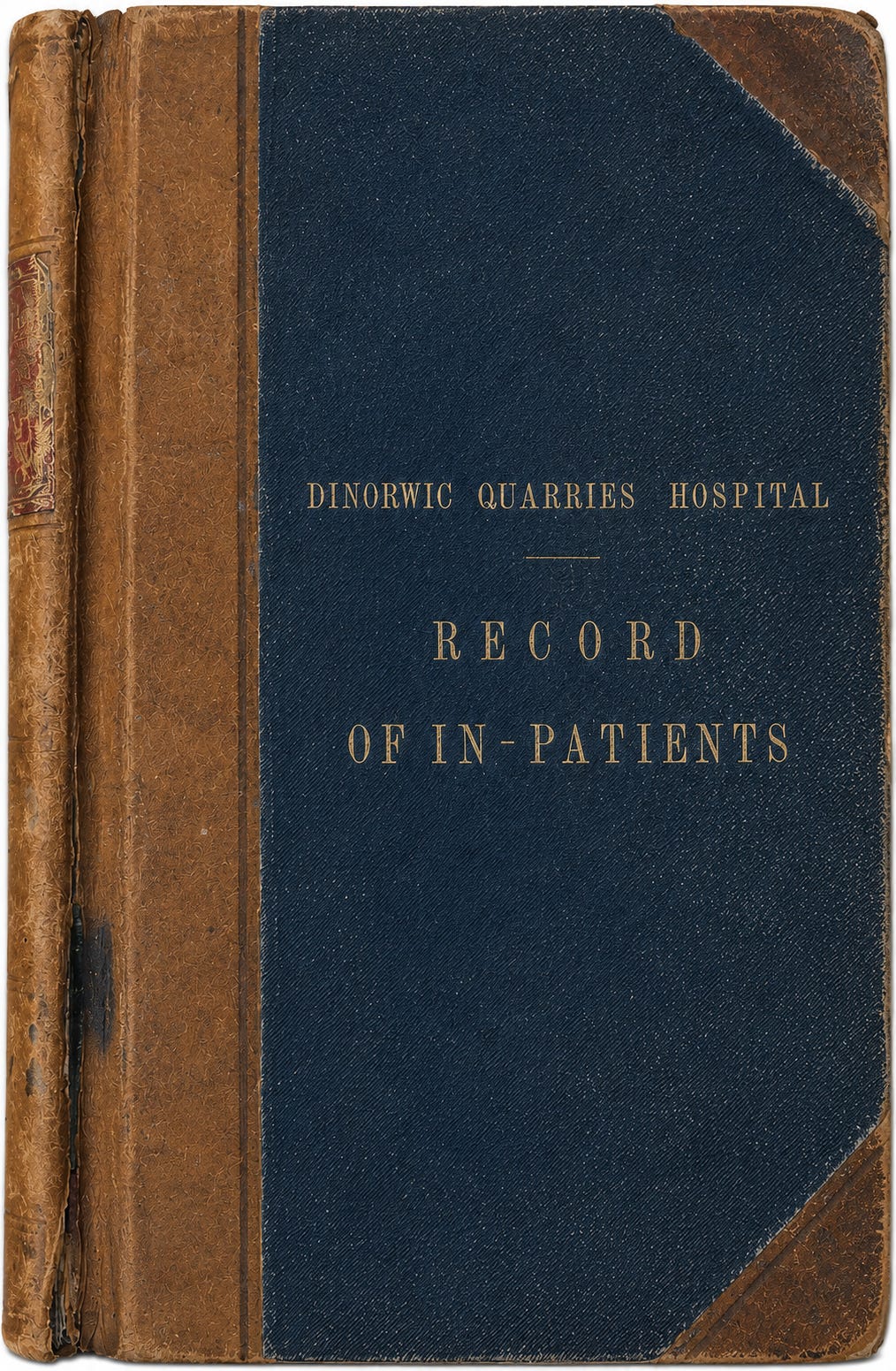
Billy looked puzzled. Mr Rogers smiled. “This,” he said quietly, “is one of the old hospital registers.”
Billy peered over the edge of the display. The pages were covered with neatly ruled lines. Some writing was printed. Most of it had been written carefully by hand using black ink.
There were columns with headings.
Name; Address; Admitted; Diagnosis; Discharged; Result; Remarks.
Billy recognised several of the words. Others were new to him. “It doesn’t look very exciting,” he thought.
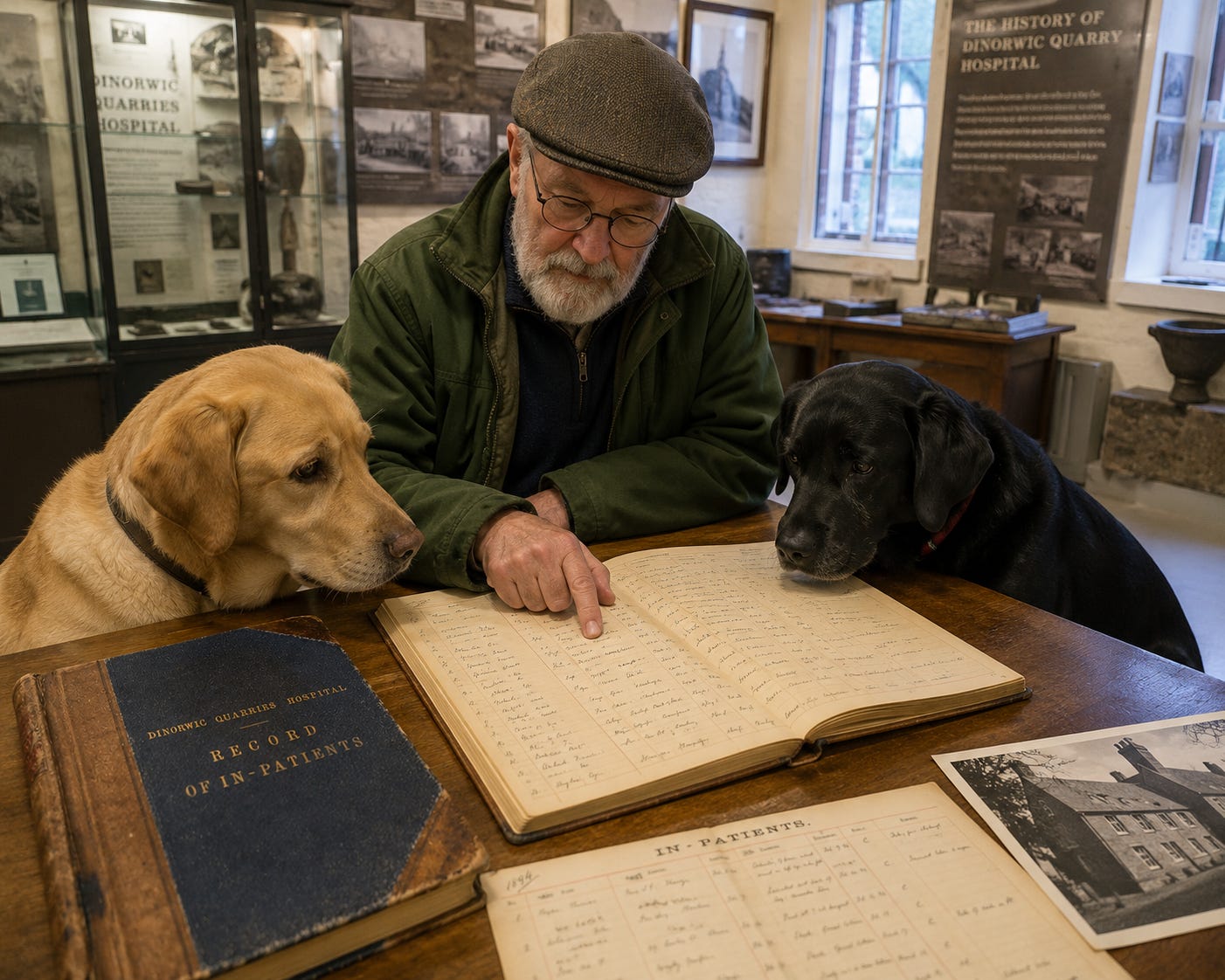
Mr Rogers seemed to know exactly what Billy was thinking. “It isn’t exciting because of what it looks like. It’s exciting because of what it tells us.”
The volunteer pointed to one line. “Look how little is written.”
Billy read slowly. A name. A village. A date. A few words describing an injury.
Only one short line. “Is that all?” wondered Billy.
Mr Rogers nodded. “Sometimes that really is all that survives.”
Billy looked surprised. “But... what happened?”
“That’s the question,” smiled Mr Rogers. “The register gives us clues. But it doesn’t tell the whole story.”
Billy imagined the patient arriving at the hospital. Perhaps his workmates had carried him there on a stretcher. Perhaps he had come in a horse and cart. Perhaps he had walked painfully through the hospital doors. The register didn’t say. It simply recorded that he had arrived.
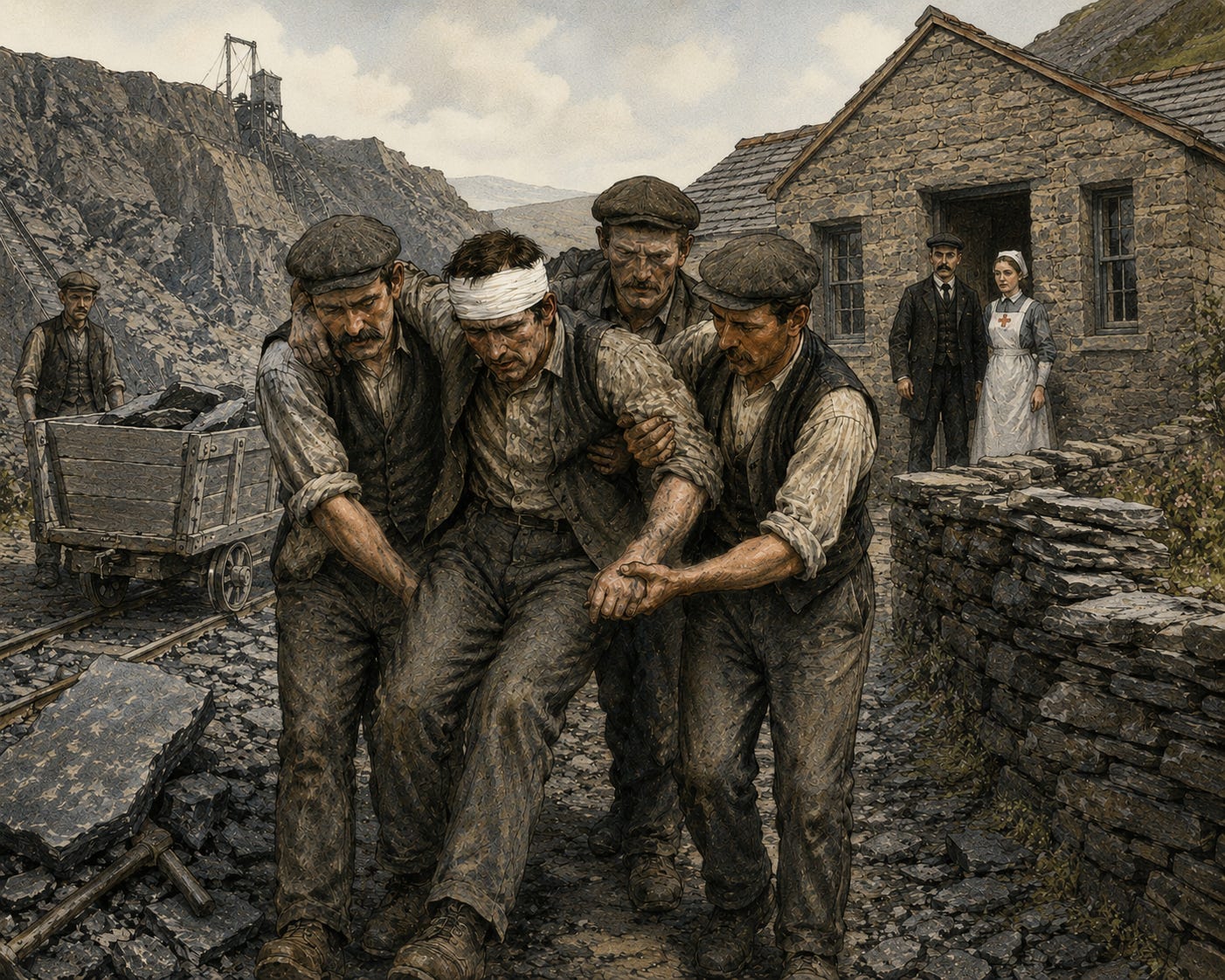
Mr Rogers pointed to another entry. “This patient came from Llanberis.”
Another. “This one lived in Deiniolen.”
Another. “And this one travelled much further.”
Billy noticed that people came from all over the slate country. Some from as far away as Anglesey. “They all have something in common,” said the volunteer.
Billy looked again. “They were all somebody’s son. Or daughter. Somebody’s husband. Somebody’s wife. Somebody’s friend.”
The room became very quiet. Mr Rogers gently turned to Billy. “When we first visited here, we looked at the stretchers.” Billy nodded. “The splints.” Billy remembered. “The medicine bottles.”
Billy glanced at the little green bottle safely tucked away in Mr Rogers’ rucksack. “But now,” said Mr Rogers softly, “I think we’re ready to look beyond the objects.”
Billy looked back at the register. Every line had once been a real person. Every line had once begun with somebody waking up expecting an ordinary day. Just like any other morning. Until something unexpected happened.
The volunteer smiled. “That’s why we take such care of these old books. They help us to remember people who might otherwise be forgotten.”
Billy thought about the old medicine bottle. Someone had held it. Someone had written these pages. Someone had lain in those hospital beds. History wasn’t made only by famous people. It belonged to everyone.
Just then, Mr Rogers noticed something displayed beside the register. A large photograph.
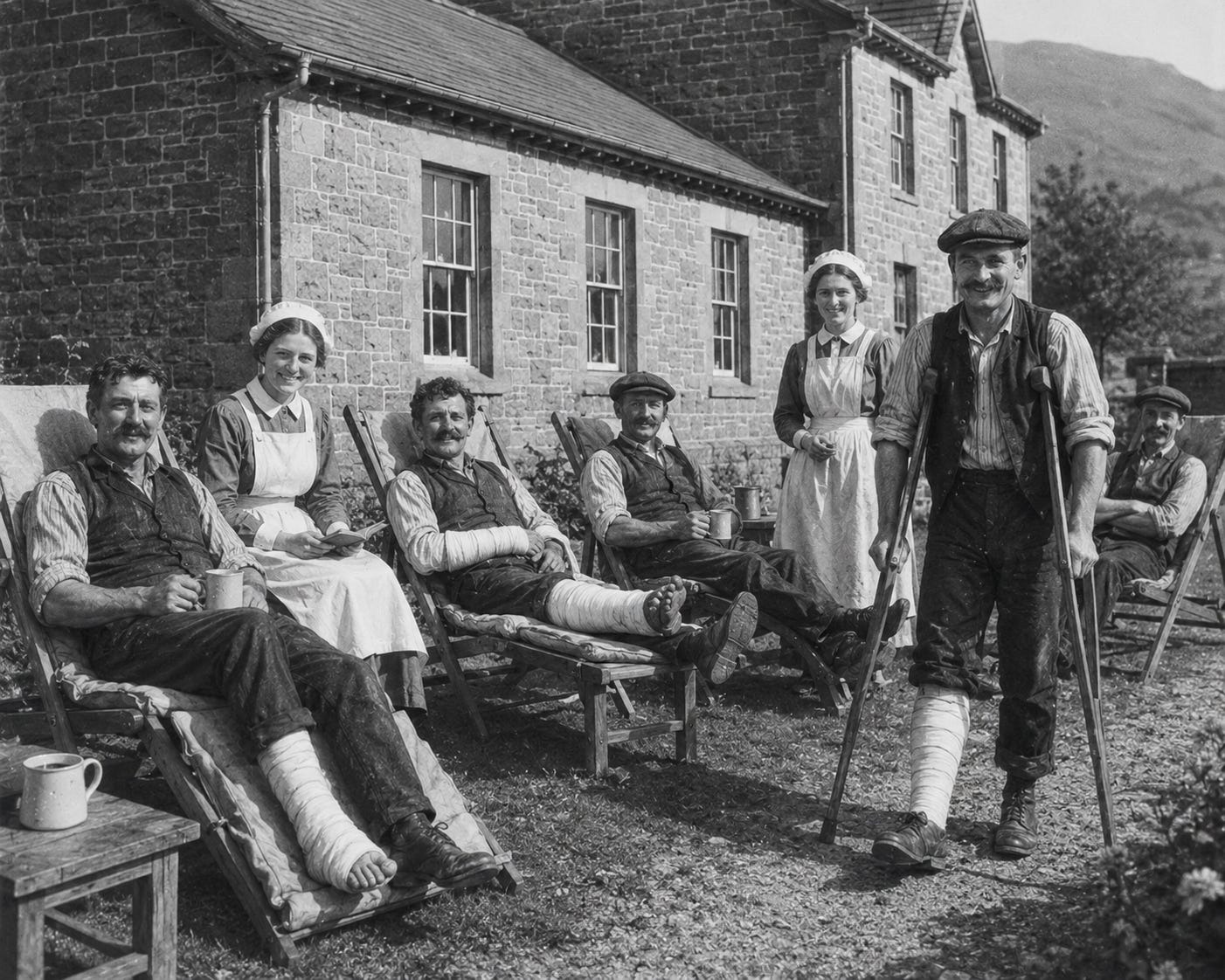
It showed a group of quarrymen standing proudly outside the hospital many years before. Doctors. Nurses. Patients. Everyone looking directly towards the camera.
Billy stared carefully. “That’s funny...”
Mr Rogers smiled. “What have you noticed?”
Billy tilted his head. “They’re smiling.”
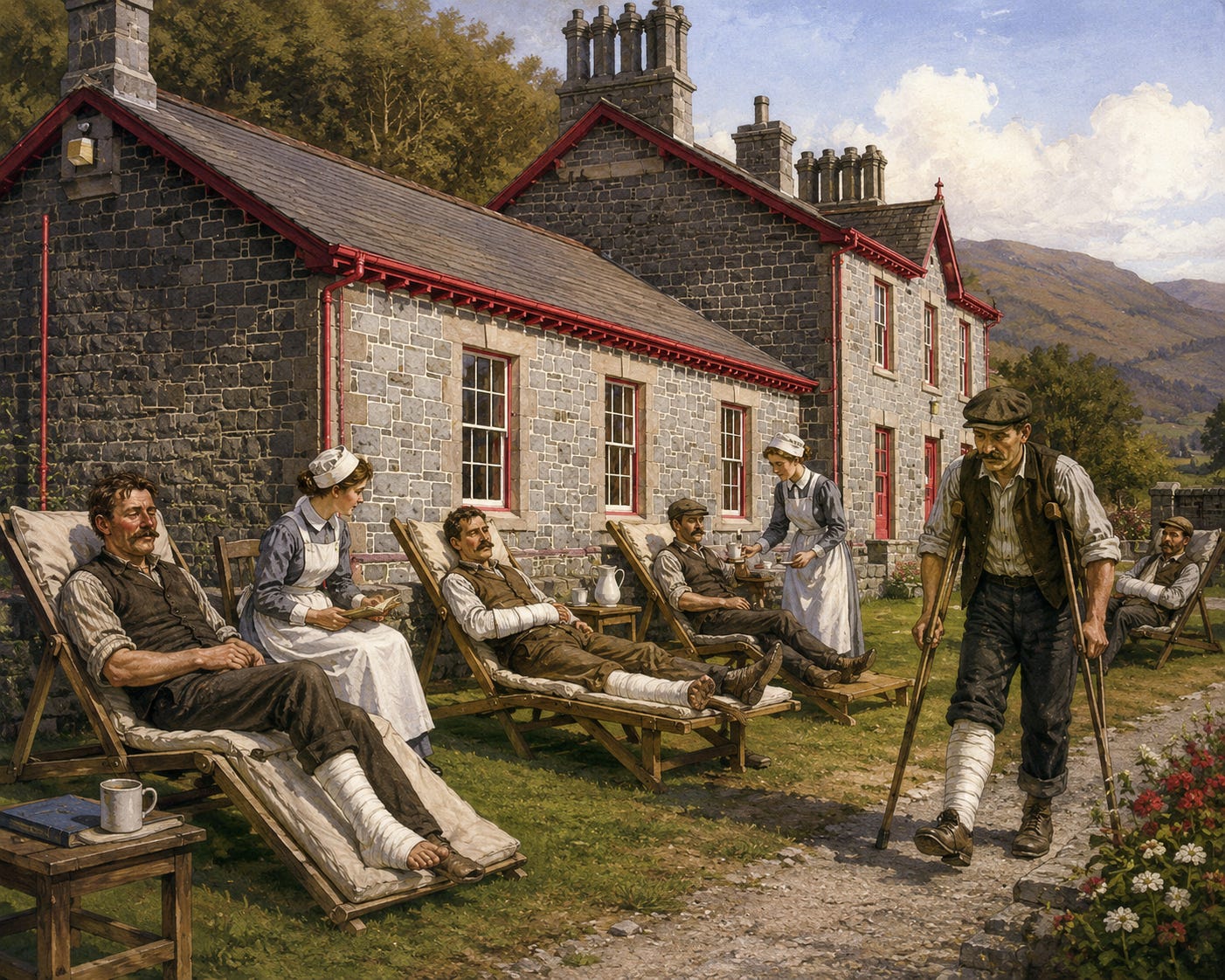
The volunteer nodded. “Many people imagine Victorian hospitals were always gloomy places. Of course there was sadness, and pain. But there was hope too. People recovered. They returned to work. They went home to their families.”
Mr Rogers smiled. “Rather like somebody else I know.”
Billy looked at his friend. Only then did he notice something. Without thinking about it... Mr Rogers had been standing comfortably for several minutes. His walking stick rested quietly against the display case. He hadn’t needed it.
Billy’s tail wagged gently. Mr Rogers followed Billy’s gaze. He looked at the walking stick. Then at his new knee. Then back at the old patient register.
“You know...” he said thoughtfully, “I don’t think recovering has made me feel closer to the operation…” Billy listened. “it’s made me feel closer to the people.”
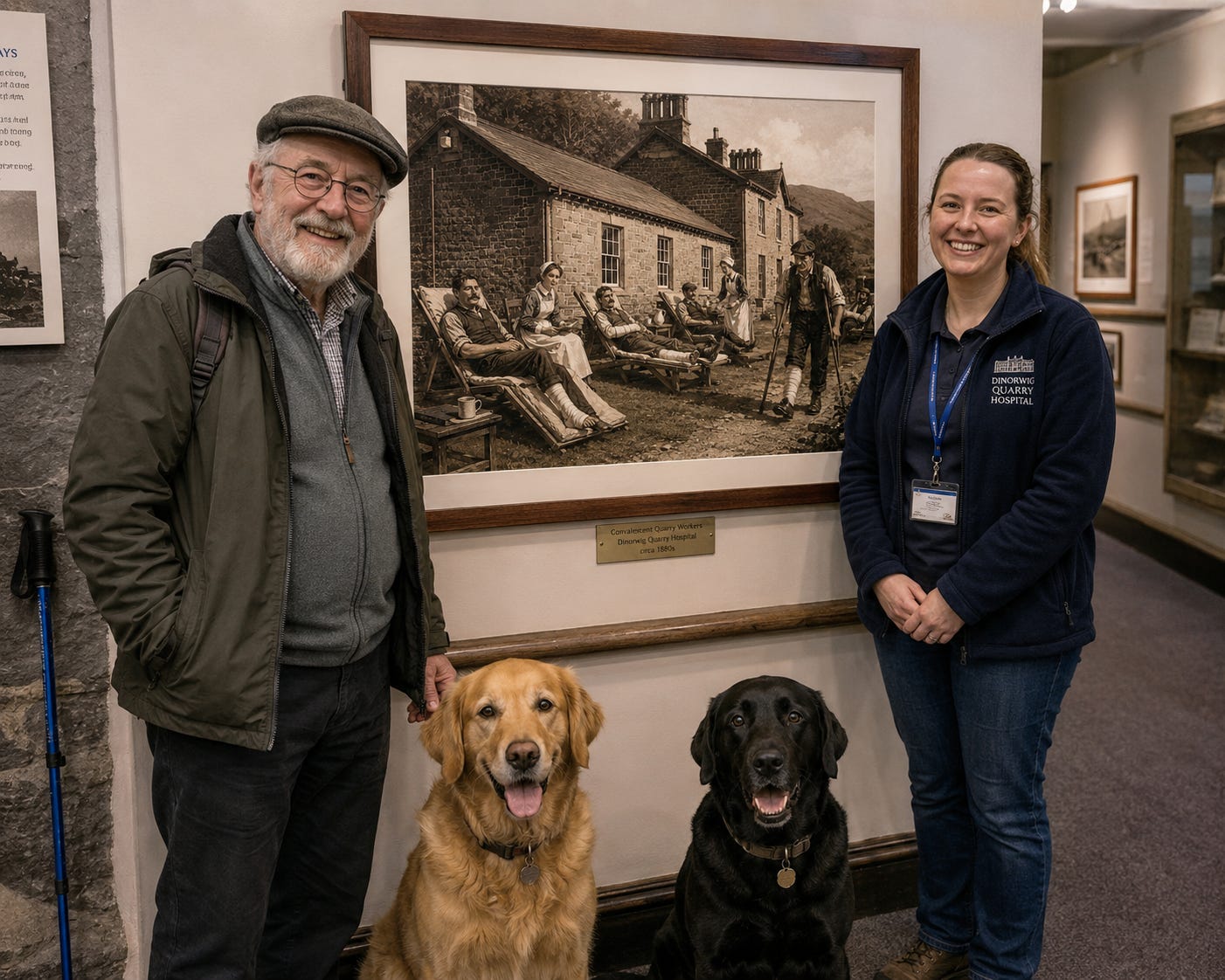
The volunteer nodded quietly. “I think every visitor who has ever spent time with these records understands exactly what you mean.”
As they turned to leave the gallery, Billy glanced back one last time at the great leather-bound register. It lay silently beneath its glass cover. Its pages never spoke.
Yet somehow... they had just told hundreds of stories.
Marks in the Slate
As Billy, Spud and Mr Rogers stepped outside into the warm afternoon sunshine, they paused for a moment on the hospital terrace. From here they could see the mountains stretching away into the distance.
The quarry lay quietly beneath the summer sky. The great tips of slate no longer echoed with the sounds of blasting or hammering. Instead, visitors wandered peacefully around the museum.
Mr Rogers rested one hand on the stone wall surrounding the terrace. He smiled. “This is one of my favourite parts of the hospital.”
Billy looked around. There were no display cases. No labels. No photographs. Just a simple wall built from great slabs of grey slate. “What are we looking for?” he wondered.
Mr Rogers didn’t answer immediately. Instead, he slowly ran his fingertips across the smooth slate coping stones.
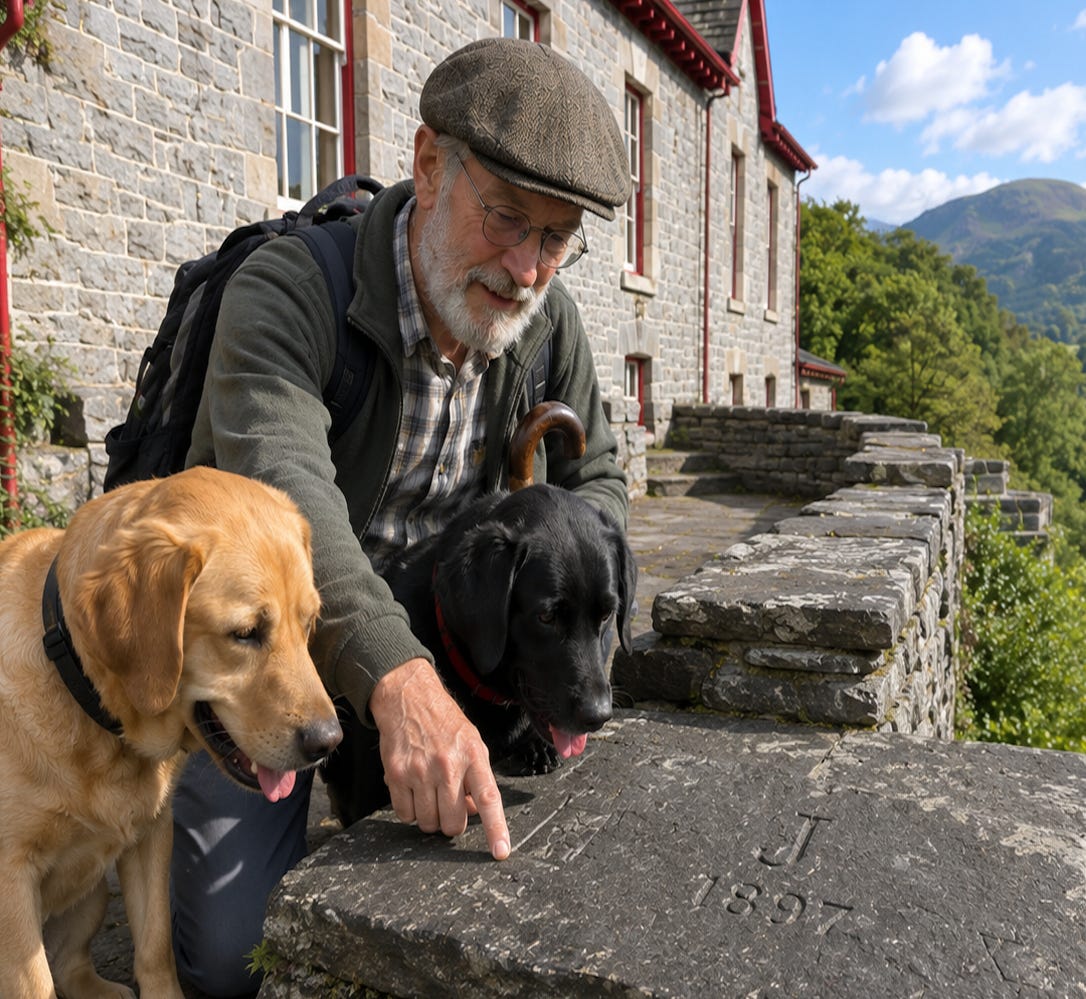
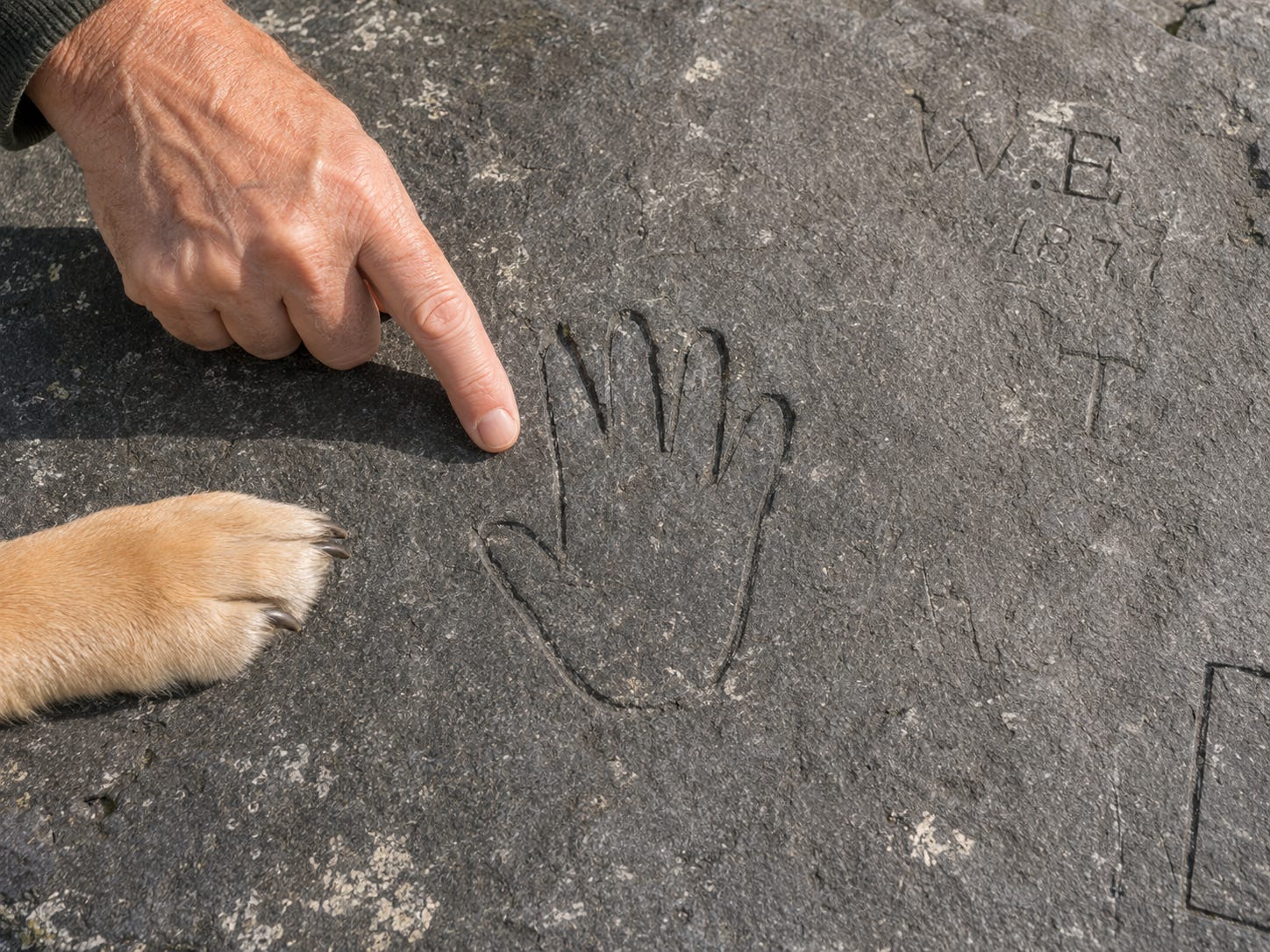
Billy watched carefully. Then he noticed it. A single letter. Scratched into the slate. The letter J.
Nearby was another. Two initials. Further along the wall... another. Then another.
Billy began walking slowly beside the wall. The more carefully he looked... the more he found. Some initials were deeply carved. Others had almost disappeared after many years of wind and rain.
Spud discovered one that had become covered with soft green moss. Mr Rogers gently brushed the moss aside. “There you are.” The little letters appeared once again.
Billy looked puzzled. “Who wrote these?”
Mr Rogers smiled. “We’re not completely sure.”
Billy had heard those words before. History often didn’t give complete answers. “They may have been carved by patients. Perhaps while they were recovering. Some may have been visitors. Some might even have been members of staff.”
Billy imagined someone sitting quietly on the very wall where he now stood. Perhaps they had been waiting to go home. Perhaps they had simply wanted to leave a tiny reminder that they had once been here.
Then Spud stopped. She gave a little bark. Mr Rogers walked over. “There it is…!”
Billy hurried across. This wasn’t a letter. It was something much larger.
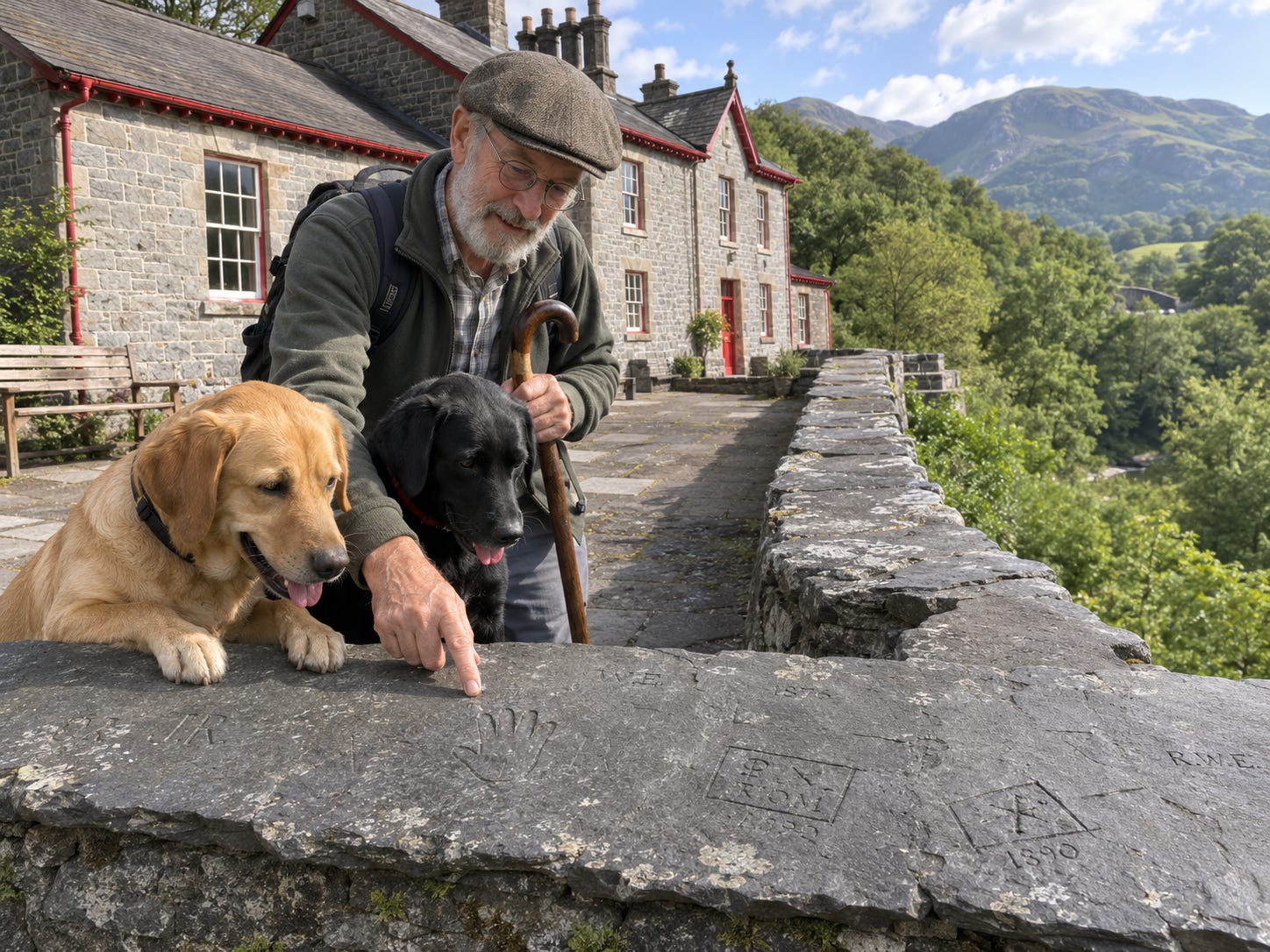
Carefully scratched into the slate was the outline of a hand. Not a drawing. A real hand had once been placed on the stone while someone slowly traced around their fingers.
Billy stared silently. It seemed strangely personal.
Mr Rogers rested his own hand gently beside it. The carved hand was smaller. Perhaps it had belonged to a young quarryman. Or perhaps someone with slender fingers. Nobody knew.
Billy quietly placed one paw inside the outline. It almost fitted. Mr Rogers laughed softly. “I don’t think it was a Labrador.”
Billy wagged his tail.
Then Mr Rogers became thoughtful again. “I’ve often wondered about these.”
Billy looked up.
“Suppose...” he said quietly, “...someone had injured their hand.”
Billy remembered the patient register. Crushed fingers. Lacerations. Fractured hands. Amputations. Suppose... after weeks of treatment... they were finally able to use that hand again. Might they have traced around it before going home?
Mr Rogers paused. “We simply don’t know. It’s only one possibility.”
Billy liked the way Mr Rogers always said that. History Detectives never pretended to know more than the evidence could tell them. The museum volunteer joined them.
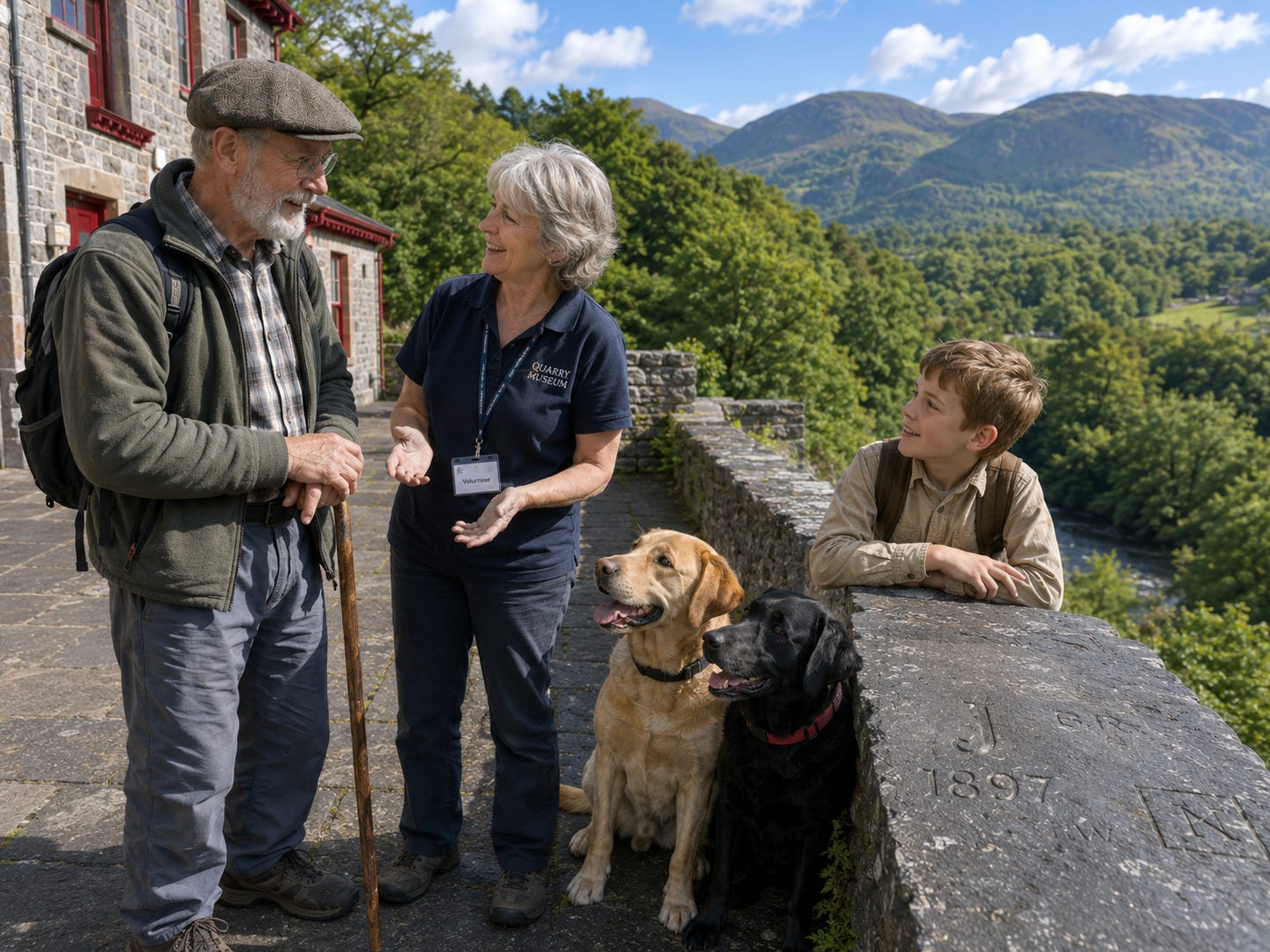
“I’ve heard many ideas over the years.”
Billy listened carefully.
“Some visitors think they were carved by recovering patients. Others believe they were made by hospital staff. Some think they may simply have been people passing the time while sitting here.” The volunteer smiled. “And perhaps all of those ideas are partly true.”
Billy looked again at the hand. Whoever had made it... they had wanted to leave something behind. Something simple. Something lasting.
Mr Rogers gently rested his hand on his own knee. A narrow scar ran down the front of it, almost hidden beneath his trousers. Billy had noticed it when the bandages were first removed. He looked from the scar... to the carved hand... to the initials in the slate.
Mr Rogers smiled. “Scars tell stories too.”
Billy looked thoughtfully at his friend. “This scar reminds me that something was repaired.” He looked back at the old hand outline. “And perhaps this reminds us that someone recovered.”
The volunteer nodded. “Or perhaps that someone hoped they would.”
For a little while nobody spoke. The afternoon sun warmed the slate. A gentle breeze stirred the leaves of the nearby trees. The old hospital stood quietly behind them.
Billy realised something. The initials... the hand... the patient register... the medicine bottle... none of them told a complete story on their own. But together... they painted a picture of hundreds of ordinary people whose lives had crossed this place.
As they prepared to leave, Billy glanced back one last time. The hand remained exactly where it had been for more than a hundred years. Waiting patiently. Ready for the next curious visitor to place their own hand beside it... and wonder.
One Line in the Ledger
Before leaving the museum, the volunteer smiled. “Would you like to try something?”
Billy’s ears immediately stood upright. History Detectives always liked trying something. The volunteer led them back towards the old patient register. This time, instead of looking at the whole page, they pointed to just one single entry. “Imagine,” they said quietly, “that this is all we know.”
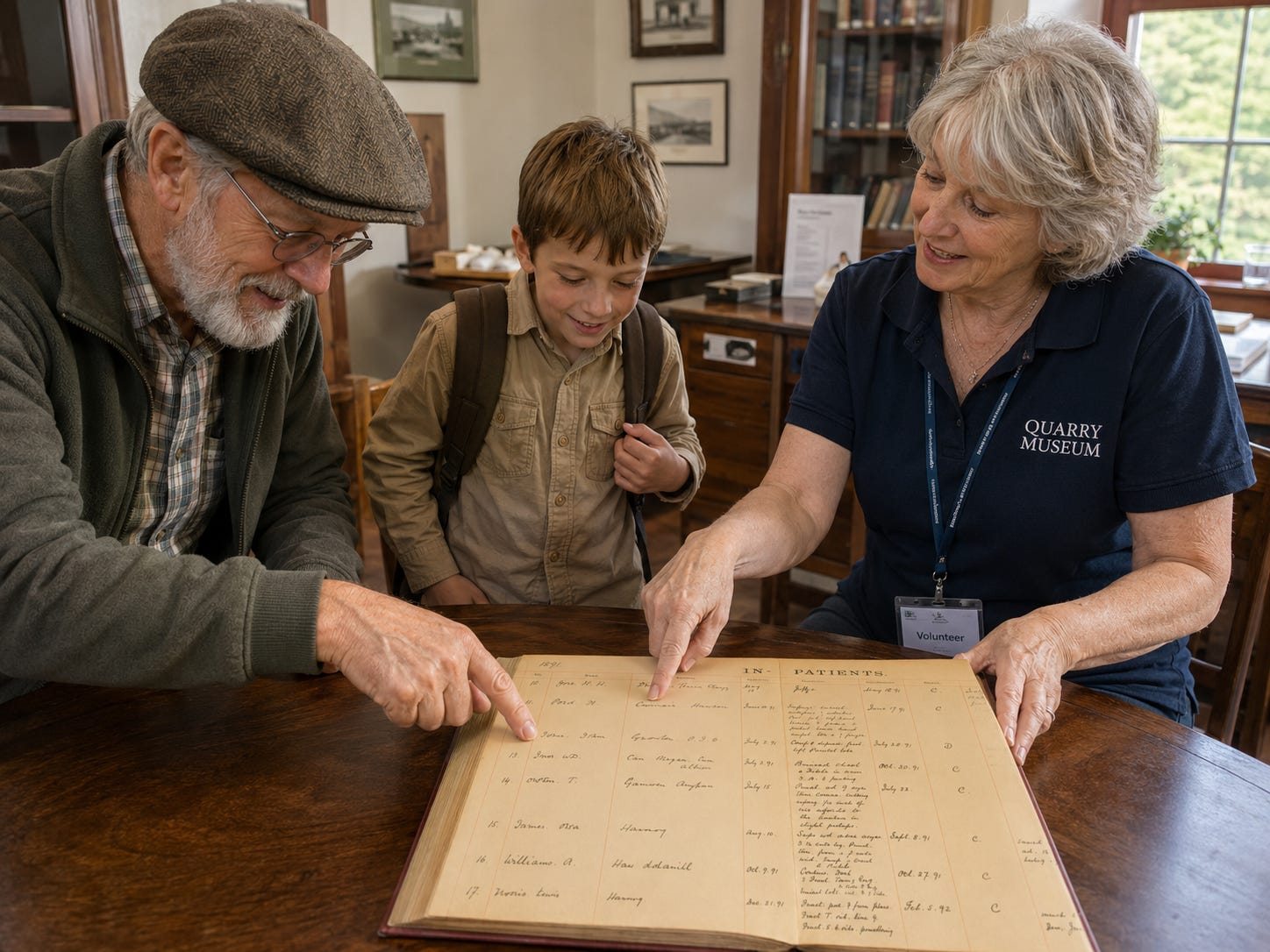
Billy looked carefully. One line. One name. One address. One date. A short description of an injury. A date of discharge. Nothing more.
“It doesn’t tell us very much,” thought Billy. Mr Rogers smiled. “At first glance, perhaps.”
The volunteer covered the rest of the page with a sheet of card so that only that one single line remained visible. “Now,” they asked, “what questions would a History Detective ask?” Billy thought hard. “What sort of work did this person do?”
“Good question.”
“Were they young or old?”
“Excellent.”
“How did they travel here?”
“Another good question.”
“Did they recover?”
Mr Rogers nodded. “The register gives us one clue.” Billy looked again. The final column simply said:
Recovered.
Billy smiled. “So they went home.”
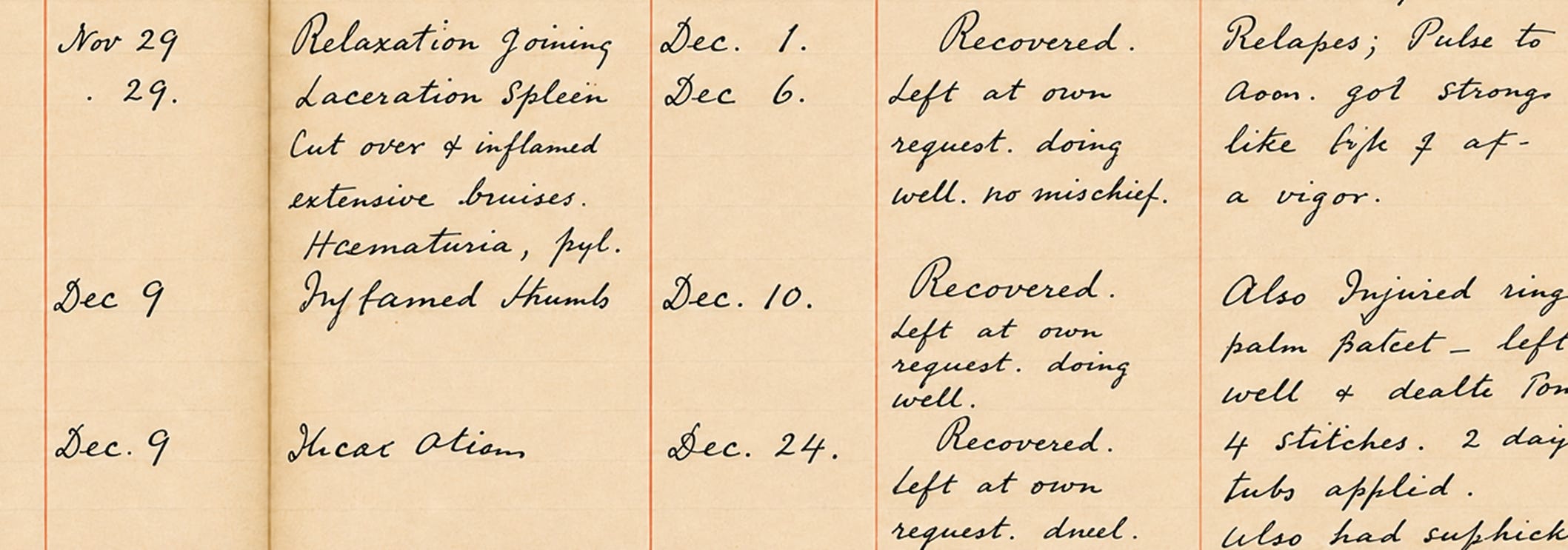
“They did,” the volunteer nodded, “and somewhere, perhaps, their family breathed a sigh of relief.”
Billy imagined a cottage with smoke rising from its chimney. Someone looking anxiously down the lane. Children running to greet their father. Or perhaps a wife opening the door with a smile. None of that was written in the register. But it might have happened.
Mr Rogers crouched beside Billy. “This is where History Detectives have to be careful.”
Billy listened closely. “We can imagine possibilities. But we mustn’t pretend they are facts.” Billy remembered the hand carved into the slate. Perhaps it had been made by a patient. Perhaps not.
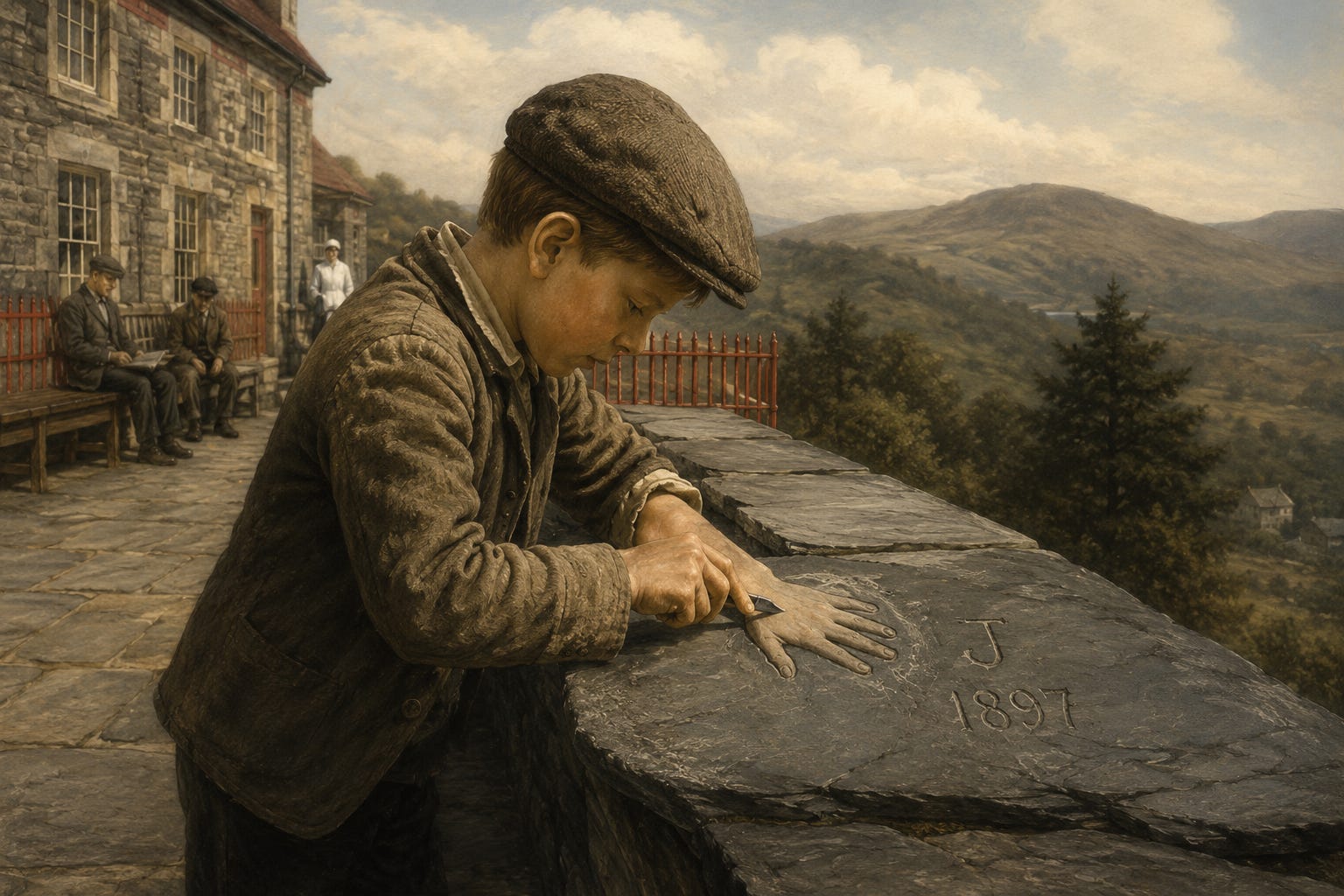
The medicine bottle. Perhaps it had belonged to a hospital. Perhaps not.
The initials. Perhaps they celebrated recovery. Perhaps they simply marked an idle afternoon.
Every clue deserved respect. The volunteer smiled. “Historians use three very important words.”
Billy looked up.
Maybe.
Perhaps.
Possibly.
“They’re wonderful words,” said Mr Rogers. “They remind us to keep an open mind.”
Billy liked that. He didn’t need every mystery to be solved. Sometimes asking good questions was just as exciting.
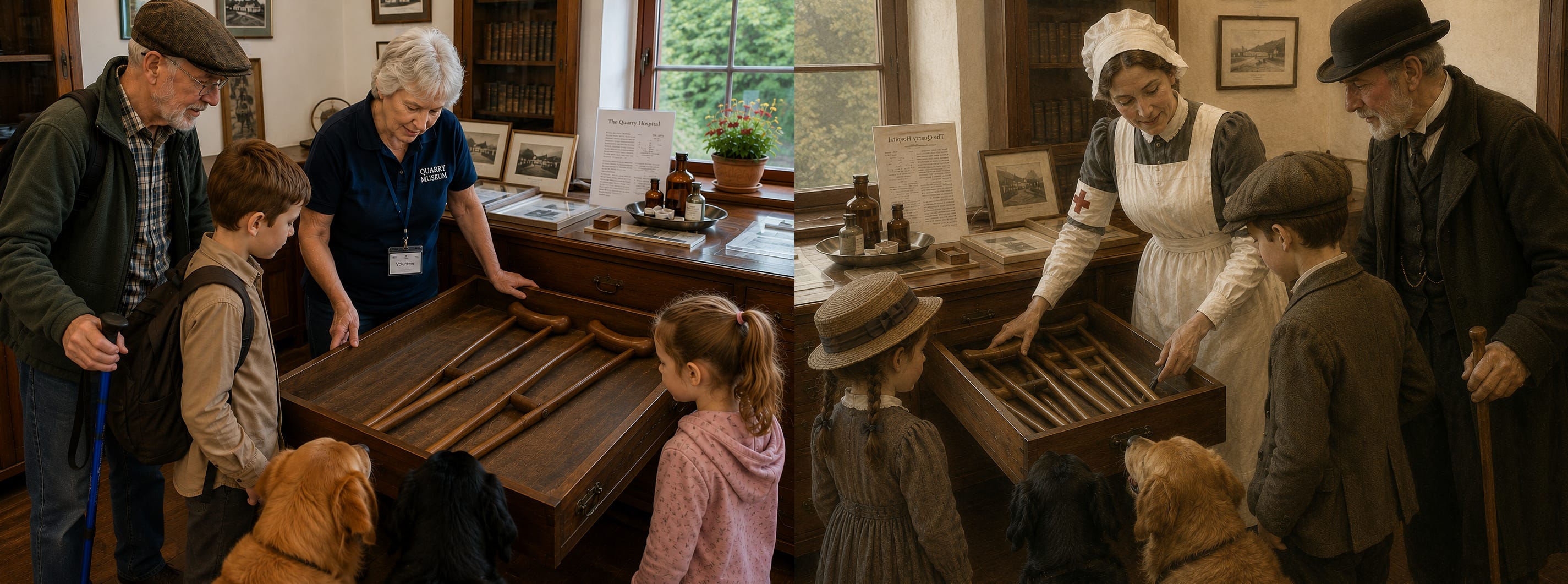
The volunteer reached into a drawer beneath the display. “I’ve something I’d like you to see.” Carefully, they lifted out a pair of old wooden crutches. Billy recognised them from an earlier visit. Their smooth handles shone from years of use.
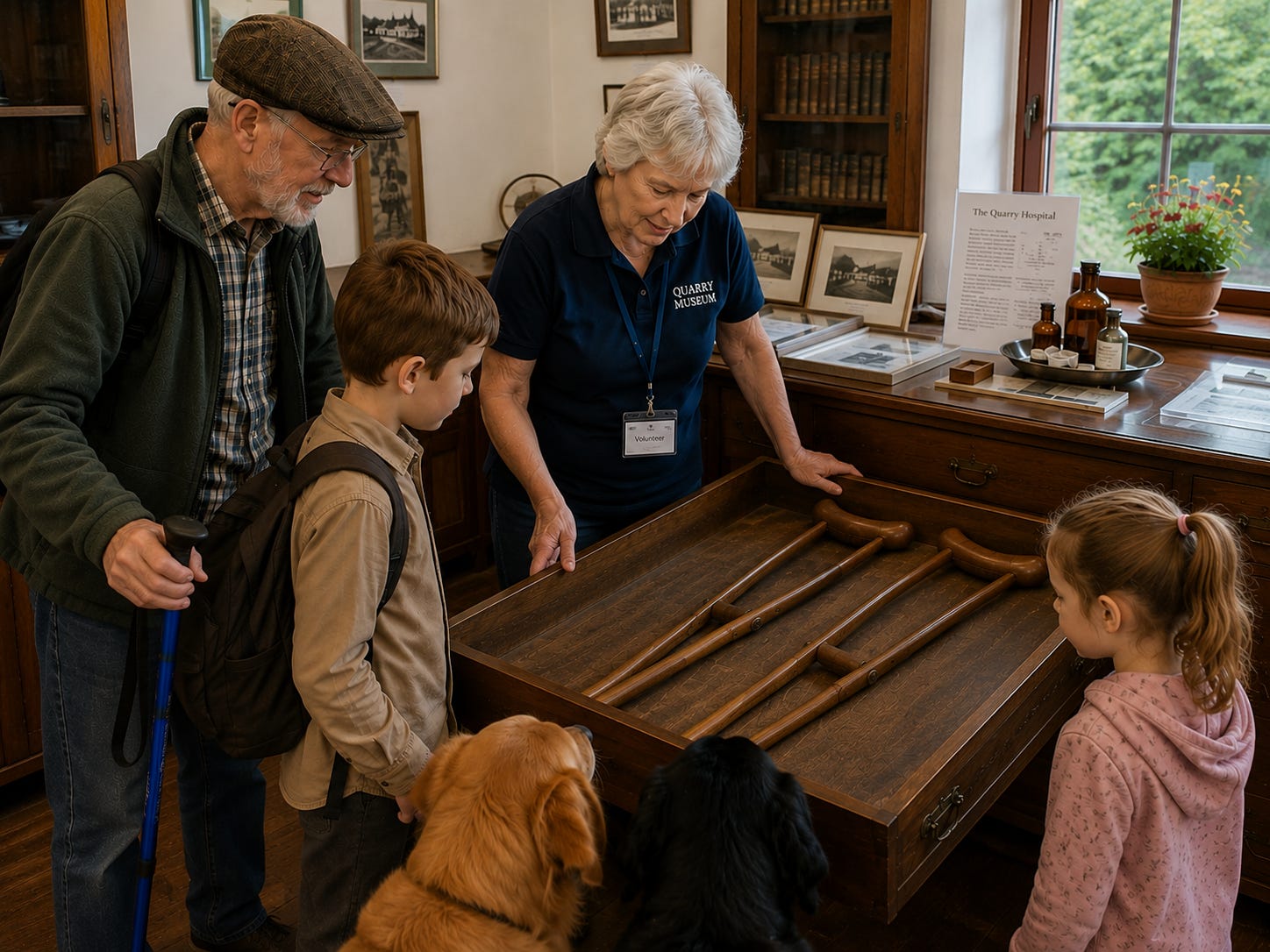
Mr Rogers gently took hold of them. “They’re heavier than I remember.”
The volunteer smiled. “Imagine using those for several months.”
Mr Rogers looked thoughtfully at his own lightweight aluminium walking stick leaning against the display. “What a difference.”
He gently balanced one of the old crutches beside his modern stick. Billy immediately noticed the contrast. The Victorian crutch was beautifully made. Ash wood, polished by generations of hands. Strong. Solid. But so heavy.
Mr Rogers lifted his own stick. Light. Comfortable. Easy to hold.
“Neither is wrong,” he said quietly. “They simply belong to different times.”
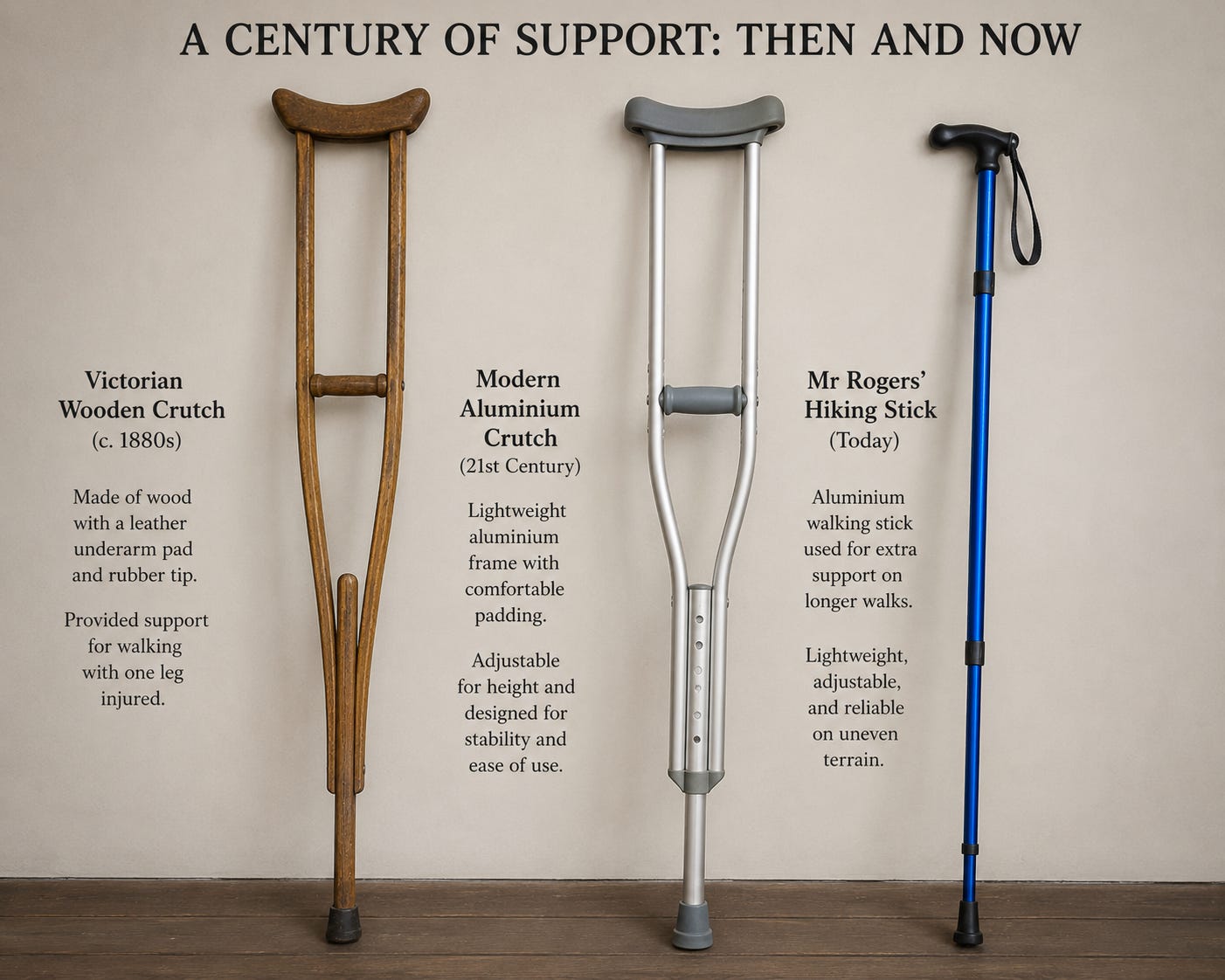
Billy looked from one to the other. Then at Mr Rogers’ new knee. He realised something. One hundred and forty years ago, someone might have relied on these wooden crutches. Today, Mr Rogers hardly needed his stick at all. Medicine had moved on. Engineering had moved on. Understanding had moved on.
Yet one thing had not changed. People still encouraged one another. They still cared. They still hoped.
The volunteer carefully returned the old crutches to their place. “I think,” they smiled, “our visitors sometimes leave here believing the museum is about old medical equipment.”
Mr Rogers shook his head gently. “No.”
Billy wagged his tail. “It isn’t about the equipment. It’s about the people who used it.”
As they walked towards the museum entrance, Billy glanced once more at the great leather-bound register. Hundreds of names. Hundreds of stories. Most of them almost forgotten. Almost.
Billy smiled to himself. Perhaps not quite forgotten after all.
Looking with New Eyes
The journey home seemed shorter than usual. Billy sat quietly beside Spud, watching the familiar landscape glide past the car windows. Grey slate walls. Green fields. White cottages. Woodlands climbing the hillsides. Everything looked exactly as it always had.
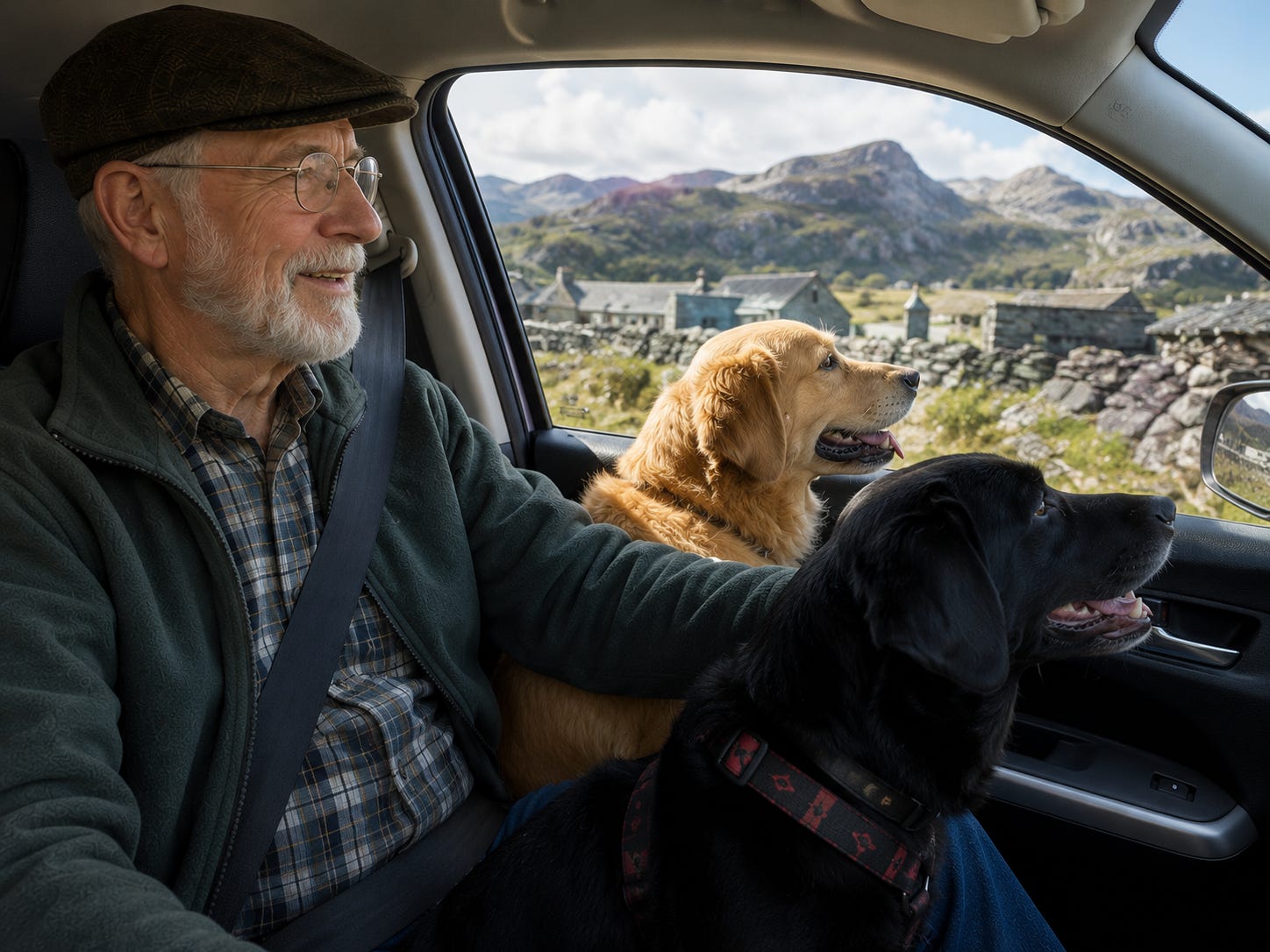
Yet somehow... everything looked different.
Mr Rogers seemed to be thinking the same thing. “You know,” he said quietly, “History Detectives don’t really change the places they visit.”
Billy looked up.
“The places stay exactly the same.”
“So what changes?” wondered Billy.
“We do.”
Billy thought about that. When they had driven this road only a few weeks earlier, he had seen mountains. Now he saw quarries. He saw old tramways disappearing into the trees. He saw villages built by generations of quarry workers. He even found himself wondering where patients might once have travelled on their slow journey to the Quarry Hospital.
History had become part of the landscape.
As they approached their home village, Billy recognised another familiar view. Beyond the trees lay the peaceful woodland of the old Gwaith Powdwr. The afternoon sunshine flickered through the leaves. Nothing moved except a pair of butterflies dancing above the wildflowers
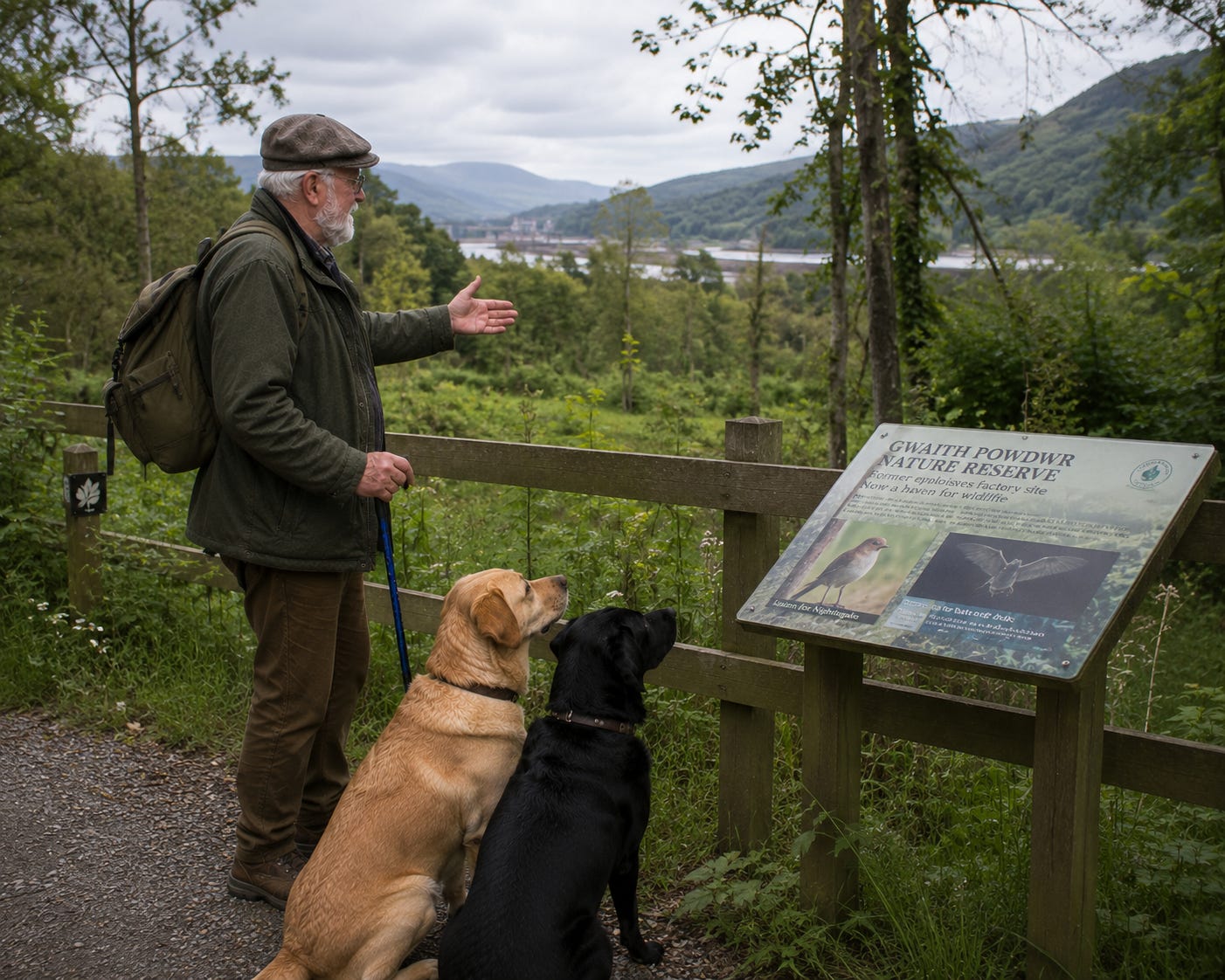
.“It seems impossible, doesn’t it?…” said Mr Rogers.
Billy tilted his head.
“…that such a peaceful place once echoed with the sounds of industry.”
Spud gazed across the woodland. She couldn’t imagine explosions. Only birds.
Mr Rogers smiled. “Landscapes have memories.”
Billy looked puzzled. “They remember people. They remember work. They remember change.”
Billy thought about the old medicine bottle. The patient register. The carved hand in the slate. Perhaps landscapes remembered in much the same way. Not by writing things down... but by quietly keeping the places where they happened.
A few minutes later they arrived home. As always, Billy bounded eagerly through the front door. Then he stopped. Back on the mantelpiece, where Mr Rogers had just placed it, stood the little green bottle. It looked exactly as it had before. But Billy no longer saw just a bottle. He saw a question.
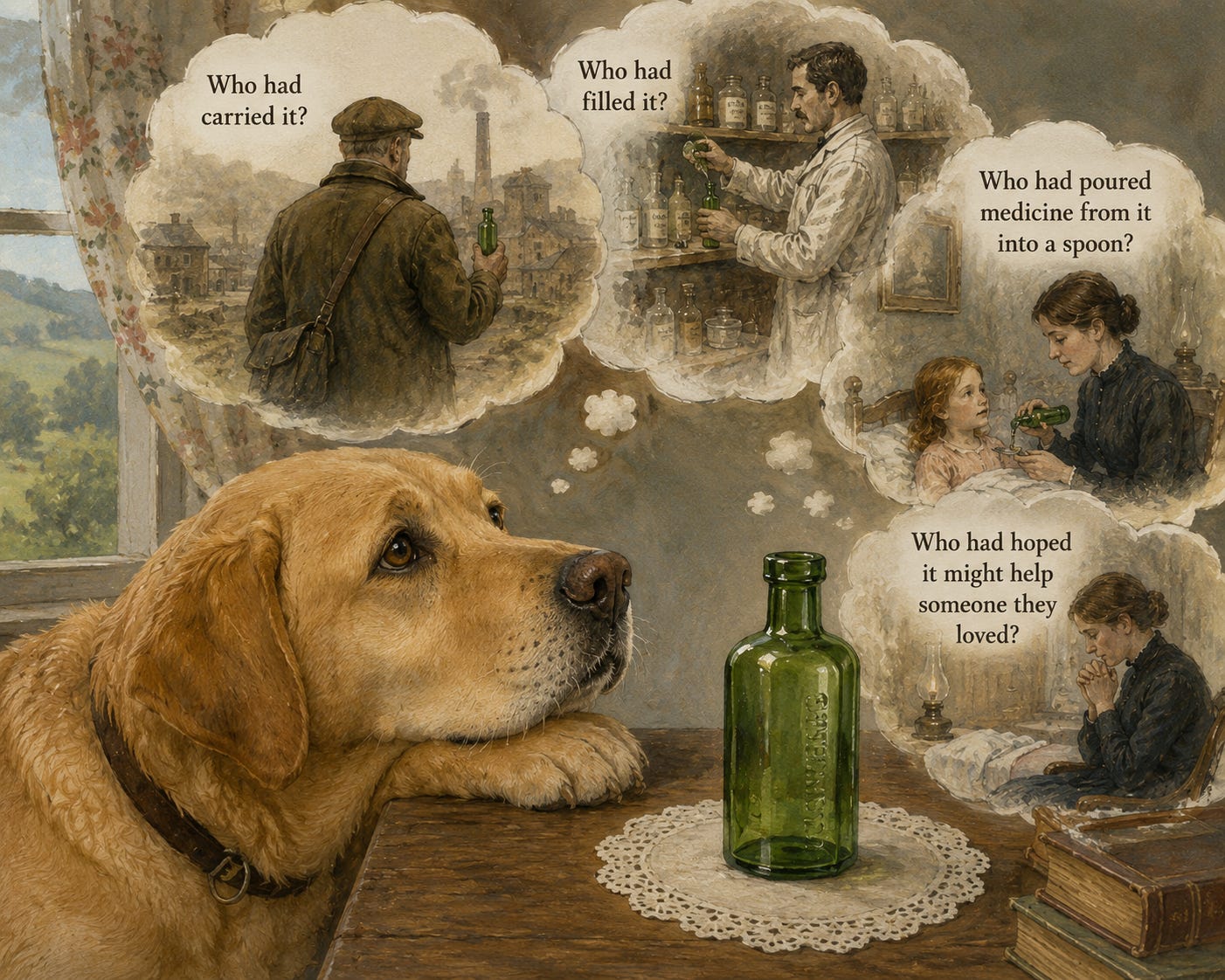
Who had carried it?
Who had filled it?
Who had poured medicine from it into a spoon?
Who had hoped it might help someone they loved?
Mr Rogers carefully placed his walking stick beside the door. Then... without really thinking... he walked into the kitchen.
Billy stared. There was something missing. The walking stick. Mr Rogers hadn’t picked it up again. He laughed as he noticed Billy watching. “Oh dear.”
Billy looked worried.
“Have I forgotten something?”
Billy gently nudged the walking stick with his nose.
Mr Rogers looked down. Then smiled, “I suppose I have.” He picked the walking stick back up. Not because he needed it. Simply because he had become so used to carrying it.
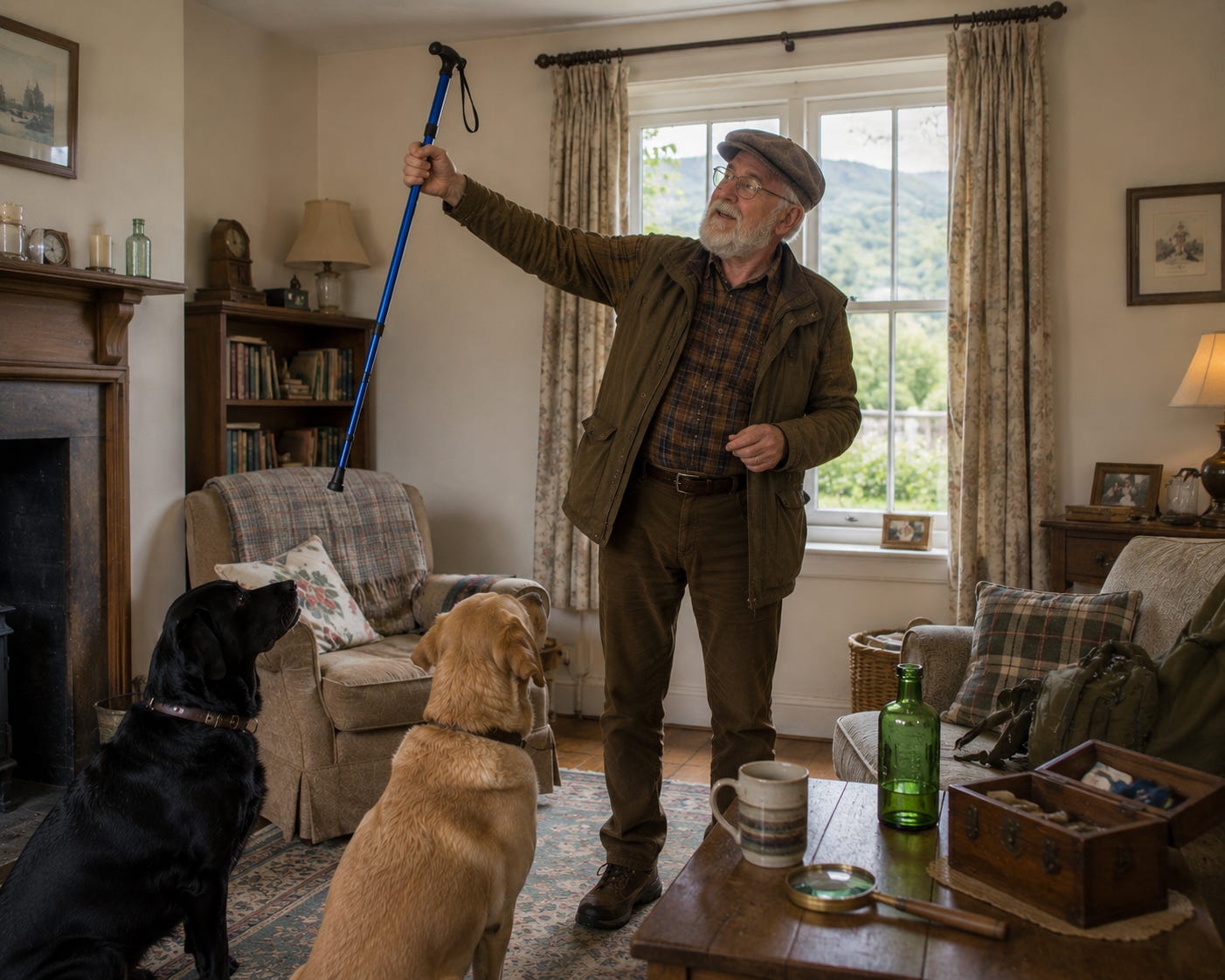
Billy’s tail began wagging furiously. Mr Rogers chuckled. “I think that’s rather good news.” Spud gave a happy little bark.
That evening, after supper, Mr Rogers sat quietly by the fire. Billy lay stretched across the rug. Spud rested beside him. The room felt peaceful.
Mr Rogers opened a notebook. Not the old patient register. His own notebook. On the first empty page he wrote three words.
“Questions to Explore”
Billy wandered over. Mr Rogers smiled. “I don’t want today’s adventure to end.”
He began writing.
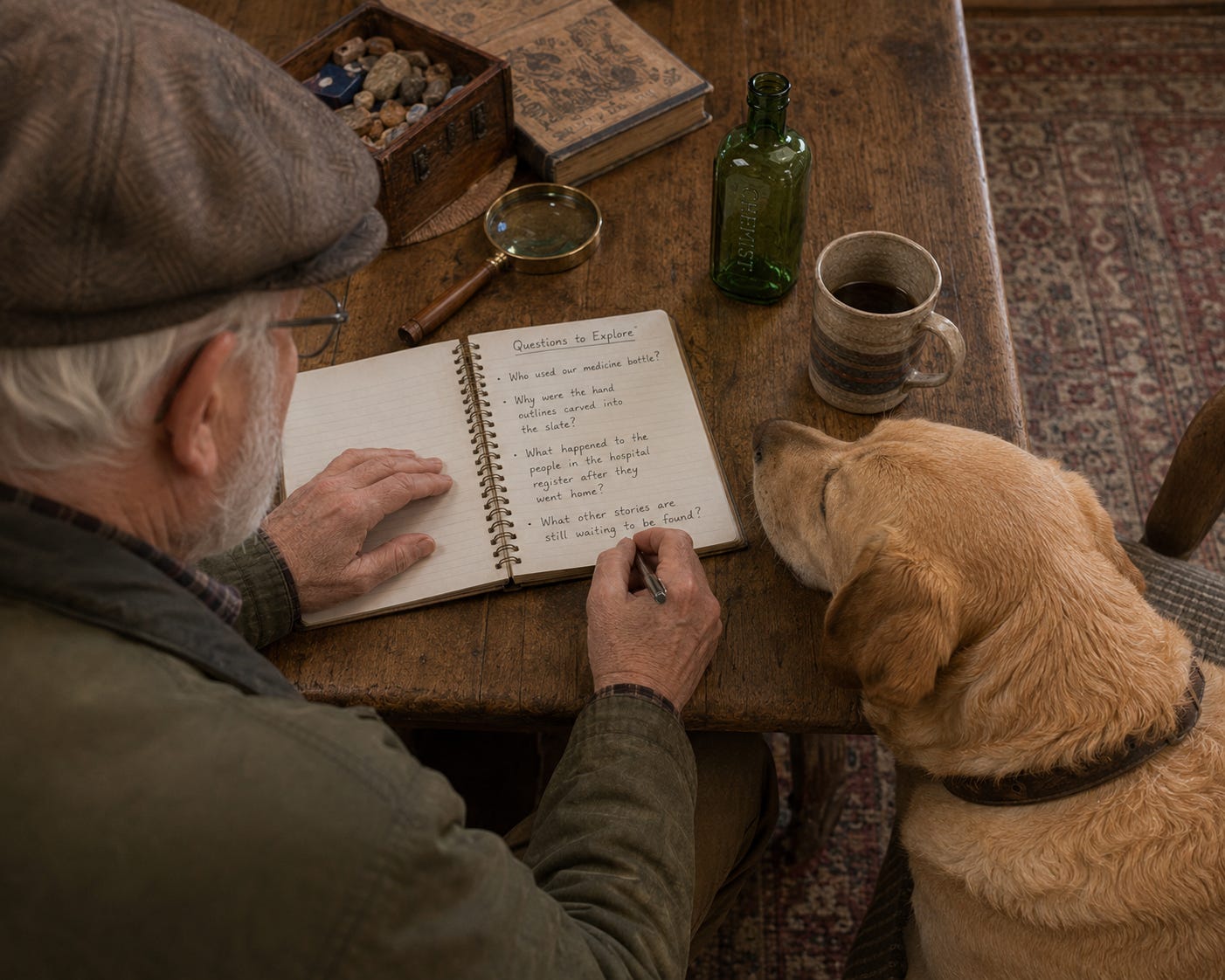
Who used our medicine bottle?
Why were the hand outlines carved into the slate?
What happened to the people in the hospital register after they went home?
Billy watched each question appear. Mr Rogers paused. Then he added another.
What can today’s hospitals teach future History Detectives?
Billy looked up. “That’s an unusual question.”
Mr Rogers nodded. “One day...” he said thoughtfully, “...children a hundred years from now may visit a museum-version of the modern day Ysbyty Gwynedd (where I had my knee operation).”
Billy’s eyes widened. Mr Rogers laughed. “They’ll look at my knee replacement and think it was terribly old-fashioned.”
Billy tried to imagine such a thing. Perhaps doctors of the future would mend broken bones without operations. Perhaps they would grow new joints. Perhaps people would recover even more quickly.
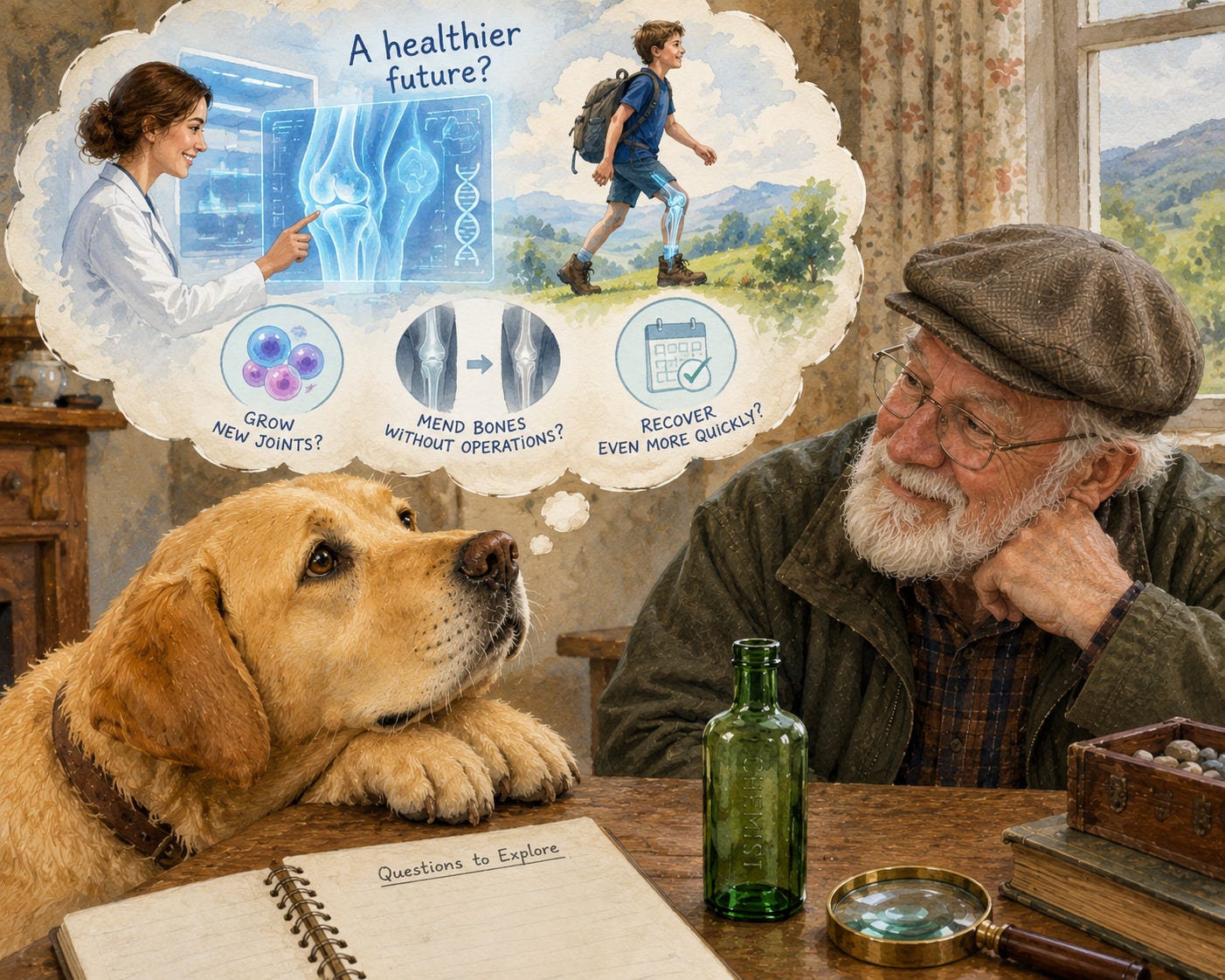
He suddenly realised something. Just as Victorian doctors had done their very best with the knowledge they had... today’s doctors were doing exactly the same.
And somewhere... people were already discovering better ways still.
Mr Rogers closed his notebook. “History isn’t only about the past…”
Billy looked puzzled.
“…it helps us to understand how tomorrow will be different.”
Outside, the evening sunlight faded gently across the hills.
Billy looked through the window. The familiar footpath leading towards Bron-y-Garth disappeared between the hedgerows. Tomorrow... perhaps... they would walk a little farther again.
Adventure Ahead
Several weeks passed. Each morning, Billy waited by the front door. Each morning, Mr Rogers walked a little farther. Some days they wandered only through the village. On other days they explored quiet lanes beneath the trees.
Every walk was just a little easier than the one before. Billy hardly noticed the change happening. Neither did Spud. Neither, perhaps, did Mr Rogers.
Little improvements are often like that. They happen one small step at a time. Until one day... you suddenly realise how far you’ve come.
The sunshine returned early one Saturday morning. Mr Rogers laced up his walking shoes. Billy was already waiting. Spud gave a happy bark.
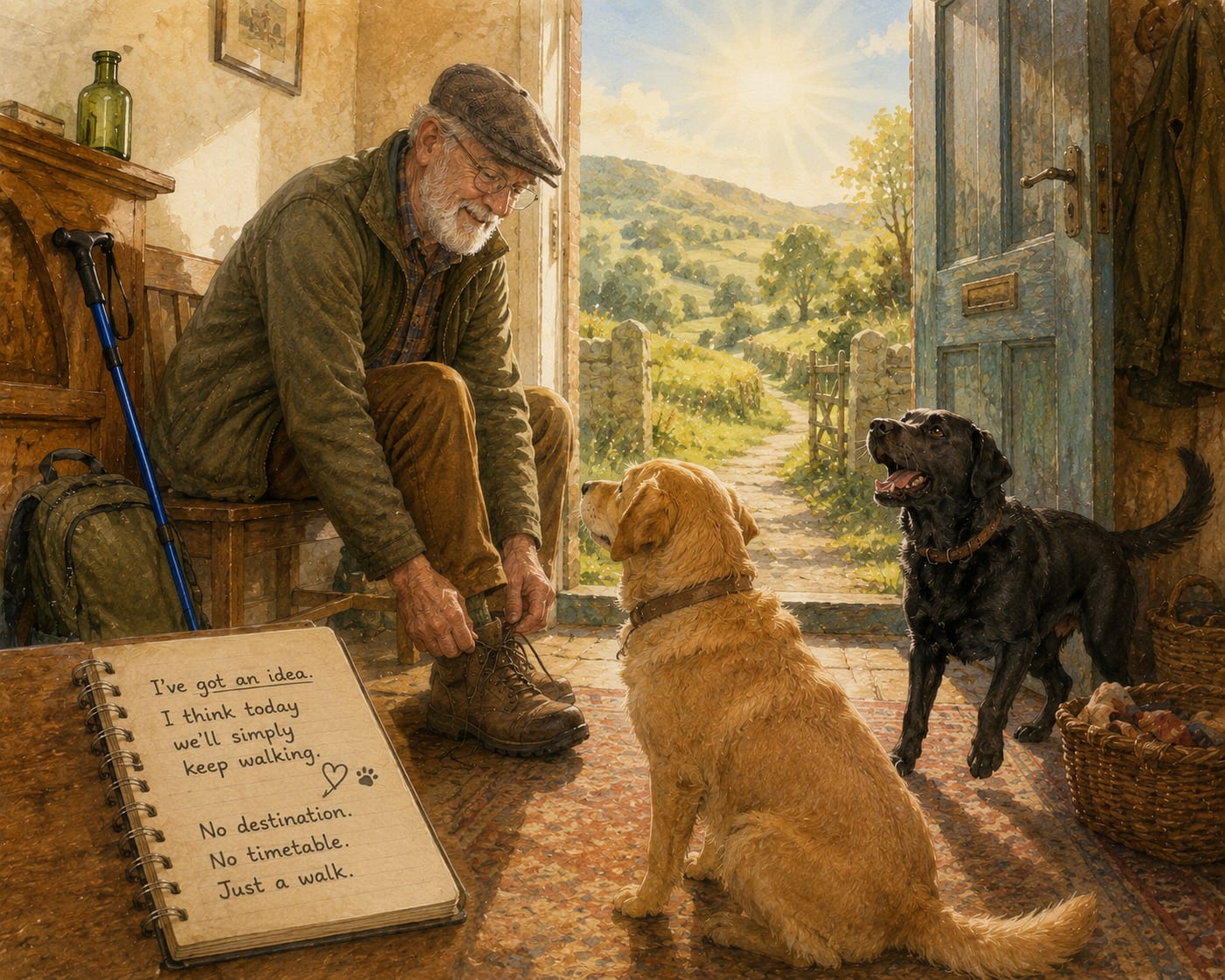
“I’ve got an idea,” said Mr Rogers. “I think today we’ll simply keep walking.”
Billy liked the sound of that. No destination. No timetable. Just a walk.
They followed the familiar lane towards Bron-y-Garth. The old hospital stood quietly beneath the trees. Billy glanced towards its windows. He no longer saw an empty building. He imagined nurses; doctors; patients; people hoping; people healing.
They walked on. Soon they reached the little gate leading into the Tranquility Garden.
Mr Rogers opened it. The lavender was alive with bees. Butterflies drifted lazily among the flowers. The old oak trees cast cool shadows across the grass.
Billy walked over to the familiar bench. Then he stopped. Something was different.
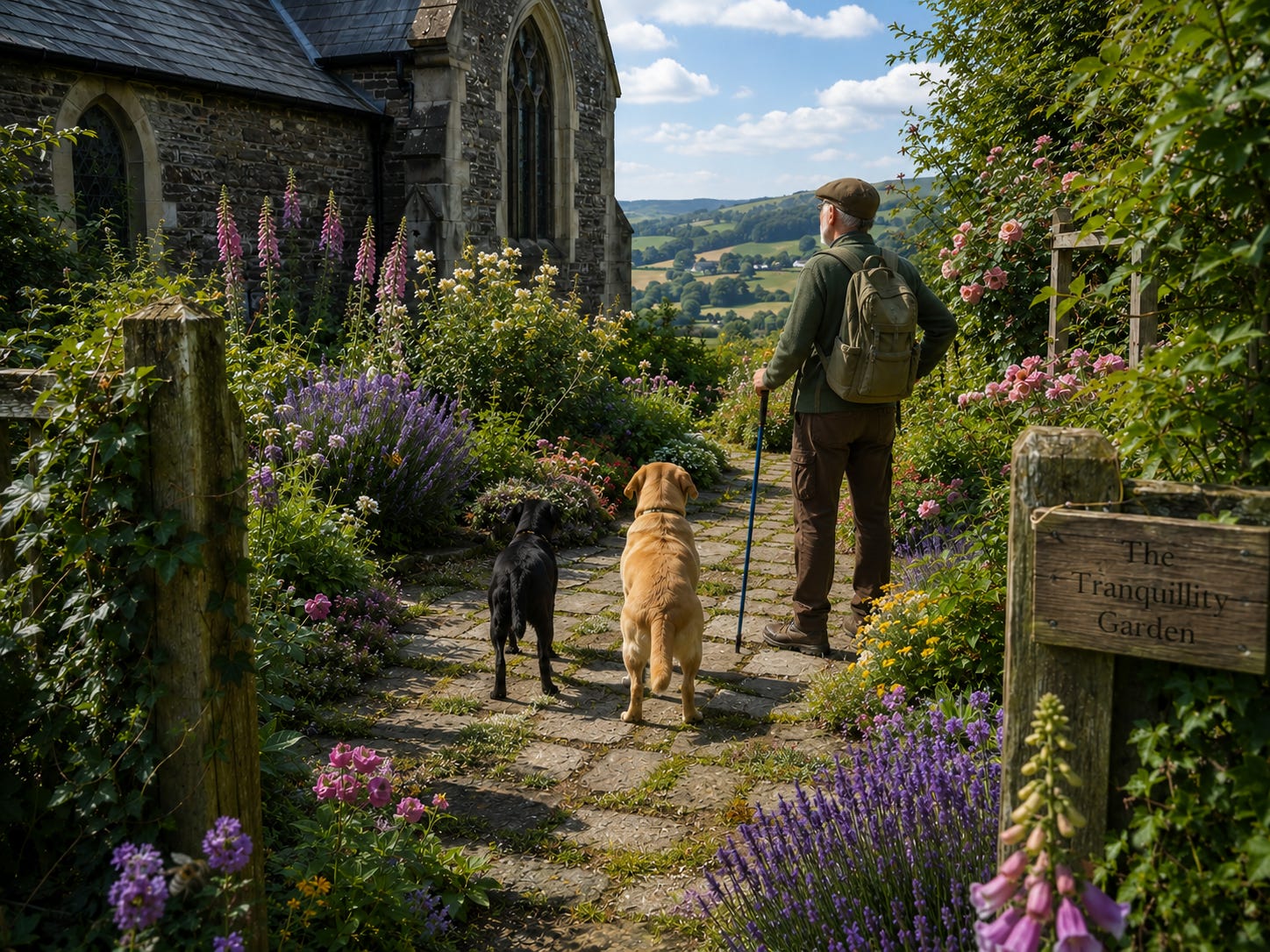
Mr Rogers hadn’t sat down. Instead, he stood quietly for a moment, looking across the valley towards the woodland that had once been Gwaith Powdwr. “It looks beautiful today,” he said. Billy followed his gaze. The trees shimmered in the warm breeze.
Somewhere beyond them, hidden among the branches, bats would be sleeping until evening. Nightjars would come later. The valley had changed. It had found a new purpose.
Mr Rogers smiled. “I think I’ll save my rest for another day.”
Billy’s ears lifted. No rest? Spud looked surprised too. They left the Tranquility Garden and continued along the lane.
A little further on stood the doctor’s surgery. Billy looked towards the waiting room window. He could almost picture the curious machine that gave Mr Rogers’ arm its gentle squeeze. Mr Rogers laughed. “I don’t think we need to stop today.”
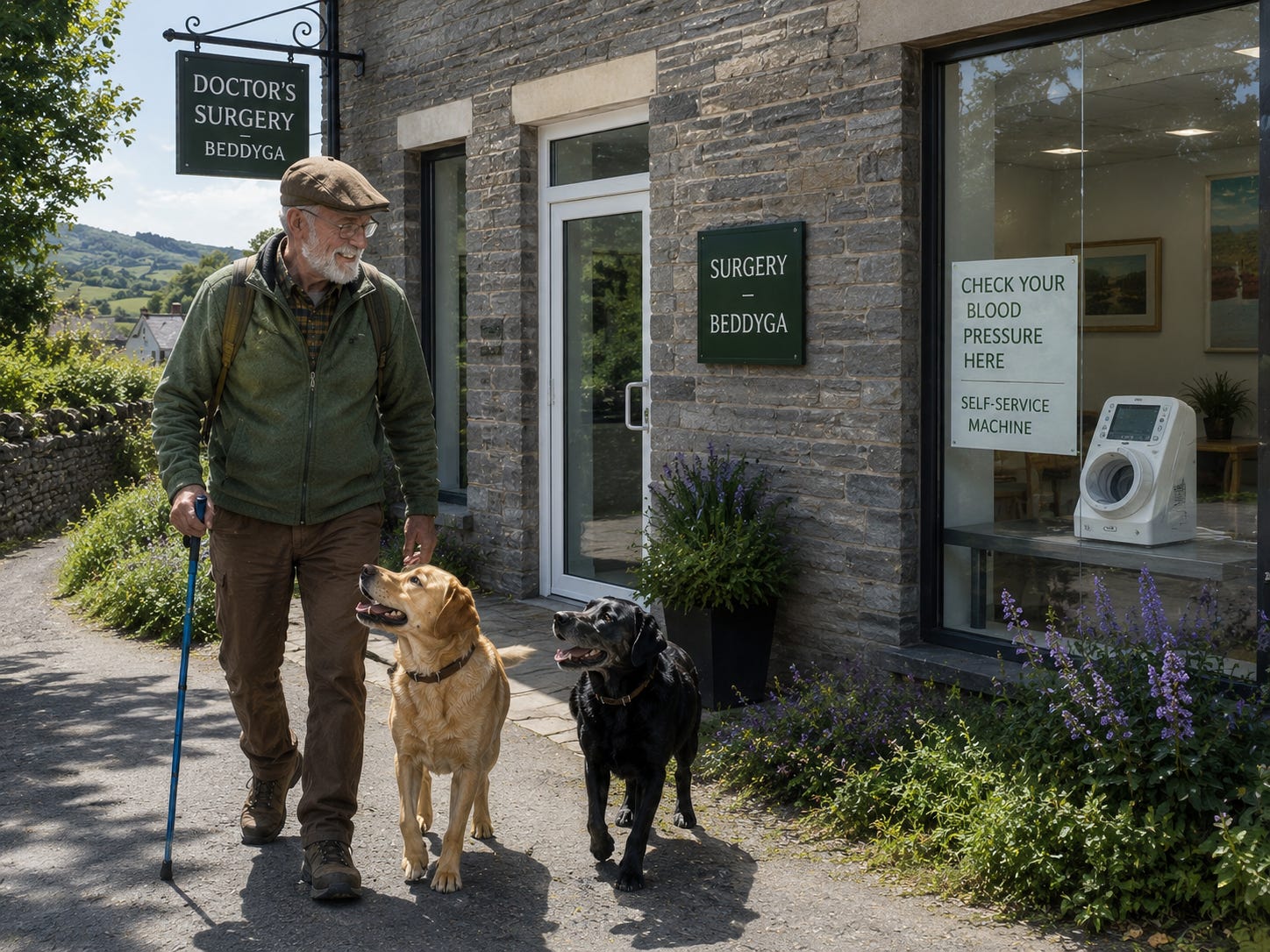
Billy looked astonished. “No blood pressure check?”
“I’ve been feeling rather well.”
Billy wagged his tail. That sounded like excellent news. They continued walking. Past the point where they would normally have turned for home. Past another bend. Past another field. The lane began to climb gently.
Mr Rogers slowed a little. Not because his knee hurt. Simply because hills have always asked walkers to take their time.
Billy trotted happily ahead before turning to check on his friend.
Mr Rogers was smiling. Not the careful smile of someone recovering, but the broad smile of someone simply enjoying being outdoors again.
Billy suddenly remembered their very first walk after the operation. The crutches. The slow steps. The frequent rests. How different everything felt now.
Mr Rogers stopped for a moment…
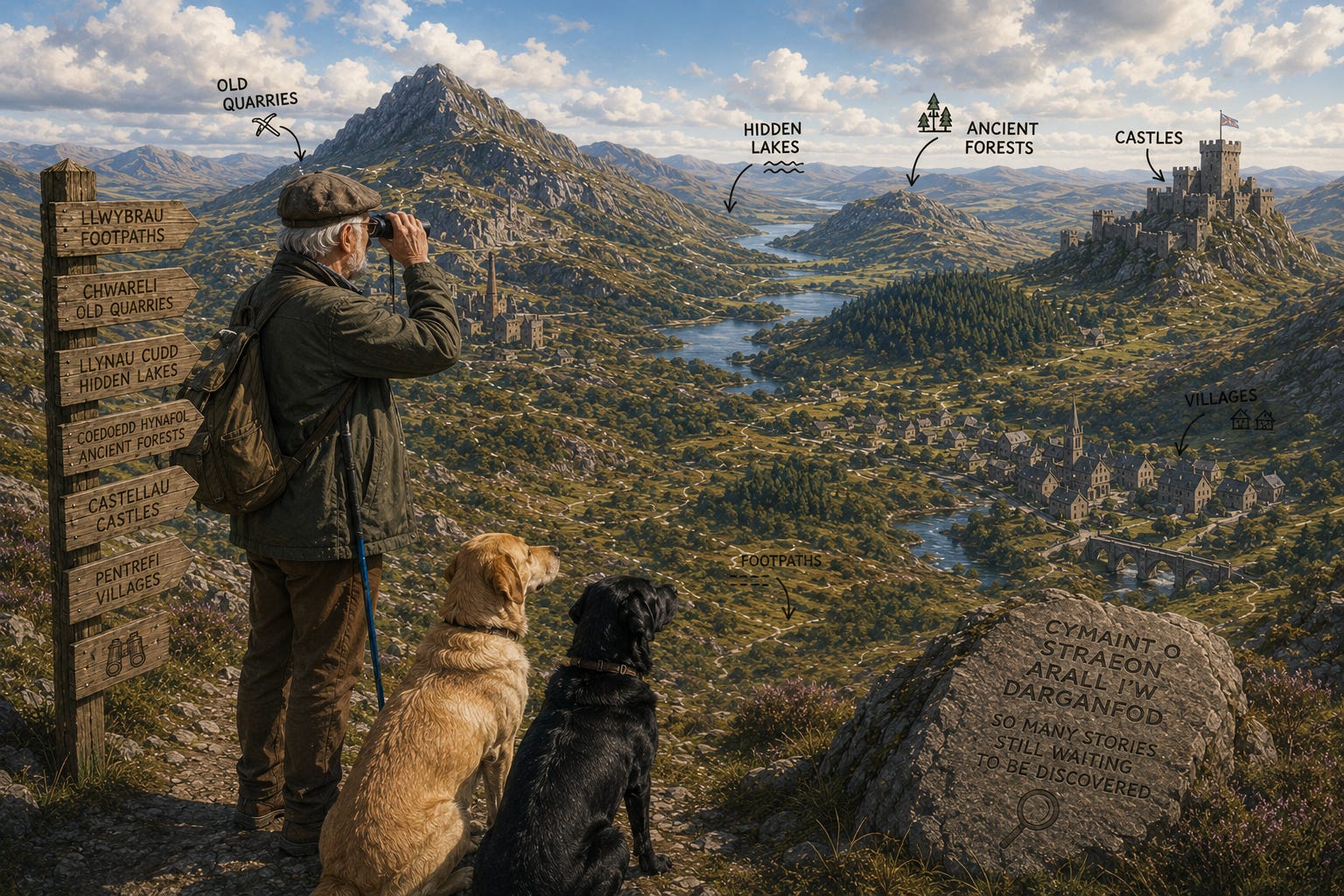
He looked across the mountains of Eryri stretching into the distance. Beyond them lay countless footpaths. Old quarries. Hidden lakes. Ancient forests. Castles. Villages. So many stories still waiting to be discovered.
Spud sat beside him. Billy looked up. Mr Rogers rested a hand gently on each dog’s head. “Thank you.”
Billy wagged his tail. “What for?”
“For waiting when I needed to walk slowly. For making me come outside. For reminding me that every small step matters.”
Billy leaned gently against his leg. After a few moments, Mr Rogers reached into his rucksack. Billy recognised the familiar wrapping. Inside was the little green medicine bottle.
Mr Rogers held it carefully in the sunshine. “It belonged to someone.”
Billy nodded. “We don’t know who.”
Billy nodded again. “But whoever they were...” Mr Rogers looked thoughtfully towards the distant hills, “...I hope they recovered well…” He smiled. “…just as I have.”
For a little while, the three friends stood quietly together. The bottle caught the sunlight. The breeze stirred the grasses. Somewhere high above them, a buzzard circled lazily on the warm air.
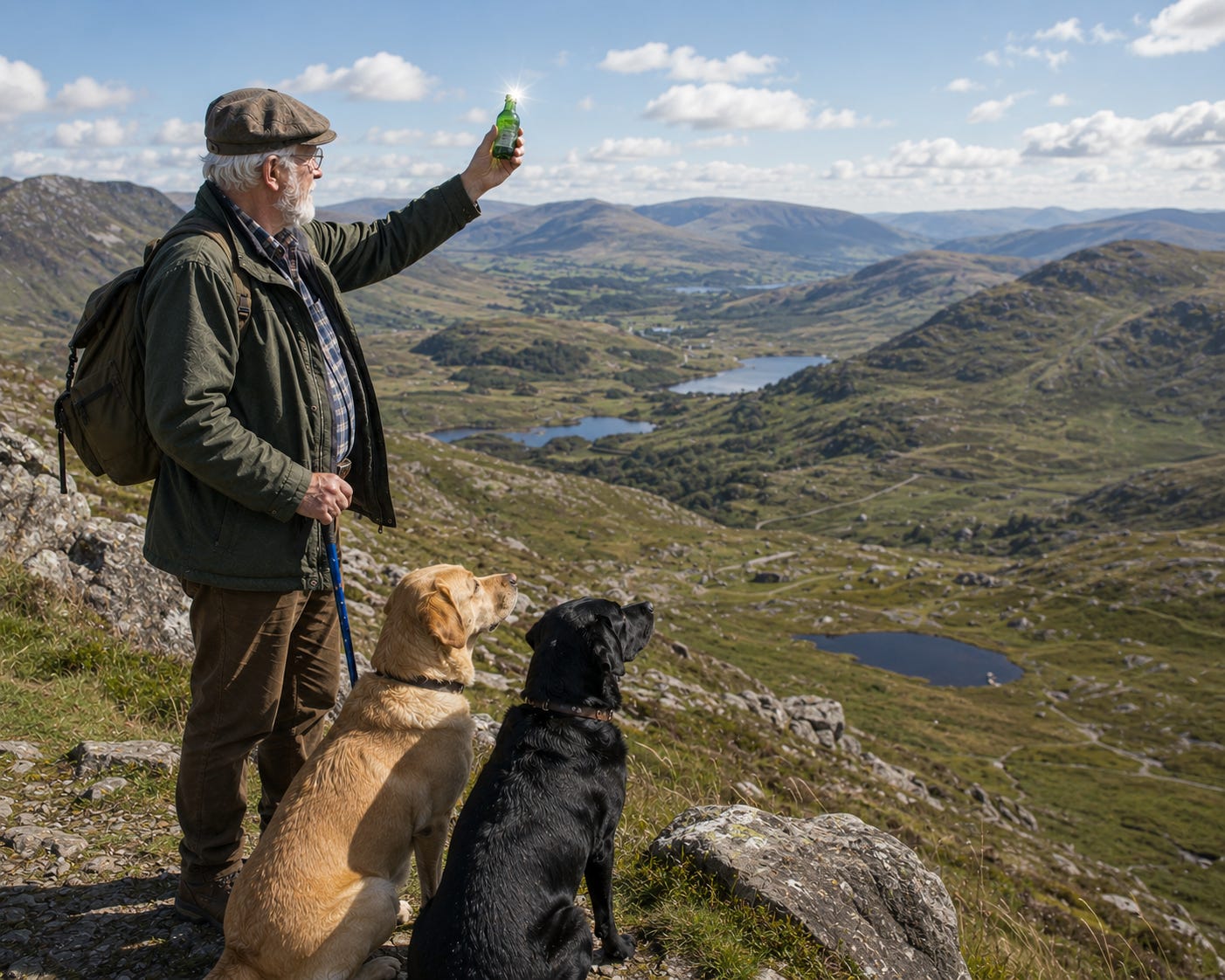
Mr Rogers carefully wrapped the bottle once more and placed it back inside his rucksack. “I think,” he said, “it’s time for it to come home again.”
Billy looked puzzled. “It has shown us everything it could.” He smiled. “The rest of the story belongs to the people.”
Billy thought about the patient register. The carved hand. The initials in the slate. Bron-y-Garth. The woodland where explosions had once echoed. The little machine that gently squeezed Mr Rogers’ arm. His new knee. His scar. The old bottle.
Every one of them had left a mark. Some on stone. Some on paper. Some on the landscape. Some on people’s lives.
Mr Rogers adjusted the straps of his rucksack. Then he looked towards a narrow footpath disappearing over the hillside. Billy recognised that look immediately. It was the look Mr Rogers always had whenever he spotted a path they had never explored before.
“So...” said Billy hopefully.
Mr Rogers grinned.
“So...” echoed Spud with an excited bark.
Mr Rogers laughed. “What do you say, History Detectives?”
Billy barked once. Spud barked twice.
“I think...” said Mr Rogers, “...our next adventure begins here.”
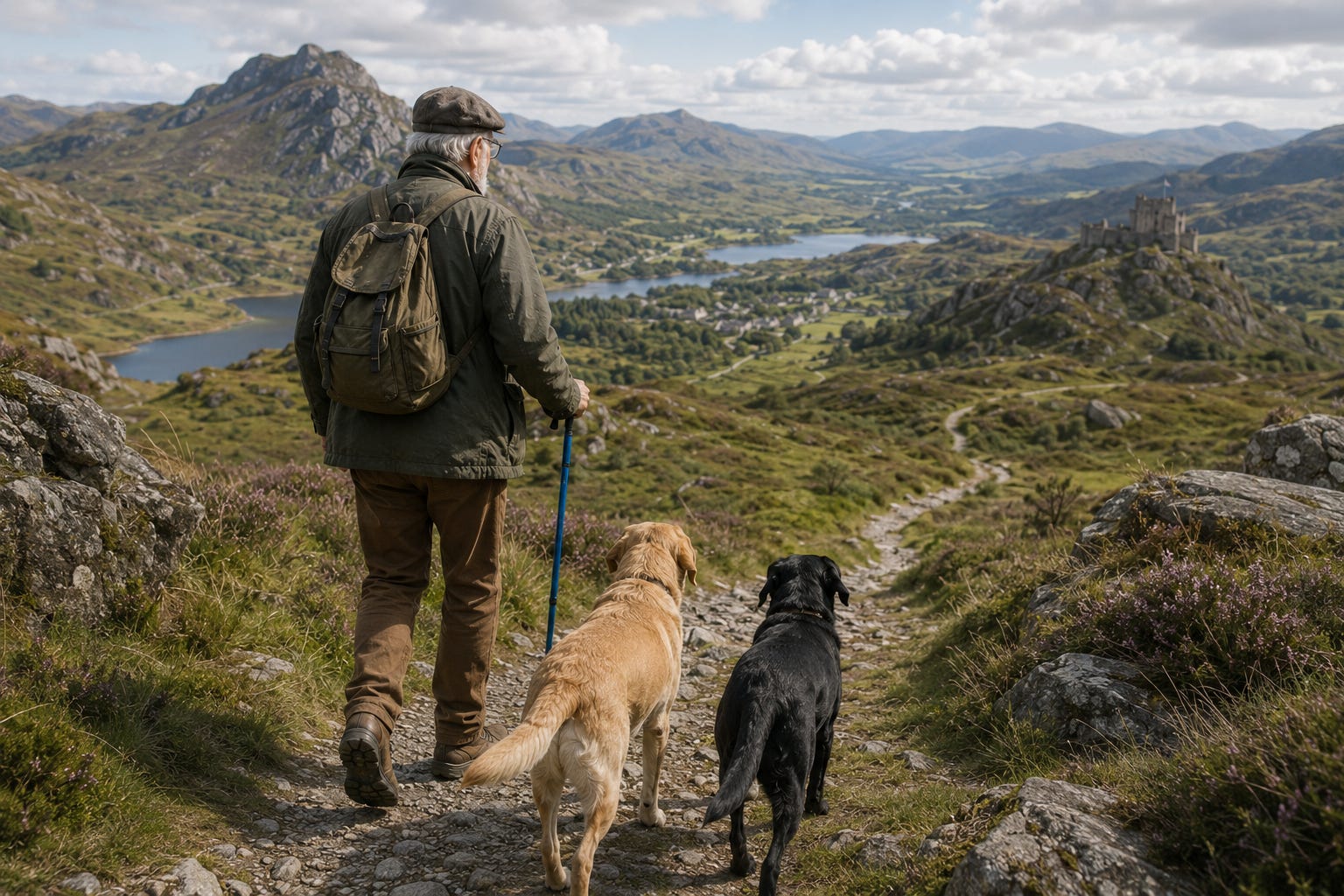
Together they stepped onto the winding path. Not because they knew exactly where it would lead. They didn’t. But because that... Billy had discovered... was the very best kind of journey.
If you ever visit the old Dinorwig Quarry Hospital, look carefully.
You may see the polished iron bedsteads. The medicine bottles. The wooden crutches. The patient register. Outside, you may even discover the scratched initials and the mysterious hand outlines carved into the slate.
Nobody knows every story hidden there. Perhaps nobody ever will.
But if you stop for a moment... look carefully... and ask thoughtful questions... you’ll already be thinking like a History Detective.
And who knows? Perhaps one day you will discover a story that nobody has noticed before.
Dedication
For everyone whose names appear in the old hospital registers. Their stories helped us remember how far medicine - and kindness - have travelled.